


What Are AI Guardrails and How Do They Work?

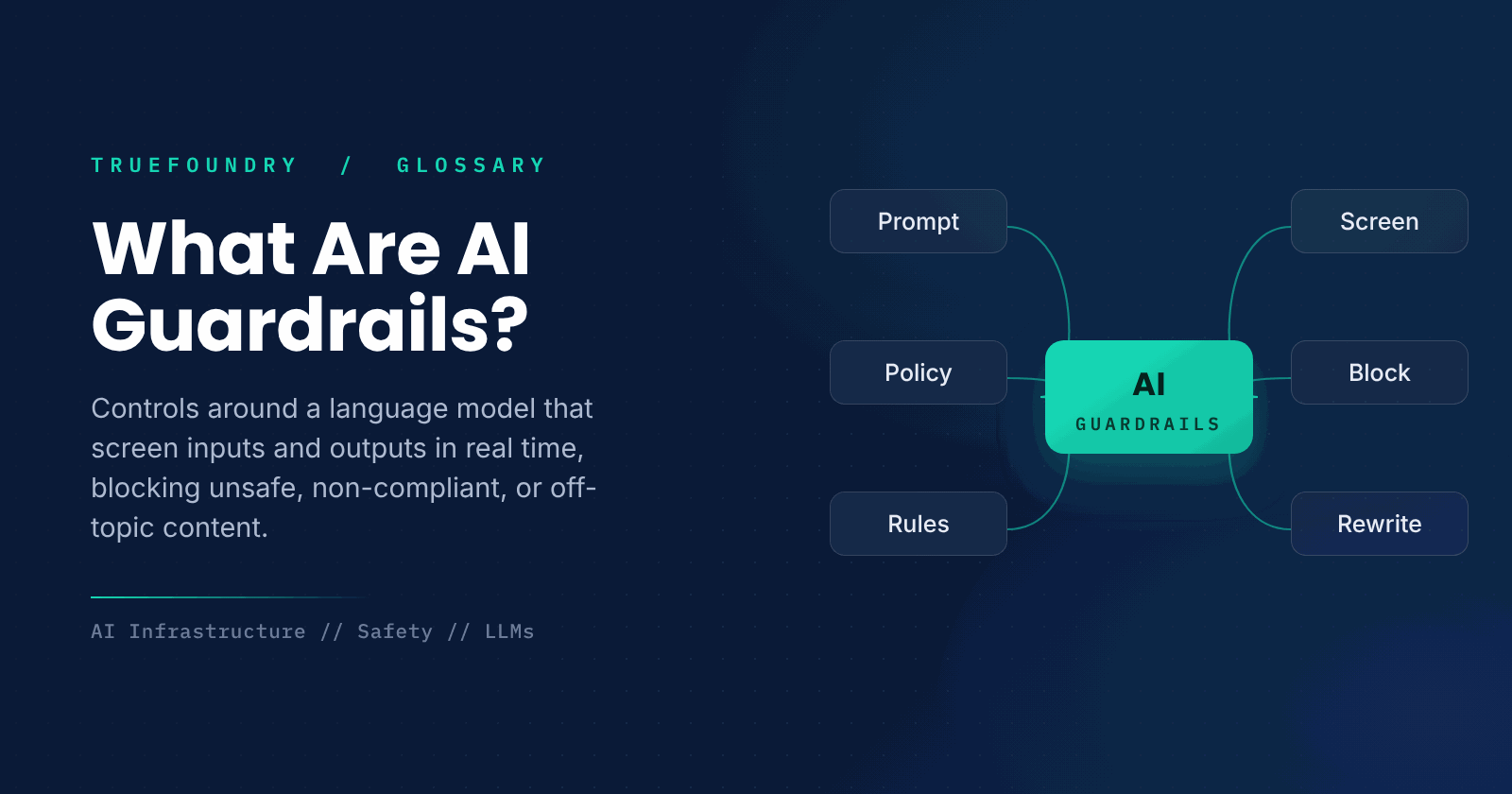
A language model on its own will do its best to answer whatever it is asked, which is not always what you want. It may produce unsafe content, leak sensitive data, wander off-topic, or ignore a policy. AI guardrails are the controls you put around the model to prevent that, checking what goes in and what comes out against rules you define.
Rather than trusting the model's training to handle every case, guardrails add an explicit layer of enforcement. They turn vague hopes about safe behavior into concrete checks that run on every request and response, which is what makes an LLM application dependable enough to ship.
This guide explains what AI guardrails are, how they work, the main types, and why they matter for production systems.
What are AI guardrails?
AI guardrails are safety and policy controls that monitor and constrain a language model's inputs and outputs. They sit between the user and the model, and between the model and the user, screening prompts and responses in real time to enforce rules about safety, privacy, topic, and format before content is allowed through.
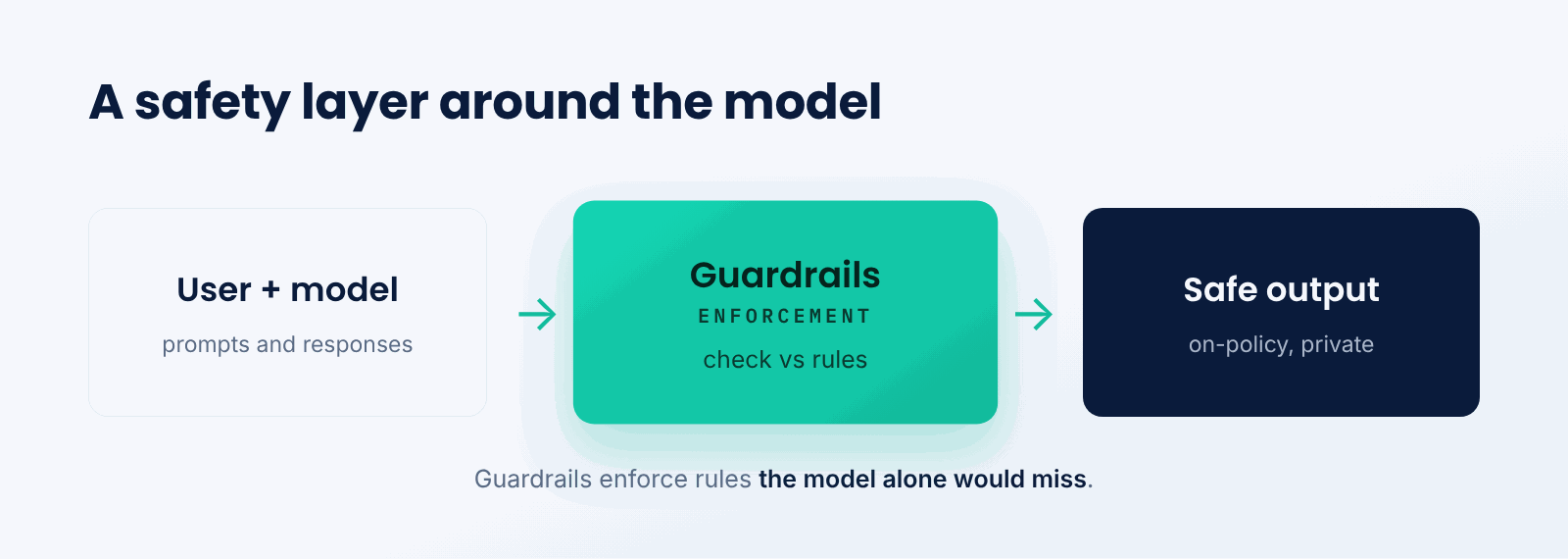
Think of them like the safety systems around a powerful machine, guards, sensors, and cut-offs. The machine does the work, but the safety systems make sure it operates within safe limits. Guardrails do the same for a model: the model generates, and the guardrails ensure what passes through stays within bounds.
The key idea is that guardrails are separate from the model. Because they are an explicit layer, you can define, update, and audit them independently of how the model was trained.
How do AI guardrails work?
Guardrails intercept requests and responses and check them against rules before letting them continue.
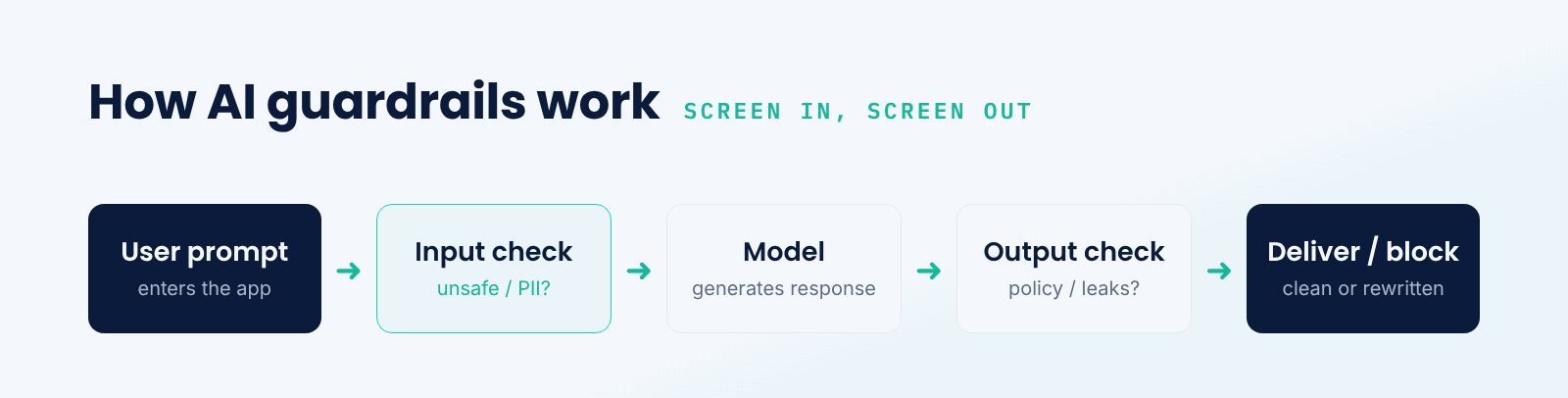
- User sends a prompt. The request enters the application on its way to the model.
- Input guardrails check it. The prompt is screened for unsafe content, PII, or off-topic use.
- The model generates. If the prompt passes, the model produces a response.
- Output guardrails check it. The response is screened for policy violations or leaked data.
- Deliver or block. Clean content is returned; anything failing a check is blocked or rewritten.
Guardrails use a mix of methods, keyword and pattern rules, classifiers, and even other models acting as judges. The right combination depends on what you are enforcing, and layering several catches more than any single technique.
Input vs. output guardrails
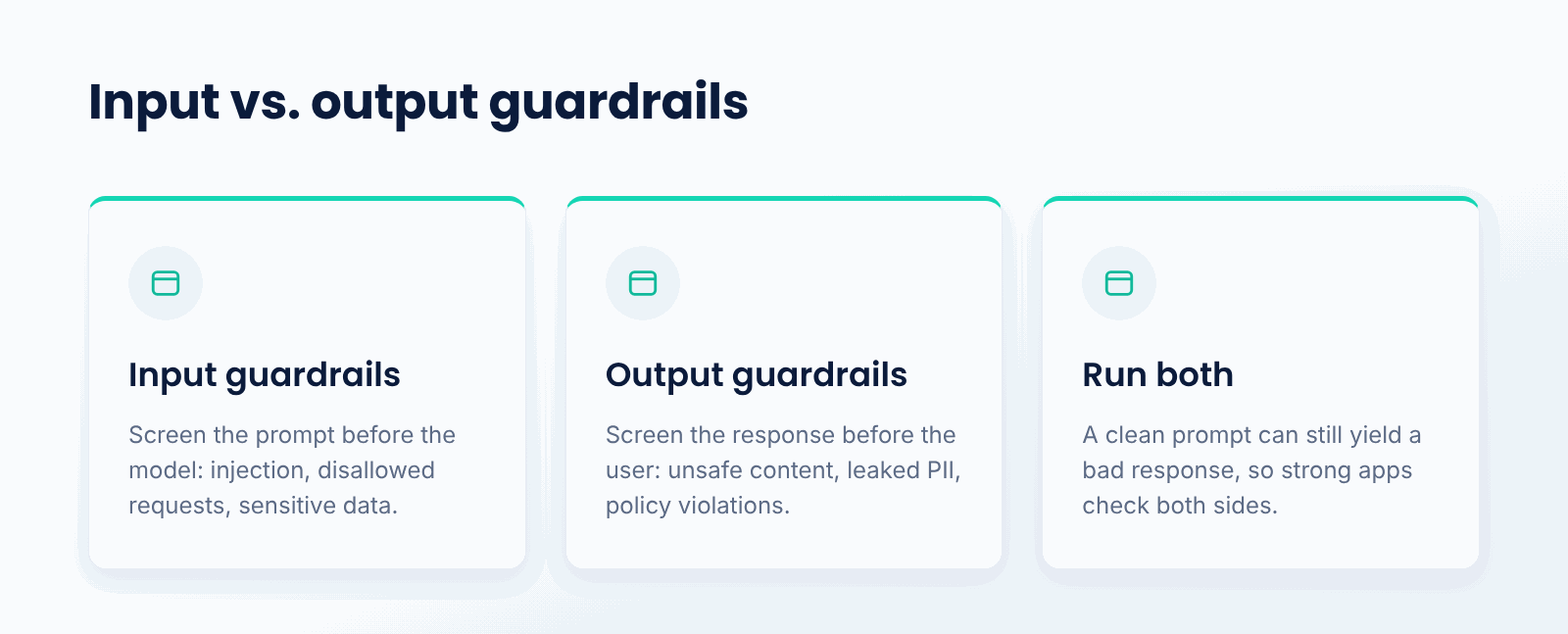
Guardrails act at two points. Input guardrails screen the prompt before it reaches the model, catching things like injection attempts, disallowed requests, or sensitive data a user should not send. Output guardrails screen the response before it reaches the user, catching unsafe content, leaked PII, or answers that violate policy regardless of how the prompt was phrased.
Both matter because they catch different problems. A clean prompt can still produce a bad response, and a bad prompt should be stopped before it costs a model call. Strong applications run both, so nothing slips through on either side.
What do guardrails protect against?
- Unsafe content. They block harmful, toxic, or disallowed outputs.
- Data leakage. They catch PII or secrets in prompts and responses.
- Prompt injection and jailbreaks. They screen for attempts to hijack or bypass the model.
- Off-topic use. They keep the application focused on its intended purpose.
- Policy violations. They enforce business and regulatory rules on every interaction.
What are the challenges?
- Balancing strictness. Too tight and you block legitimate use; too loose and problems slip through.
- Latency. Each check adds time, so guardrails must be fast enough for real-time use.
- Evolving threats. New jailbreaks and attacks require guardrails to be updated regularly.
- Consistency. Applying the same rules across many models and apps takes deliberate design.
When do you need AI guardrails?
You need them for essentially any production LLM application, especially one that is public-facing, handles sensitive data, or operates in a regulated domain. Once real users and real stakes are involved, relying on the model's training alone is not enough.
A private experiment with trusted users and no sensitive data can get by with lighter controls. But as soon as an application ships to real users, guardrails become a basic requirement rather than an optional extra.
Best practices for AI guardrails
- Run both input and output guardrails so problems are caught on either side.
- Match the strictness of each check to the risk of the application.
- Keep latency low by choosing efficient checks for real-time paths.
- Update guardrails as new attacks and failure modes are discovered.
- Log what guardrails catch so you can audit and improve them over time.
- Apply guardrails centrally at a gateway so every model is protected consistently.
Conclusion
AI guardrails are the controls that keep a language model's inputs and outputs safe, private, and on-policy. By screening prompts and responses in real time, they catch unsafe content, data leaks, and attacks that the model's training alone would miss. Because they are a separate, explicit layer, they can be defined, audited, and updated independently, which is what makes an LLM application trustworthy in production.
TrueFoundry's AI Gateway lets teams apply input and output guardrails across every model from one layer, enforcing safety, privacy, and policy consistently. As LLM applications take on real users and real stakes, guardrails are how teams keep them safe and compliant.

Govern, Deploy and Trace AI in Your Own Infrastructure
Frequently Asked Questions
What are AI guardrails in simple terms?
They are controls around a language model that filter both what goes in and what comes out. If a prompt or response violates a rule of safety, privacy, or business policy, the guardrail blocks or rewrites it before it reaches anyone.
What is the difference between input and output guardrails?
Input guardrails screen the prompt before it reaches the model, catching injection or sensitive data. Output guardrails screen the response before it goes to the user, catching unsafe content or leaked data. Strong apps run both.
What do AI guardrails protect against?
Unsafe or toxic output, leaked PII and secrets, prompt injection and jailbreaks, off-topic use, and policy or regulatory violations. They impose rules on both the request and the response rather than trusting the model alone.
Do guardrails slow down a model?
Each check adds some latency, but guardrails are chosen to be fast enough for real-time use. The small cost is usually worth it, and running checks efficiently keeps the impact minimal.
Why not rely on the model's own safety training?
Because training is probabilistic and cannot cover every case. Guardrails add an explicit, auditable layer you control, catching problems the model misses and letting you update rules without retraining.


- © 2022 ENSEMBLE Technologies



Subscribe to our newsletter
The latest news, articles, and resources sent to your inbox


