


What Is Agent Memory and How Does It Work?

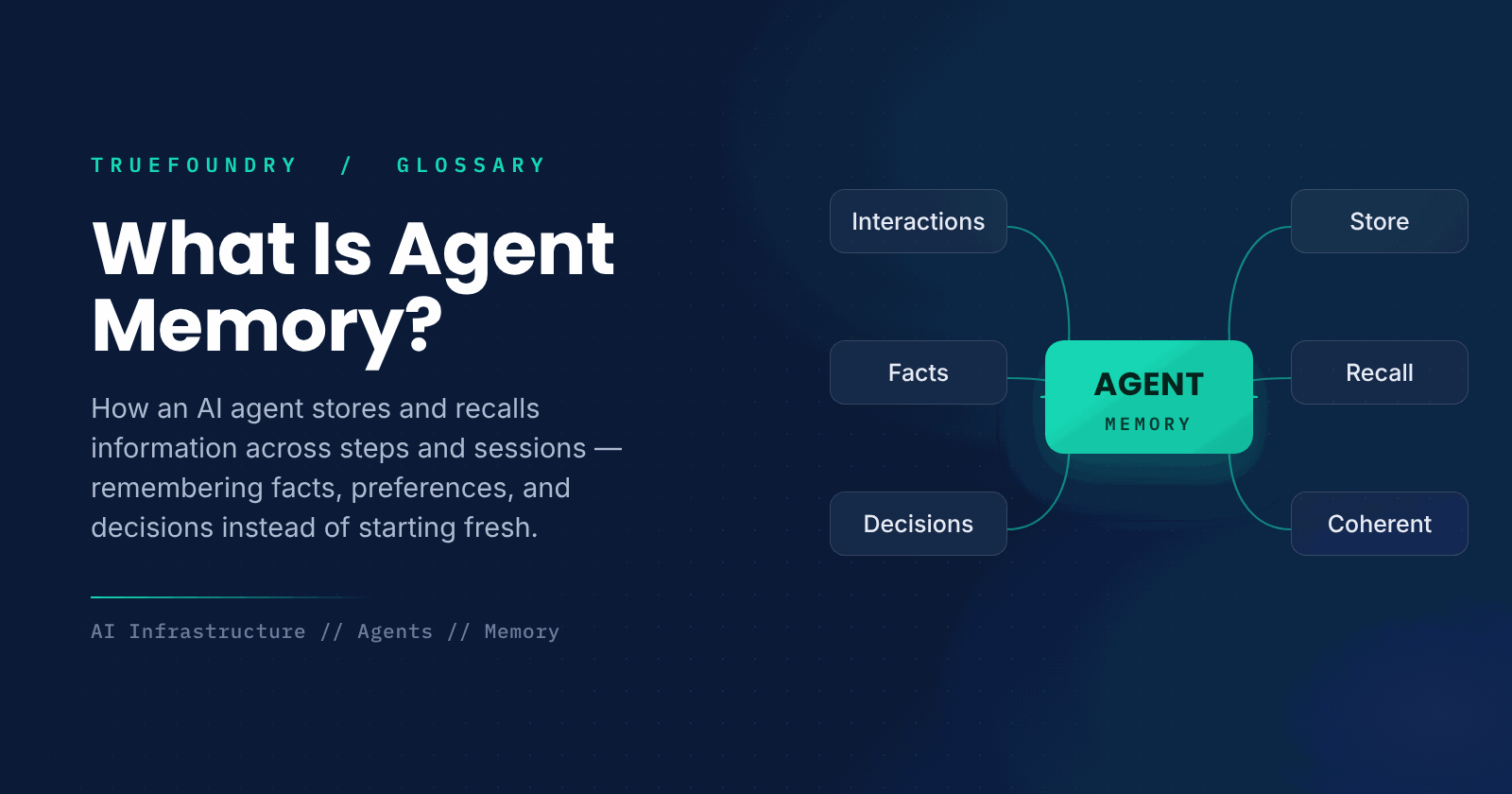
A language model, by default, remembers nothing between calls. Each request starts with a blank slate, limited to whatever fits in the context window. That is fine for a one-off question, but an agent that works across many steps or comes back tomorrow needs to remember what happened before. Agent memory is what gives it that continuity.
Without memory, an agent repeats itself, forgets your preferences, and cannot learn from earlier steps. With memory, it can recall facts, build on past decisions, and act coherently over time. Memory is much of what separates a genuine agent from a stateless chatbot.
This guide explains what agent memory is, how it works, the main types, and how to use it well.
What is agent memory?
Agent memory is the set of mechanisms an AI agent uses to store information and recall it later, both within a single task and across separate sessions. It lets an agent keep track of the current context, remember facts and preferences long term, and look back on what it has done, rather than being limited to what fits in one context window.
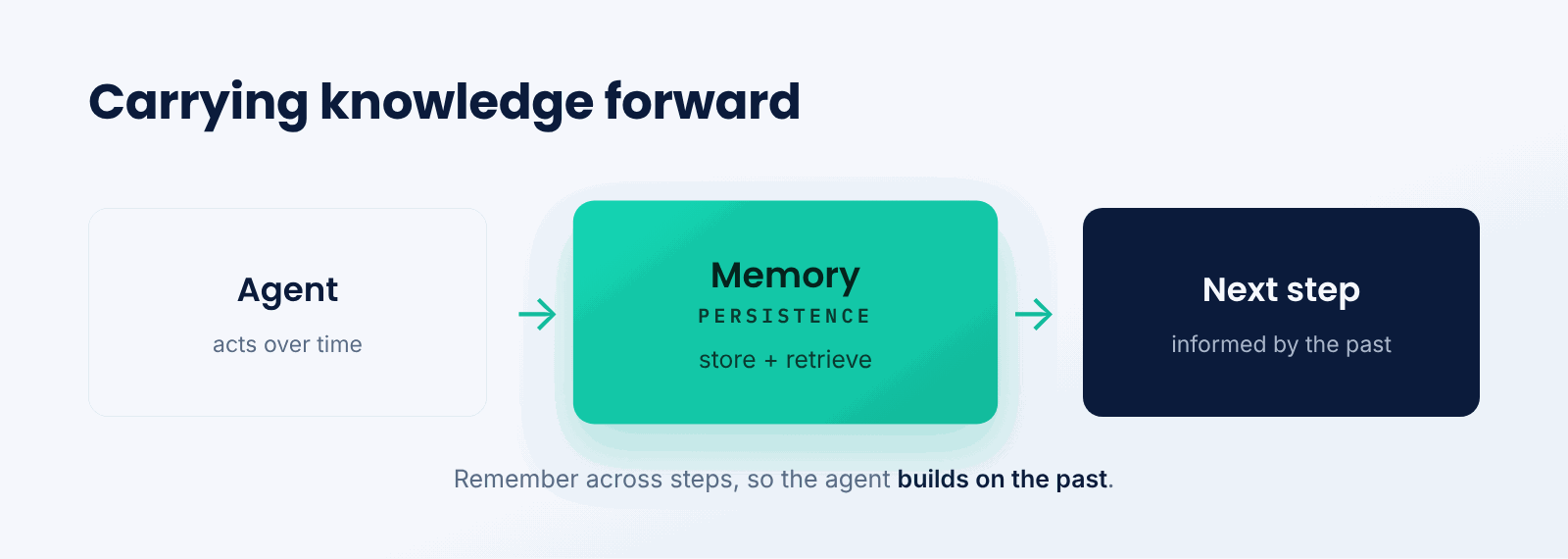
Think of the difference between someone with no short-term recall and a seasoned colleague. The colleague remembers your preferences, what you discussed last week, and the decisions already made, so you never start from scratch. Agent memory is what turns a forgetful model into that colleague, carrying relevant knowledge forward.
The key idea is that memory lives outside the context window. Because the window is finite, an agent stores information externally and pulls the relevant pieces back in when it needs them.
How does agent memory work?
Memory is a loop of writing information down and reading the relevant parts back later.
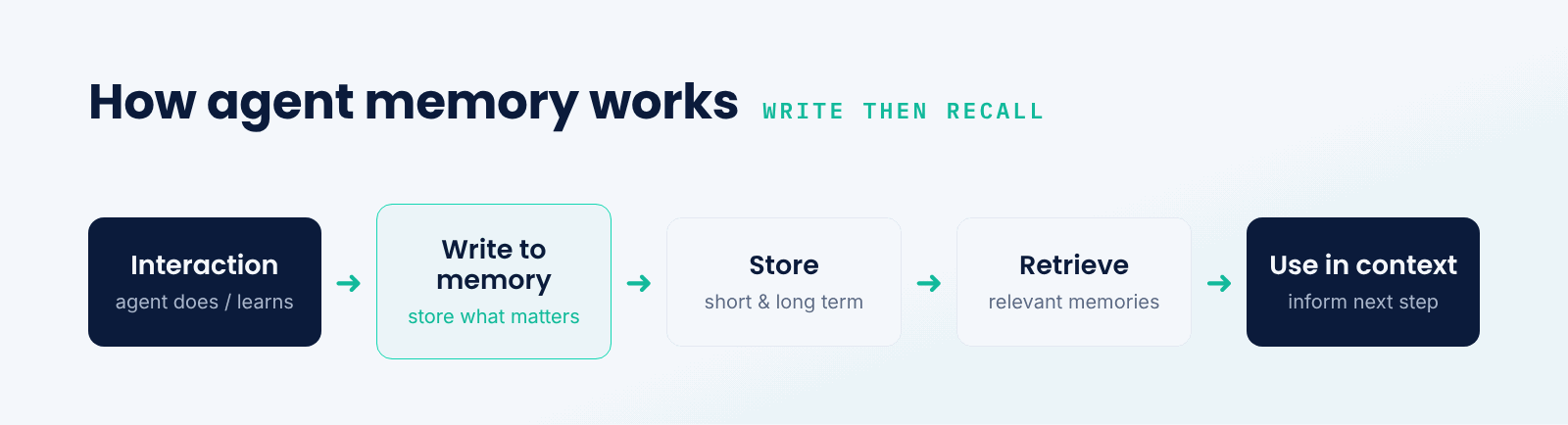
- An interaction happens. The agent does something or learns something worth remembering.
- Write to memory. The important information is saved, often as text with an embedding of its meaning.
- Store it. Short-term context stays in the window, while long-term memories go to an external store.
- Retrieve when relevant. On a later step or session, the agent searches memory for what is relevant now.
- Use it in context. The retrieved memories are added to the context so they inform the next action.
Because the window cannot hold everything, retrieval is central: the agent must find the few relevant memories among many. This is often done with embeddings and similarity search, the same machinery behind retrieval-augmented generation.
Short-term vs. long-term vs. episodic memory
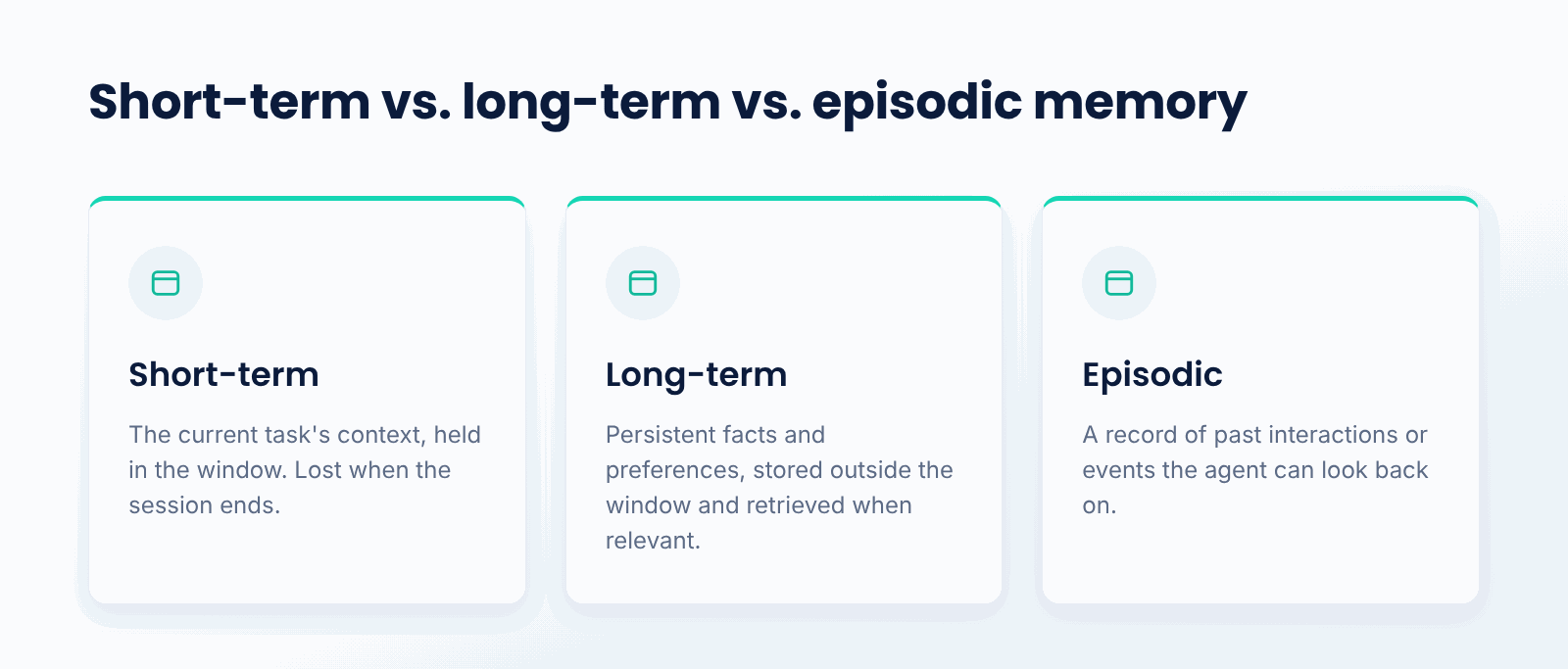
Agent memory comes in a few forms. Short-term memory is the current task's context, held in the window and lost when the session ends; it keeps the agent coherent within a task. Long-term memory stores durable facts and preferences outside the window, retrieved when relevant, so the agent remembers across sessions. Episodic memory is a record of past interactions or events the agent can look back on, like a history of what it did and when.
Real agents combine these. Short-term memory handles the here and now, long-term memory carries durable knowledge forward, and episodic memory lets the agent reflect on its own past, together giving it continuity over time.
Why does agent memory matter?
- Continuity. The agent remembers past interactions instead of starting fresh every time.
- Personalization. It can recall a user's preferences and context across sessions.
- Learning from steps. It builds on earlier decisions rather than repeating or contradicting them.
- Efficiency. Recalling a known fact is cheaper than rediscovering or re-asking for it.
- Coherence. Memory is much of what makes a multi-step agent feel consistent and capable.
What are the challenges?
- What to remember. Storing everything is noisy; deciding what matters is hard.
- Retrieval quality. The agent must surface the right memories at the right time, not stale or irrelevant ones.
- Staleness and conflicts. Memories can go out of date or contradict each other and must be managed.
- Privacy. Storing user information long term raises real data-protection responsibilities.
When do you need agent memory?
You need it whenever an agent works across many steps or returns over time: a personal assistant that should remember your preferences, a support agent that recalls past tickets, or a long-running task where earlier results inform later ones. In these, memory is what makes the agent useful rather than forgetful.
For a single, self-contained request, memory adds little. The need grows with the length of interactions and the value of remembering across them.
Best practices for agent memory
- Be selective about what you store, keeping durable facts and dropping noise.
- Use embeddings and similarity search to retrieve only the memories relevant to the moment.
- Separate short-term working context from long-term stored knowledge.
- Keep memories fresh by updating or expiring ones that go stale.
- Handle user data responsibly, with clear retention and privacy controls.
- Manage memory and retrieval behind a gateway so it is observable and governed.
Conclusion
Agent memory is how an AI agent stores information and recalls it across steps and sessions, giving it continuity instead of a blank slate each time. By keeping short-term context in the window and long-term knowledge in an external store it retrieves from, an agent can remember facts, preferences, and past decisions. Good memory is much of what turns a stateless model into a coherent, capable agent.
TrueFoundry helps teams build and run agents on their own infrastructure, with retrieval, memory stores, and the models behind them managed in one place and governed through a gateway. As agents take on longer tasks, memory is the capability that lets them build on the past rather than forget it.

Govern, Deploy and Trace AI in Your Own Infrastructure
Frequently Asked Questions
What is agent memory in simple terms?
It is the means by which an AI agent remembers things from one step to another, and from session to session, rather than starting from scratch each time. It stores facts, preferences, and interactions, and recalls the ones it needs.
Why do agents need memory?
This is because a model starts afresh with each call by default. Memory enables an agent to maintain continuity, since it can recall your preferences, base actions on previous ones, and avoid repeating itself, which is much of what makes a multi-step agent coherent.
What is the difference between short-term and long-term memory?
Short-term memory contains the context of the current task and is forgotten once the session ends. Long-term memory holds durable information outside the window and recalls it whenever the agent needs it, so the agent remembers across sessions.
How does an agent retrieve memories?
This is usually achieved by storing memories as embeddings and doing a similarity search to find those relevant to the current context, then adding them to the context. It is exactly the retrieval machinery used in RAG.
What are the risks of agent memory?
Storing the wrong things creates noise, memories may become obsolete or even conflicting, and retaining user data raises privacy obligations. Good memory systems are selective, keep data up to date, and handle users' private data responsibly.


- © 2022 ENSEMBLE Technologies



Subscribe to our newsletter
The latest news, articles, and resources sent to your inbox


