


August 31, 2026
|
5 min read


احصل على وصول فوري إلى بيئة TrueFoundry مباشرة. انشر النماذج، ووجّه حركة مرور LLM، واستكشف المنصة بالكامل — بيئة الاختبار الخاصة بك جاهزة في ثوانٍ، ولا يلزم وجود بطاقة ائتمان.


Published: July 4, 2026

Blazingly fast way to build, track and deploy your models!
When it comes to building, training, and deploying machine learning models at scale, Amazon SageMaker has long been a go-to platform. But in 2026, the MLOps landscape has evolved—and let’s be honest, SageMaker isn’t always the perfect fit for every team or use case. Maybe it's the cost, perhaps it's the learning curve, or maybe you just want something more flexible. Whatever the reason, exploring alternatives can open up new possibilities. So if you're wondering what other tools are out there that can rival or even outperform SageMaker, you’re in the right place. Let’s dive into your top options.

Amazon SageMaker is a fully managed service from AWS that helps developers and data scientists build, train, and deploy machine learning (ML) models quickly and at scale. It was introduced to simplify the often messy, time-consuming ML pipeline and make it more accessible—even for teams without deep ML or DevOps expertise. Think of SageMaker as a one-stop shop for all things ML. It takes care of the heavy lifting involved in model development—from spinning up infrastructure to managing experiments, training at scale, deploying APIs, and even monitoring models in production. Whether you're working on a simple classification task or deploying a massive deep learning model, SageMaker offers a modular, plug-and-play approach to get you from idea to production.
Here’s a quick rundown of what it includes:

Alright, so now that we know what SageMaker is, let’s talk about how it actually works behind the scenes. At its core, SageMaker simplifies the machine learning lifecycle by breaking it down into three main stages: Build, Train, and Deploy—with plenty of helpful features tucked into each.
Build
It all starts in the "build" phase. SageMaker gives you a bunch of tools to prep your data, explore it, and build your models. You can launch Jupyter notebooks directly from the SageMaker console (no local setup needed), and connect them to data stored in S3. Whether you’re using built-in algorithms or writing your own in TensorFlow, PyTorch, or Scikit-learn, you get a fully managed environment ready to go.
It also supports integration with SageMaker Data Wrangler, which helps clean and transform data with a low-code interface. Basically, the build phase is your ML playground—minus the setup headaches.
Train
Once your model code is ready, it’s time to train it. Here’s where SageMaker really shines. You can run training jobs on powerful, scalable compute instances—CPU or GPU—without provisioning anything manually. You define your job configuration (like instance type and count), kick off the training, and SageMaker handles the rest.
Even cooler? SageMaker supports automated model tuning, where it tests different hyperparameters for you to find the best-performing model. It’s like having a mini data science assistant that runs experiments in parallel.
Deploy
After training, you’ll want to serve your model somewhere, right? SageMaker lets you deploy your model as a real-time endpoint with a few clicks or lines of code. It automatically provisions the infrastructure, sets up an HTTPS API endpoint, and even scales it based on traffic. You can also deploy models for batch inference or use multi-model endpoints if you’re serving many models cost-effectively.
On top of that, SageMaker brings in tools like Model Monitor for drift detection, Clarify for fairness and explainability, and Debugger for insights during training.
The Bigger Picture
SageMaker is like an ML pipeline in a box. But it’s a big box—great for enterprise use, but potentially overkill for smaller, nimble teams that want more control, flexibility, or budget efficiency.
While SageMaker is undoubtedly powerful, it’s not always the best fit for everyone. In 2026, the MLOps space is more diverse than ever, and many teams are actively exploring alternatives, and for good reason.
Cost and Complexity
SageMaker can get expensive quickly, especially when you start using its more advanced features or need to scale across multiple models and environments. It also has a steep learning curve for those not already familiar with AWS. If your team is small or budget-conscious, this might be a dealbreaker.
Vendor Lock-In
SageMaker is tightly integrated with AWS services. While this works great if you're all-in on AWS, it can create challenges if you're working in a multi-cloud setup or want to maintain flexibility. Alternatives often offer better portability and open standards.
Customization and Control
Some users find SageMaker a bit too opinionated. You may want more granular control over infrastructure, custom workflows, or model-serving strategies. Many open-source or hybrid platforms give you that freedom—without the overhead.
Community and Ecosystem
Tools like MLflow, BentoML, and Seldon Core benefit from strong open-source communities, frequent updates, and plug-and-play components that can fit into nearly any tech stack. They’re also often easier to extend or integrate with tools you’re already using.
Lightweight and Dev-Friendly
Developers and MLOps teams today often prefer tools that are lightweight, modular, and container-native. SageMaker, by contrast, is more monolithic, which can slow things down in agile environments.
Key Metrics for Evaluating Gateway
| Criteria | What should you evaluate ? | Priority | TrueFoundry |
|---|---|---|---|
| Latency | Adds <10ms p95 overhead for time-to-first-token? | Must Have | ✅ Supported |
| Data Residency | Keeps logs within your region (EU/US)? | Depends on use case | ✅ Supported |
| Latency-Based Routing | Automatically reroutes based on real-time latency/failures? | Must Have | ✅ Supported |
| Key Rotation & Revocation | Rotate or revoke keys without downtime? | Must Have | ✅ Supported |
| Key Rotation & Revocation | Rotate or revoke keys without downtime? | Must Have | ✅ Supported |
| Key Rotation & Revocation | Rotate or revoke keys without downtime? | Must Have | ✅ Supported |
| Key Rotation & Revocation | Rotate or revoke keys without downtime? | Must Have | ✅ Supported |
| Key Rotation & Revocation | Rotate or revoke keys without downtime? | Must Have | ✅ Supported |

Now that we’ve covered why SageMaker might not always be the perfect fit, let’s explore some solid alternatives. Whether you're looking for something more lightweight, open-source, cloud-agnostic, or just easier on the budget—there’s a tool out there for you. These six platforms stand out in 2026 for their flexibility, speed, and real-world usability. Each one brings something unique to the table depending on your team’s size, skillset, and workflow. Let’s break them down one by one.

TrueFoundry is a modern MLOps platform designed to make ML deployment fast, developer-friendly, and cloud-agnostic. It focuses on taking your models from notebook to production in under 15 minutes—without the complexities of traditional DevOps. Built with a Kubernetes-native foundation, it abstracts away infrastructure headaches while offering complete flexibility. It works well across cloud providers and can even be deployed on-prem, making it a great fit for startups, growing ML teams, or AI-first products. If you're tired of wrestling with SageMaker's layers, TrueFoundry feels refreshingly straightforward.
Features and Pricing
TrueFoundry offers automated model deployment, autoscaling, monitoring, versioning, and CI/CD integrations. It supports popular ML tools like MLflow, Prometheus, and Grafana out of the box. Its Bring-Your-Own-Container approach means you can serve models however you prefer—no lock-in. Pricing is usage-based and tailored for different business sizes, with flexible plans for startups, scale-ups, and enterprises. While it’s not entirely open-source, it’s transparent, developer-focused, and much easier to adopt than enterprise-heavy platforms.
Why it’s a good SageMaker alternative
Challenges
While TrueFoundry simplifies much of the MLOps stack, it still requires some familiarity with Docker and Kubernetes concepts, especially during initial setup. It’s a newer player compared to SageMaker, so the community and third-party integrations are still growing. Teams looking for a completely out-of-the-box solution might need a little time to adapt.

BentoML is an open-source framework that makes it super easy to package, ship, and deploy machine learning models as APIs. It’s lightweight, Pythonic, and designed for developers who want fine-grained control over how their models are served. With BentoML, you can turn any trained model—from frameworks like PyTorch, TensorFlow, or XGBoost—into a production-ready REST or gRPC service in just a few lines of code. It’s perfect for teams looking to self-manage their model-serving infrastructure without the overhead of heavyweight platforms.
Features and Pricing
BentoML offers a flexible and modular approach to model serving with features like model versioning, custom Docker container generation, and multi-model support. It integrates with a range of backends (like Triton, TorchServe, and ONNX Runtime) and plays well with CI/CD pipelines and orchestration tools like Kubernetes. Since it’s open-source, you can use it completely free—though BentoML’s parent company, BentoML.ai, offers enterprise support and managed services for teams that need scale and reliability.
Why it’s a good SageMaker alternative
Challenges
BentoML is powerful, but it assumes some DevOps familiarity—especially when scaling with Kubernetes or integrating into production workflows. There's no managed UI or built-in model training pipeline, so it's focused purely on serving. That’s great for flexibility but may require more manual setup if you’re not already DevOps-savvy.

Vertex AI is Google Cloud’s end-to-end machine learning platform that brings together all the tools you need to build, train, deploy, and manage ML models at scale. It's deeply integrated into the Google Cloud ecosystem and designed to streamline workflows across data engineering, modeling, and MLOps. With native support for AutoML and custom training, Vertex AI works for both no-code users and experienced data scientists. It’s especially appealing if you’re already working within GCP or leveraging tools like BigQuery and Dataflow.
Features and Pricing
Vertex AI offers everything from AutoML to custom model training, hyperparameter tuning, managed notebooks, pipelines, and scalable model deployment endpoints. It supports popular ML frameworks and has built-in MLOps tooling for model registry, monitoring, and version control. Pricing is usage-based and modular—you pay for computing, storage, training, and prediction services separately. While it’s powerful, costs can stack up depending on how many services you leverage.
Why it’s a good SageMaker alternative
Challenges
Vertex AI is ideal for GCP users, but not as friendly if you're multi-cloud or outside Google's ecosystem. Its pricing model can be complex, and the learning curve can feel steep for newcomers unfamiliar with Google Cloud services. While it’s robust, it can feel overwhelming for smaller teams or solo practitioners.
Also explore: Top 6 Vertex AI Alternatives

Databricks ML is a powerful machine learning platform built on top of the Databricks Lakehouse. It provides everything teams need to develop, train, track, deploy, and monitor models at scale. With deep integrations across the data and ML stack, Databricks ML is ideal for organizations looking for a single platform that unifies data engineering, analytics, and machine learning workflows.
Features and Pricing
Databricks ML includes built-in AutoML, experiment tracking via MLflow, scalable distributed training with Apache Spark, managed feature stores, and real-time model serving. The platform supports popular ML frameworks like TensorFlow, PyTorch, XGBoost, and scikit-learn. It runs on AWS, Azure, and GCP, offering flexible deployment options. Pricing is usage-based and tailored to compute and collaboration needs, with specific tiers for enterprise users.
Why it’s a good SageMaker alternative
Challenges
Databricks ML is geared toward mid to large-sized teams with mature data workflows. It’s not ideal for teams looking for a lightweight or standalone ML serving tool, and it assumes some familiarity with the Databricks ecosystem.
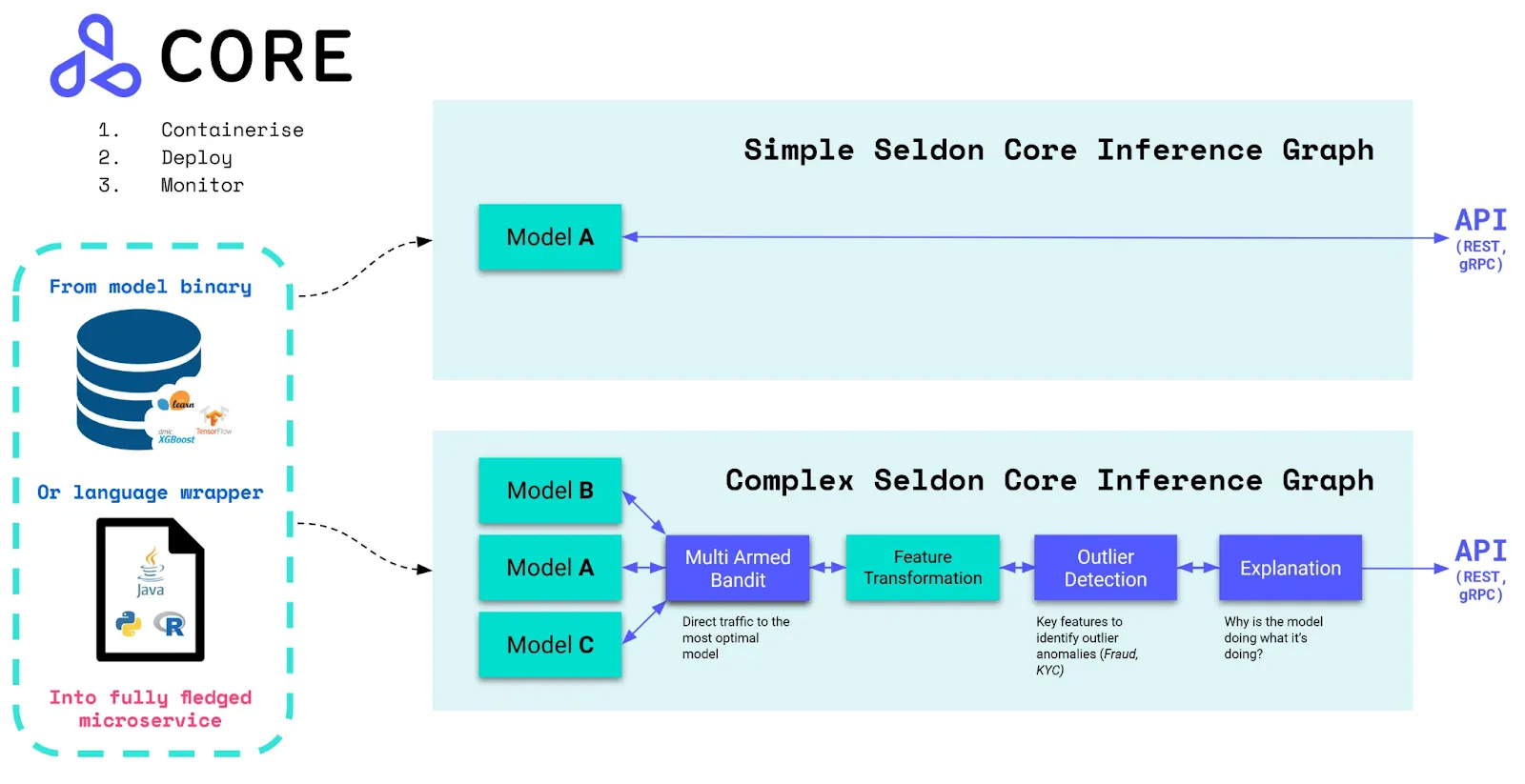
Seldon Core is an open-source MLOps platform designed for deploying, scaling, and monitoring machine learning models on Kubernetes. It’s framework-agnostic and built for teams that want to run models in production with full control over infrastructure. Seldon doesn’t try to be everything—it focuses specifically on model inference and serving and does that exceptionally well. If you’re running on Kubernetes and want a production-grade, open-source solution, Seldon Core is a strong contender.
Features and Pricing
Seldon Core supports multi-model deployments, canary rollouts, A/B testing, and request logging—all baked into its Kubernetes-native design. It works with models built in any framework and can wrap them in pre/post-processing logic using custom Python code. It also integrates easily with MLflow, Prometheus, and Grafana for observability. Being open-source, it’s completely free to use, and there’s also Seldon Deploy, a paid enterprise version with a UI, RBAC, and advanced governance tools.
Why it’s a good SageMaker alternative
التحديات
Seldon Core ممتاز إذا كان لديك بالفعل إعداد Kubernetes — ولكن إذا لم تكن على دراية بـ K8s، فقد يبدو مخيفًا بعض الشيء. لا يوفر تدريب النماذج أو بيئات الدفاتر، لذا من الأفضل استخدامه كجزء من حزمة MLOps أكبر بدلاً من حل مستقل.

MLflow هو أحد أكثر المنصات مفتوحة المصدر اعتمادًا على نطاق واسع لإدارة دورة حياة تعلم الآلة بالكامل. تم تطويره بواسطة Databricks، وهو مصمم للعمل مع أي مكتبة تعلم آلة، وأي لغة، وعلى أي سحابة. يساعدك MLflow على تتبع التجارب، وتعبئة النماذج، وإدارة سجل النماذج، وتقديم النماذج بسهولة. إنه معياري للغاية — لذا يمكنك استخدام الأجزاء التي تحتاجها فقط، أو دمجه في حزمة MLOps أكبر.
الميزات والتسعير
يتضمن MLflow أربعة مكونات رئيسية: التتبع (لتسجيل التجارب)، والمشاريع (لتعبئة الكود)، والنماذج (للتعبئة والنشر)، وسجل النماذج (لإدارة دورة الحياة). يدعم العديد من الأطر بما في ذلك TensorFlow وPyTorch وScikit-learn وXGBoost. MLflow مجاني ومفتوح المصدر، مع مجتمع ضخم ووثائق قوية. تقدم Databricks أيضًا إصدارًا مُدارًا بالكامل مع ميزات تعاون متقدمة لفرق الشركات.
لماذا هو بديل جيد لـ SageMaker
التحديات
يركز MLflow بشكل أكبر على تتبع التجارب وإدارة دورة حياة النماذج بدلاً من النشر الكامل. بينما يوفر خدمة النماذج، إلا أنه أساسي نسبيًا وغالبًا ما يتطلب الاقتران بأدوات أخرى (مثل Seldon أو BentoML) للاستدلال على مستوى الإنتاج. قد يحتاج المبتدئون أيضًا إلى بعض الوقت للإعداد للاستفادة القصوى من مكوناته.
بينما يقدم كل بديل من البدائل المذكورة أعلاه نقاط قوة محددة — Vertex AI لتعلم الآلة المتكامل، وMLflow لتتبع التجارب، وSeldon Core لخدمة النماذج، وBentoML للتعبئة — فإن TrueFoundry هي المنصة الوحيدة التي تجمع هذه الإمكانيات في حل MLOps واحد سهل الاستخدام للمطورين ومصمم للتوسع. يجمع بين مرونة الأدوات المفتوحة وهيكل منصة على مستوى المؤسسات، مما يجعله مناسبًا بشكل خاص للفرق سريعة الحركة التي ترغب في السرعة والتحكم معًا.

لماذا تكتسب TrueFoundry زخمًا سريعًا
من بين جميع بدائل SageMaker المذكورة، سواء كانت إمكانيات Vertex AI الشاملة، أو تتبع التجارب في MLflow، أو مرونة النشر في BentoML، تبرز TrueFoundry كمنصة MLOps الأكثر توازنًا والأولى في الإنتاج. توفر بنية تحتية متوافقة أصلاً مع Kubernetes تبسط نشر نماذج التعلم الآلي (ML) وتحجيمها وإدارتها. مع دعم أصلي لأكثر من 250 نموذج لغة كبير (LLM) مفتوح المصدر واحتكاري، تتصدر TrueFoundry أيضًا في تبني الذكاء الاصطناعي التوليدي (GenAI). توفر إمكانيات متقدمة مثل تحسين زمن الاستجابة، وإدارة الأوامر، وتحديد المعدل، وبوابة LLM متعددة السحابات، وجميعها مدمجة وجاهزة للإنتاج.
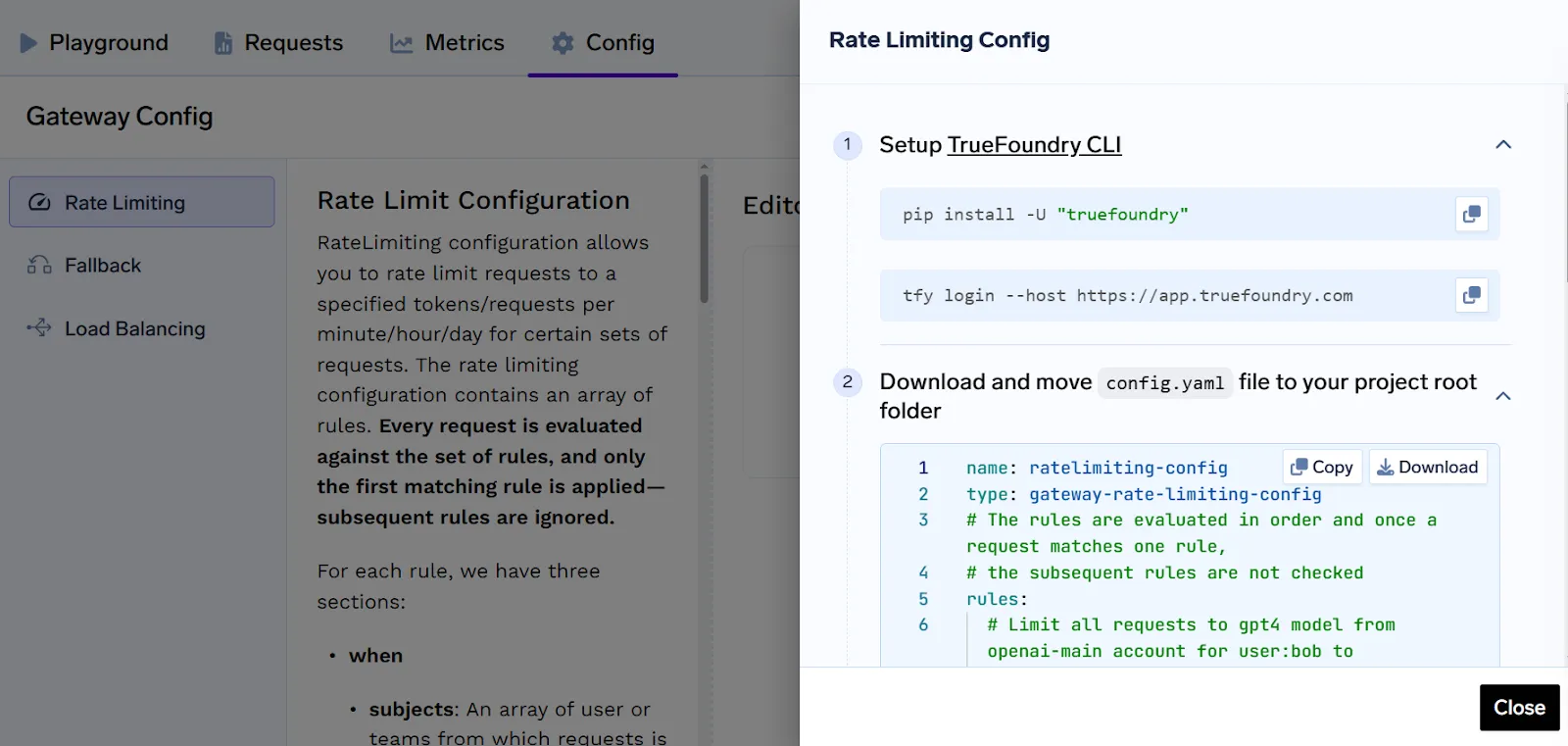
بدائل AWS Sagemaker: إعداد تحديد المعدل في TrueFoundry
على عكس المنصات التي تركز على مراحل معزولة من دورة حياة التعلم الآلي (ML)، توفر TrueFoundry تنسيقًا شاملاً، من تدريب النماذج إلى النشر والمراقبة. توفر تحكمًا دقيقًا في البنية التحتية وإمكانية المراقبة والامتثال، مع تبسيط تجربة المطور من خلال سير عمل GitOps ونهج يعتمد على API أولاً. بالنسبة للفرق التي تهدف إلى التحرك بسرعة دون المساس بالموثوقية أو المرونة، تعد TrueFoundry أكثر من مجرد بديل لـ SageMaker. إنها حل MLOps حديث مصمم للتوسع والسرعة.
يقدم مشهد MLOps في عام 2026 مرونة وابتكارًا أكثر من أي وقت مضى. بينما يظل Amazon SageMaker أداة قوية، فإنه ليس حلاً واحدًا يناسب الجميع—خاصة للفرق التي تتوق إلى السرعة أو البساطة أو تحكم أكبر في سير عمل التعلم الآلي الخاص بها. سواء كنت تميل نحو الحلول مفتوحة المصدر مثل BentoML و Seldon Core، أو تهدف إلى تنسيق قوي لخطوط الأنابيب باستخدام Valohai، أو تتعمق في نظام Google البيئي مع Vertex AI، هناك بديل قوي متاح لكل حاجة.
ومع ذلك، تبرز TrueFoundry بسرعة كخيار متميز—خاصة للفرق التي ترغب في قوة SageMaker دون قيود البائع أو التكلفة أو التعقيد. إنه سريع، وسهل الاستخدام للمطورين، ومصمم للتوسع. عند تقييم خياراتك، ضع في اعتبارك ما يهم فريقك أكثر: سرعة النشر، المرونة، التوافق مع النظام البيئي، أو كفاءة التكلفة. الأداة المناسبة لا تتعلق فقط بالميزات، بل هي تلك التي تساعدك على تقديم منتجات تعلم آلي مؤثرة باحتكاك أقل.
بينما تعد منصات مثل Databricks و Vertex AI شائعة، تعد TrueFoundry البديل الأفضل لـ SageMaker للفرق التي تبحث عن المرونة والتحكم في التكاليف. على عكس نظام SageMaker البيئي المقتصر على AWS، فإن TrueFoundry محايدة للسحابة، مما يتيح لك النشر على AWS أو GCP أو Azure أو مجموعات Kubernetes المحلية. إنها تبسط دورة حياة MLOps، من دفتر الملاحظات إلى الإنتاج في دقائق، مقدمة تجربة مطور أفضل وتكاليف أقل بكثير دون قيود البائع المرتبطة بـ SageMaker.
المكافئ المباشر في Google Cloud هو Vertex AI، والذي يقدم خدمات تعلم آلي مُدارة مماثلة. ومع ذلك، إذا كنت ترغب في تجنب الارتباط بنظام Google البيئي، فإن TrueFoundry يعد خيارًا فائقًا متعدد السحابات. فهو يعمل بسلاسة على Google Kubernetes Engine (GKE) مع الحفاظ على القدرة على الترحيل إلى سحابات أخرى. يوفر TrueFoundry لوحة تحكم موحدة لنماذجك، مما يمنحك قوة Vertex AI مع حرية البنية التحتية المفتوحة.
نظير Sagemaker من Microsoft هو Azure Machine Learning (Azure ML). بينما يتكامل بشكل جيد مع خدمات Azure، فإنه يقيدك ببنيتها التحتية. يعمل TrueFoundry كبديل مرن يعمل فوق Azure Kubernetes Service (AKS) ولكنه غير مقيد به. يتيح ذلك للمؤسسات الاستفادة من قوة الحوسبة في Azure مع الحفاظ على مكدس MLOps محايد للسحابة، مما يضمن سير عمل موحد وحوكمة عبر أي بيئة تختارها.
يعتمد ذلك على احتياجاتك. Amazon Rekognition هو واجهة برمجة تطبيقات (SaaS API) جاهزة للاستخدام لتحليل الصور، بينما SageMaker هي منصة لبناء وتدريب النماذج المخصصة. إذا كنت بحاجة إلى التخصيص الذي يوفره SageMaker ولكنك تجده معقدًا للغاية، فإن TrueFoundry هو الحل الوسط المثالي. فهو يتيح لك نشر وإدارة نماذج رؤية الكمبيوتر مفتوحة المصدر أو المخصصة بسهولة، مما يوفر مرونة التطوير المخصص مع بساطة الخدمة المُدارة.
لا، SageMaker هو مجموعة كاملة للتدريب والنشر، على الرغم من أنه يعتمد بشكل كبير على Jupyter للتطوير. ومع ذلك، غالبًا ما يبدو تكامل دفتر الملاحظات الخاص به غير عملي لسير عمل الإنتاج. يحسن TrueFoundry هذا من خلال سد الفجوة بسلاسة بين التجريب والإنتاج. فهو يسمح للمطورين بتشغيل مهام التدريب ونشر النماذج مباشرة من بيئاتهم المفضلة (بما في ذلك دفاتر الملاحظات)، مما يؤدي إلى أتمتة الانتقال إلى Kubernetes دون الحاجة إلى عبء DevOps الثقيل الذي يتطلبه SageMaker غالبًا.
ليس بشكل مباشر. تقدم OpenAI نماذج مملوكة، بينما SageMaker هي منصة بنية تحتية لبناء واستضافة النماذج. ومع ذلك، غالبًا ما تختار الشركات بين استخدام واجهات برمجة تطبيقات OpenAI واستضافة نماذج مفتوحة المصدر على SageMaker. يوحد TrueFoundry هذا الاختيار من خلال العمل كمنصة شاملة حيث يمكنك إدارة مفاتيح API الخاصة بـ OpenAI عبر بوابة آمنة و استضافة نماذج مفتوحة المصدر خاصة على البنية التحتية الخاصة بك، مما يمنحك أفضل ما في العالمين.
TrueFoundry AI Gateway delivers ~3–4 ms latency, handles 350+ RPS on 1 vCPU, scales horizontally with ease, and is production-ready, while LiteLLM suffers from high latency, struggles beyond moderate RPS, lacks built-in scaling, and is best for light or prototype workloads.





أحدث الأخبار والمقالات والموارد تصلك مباشرة إلى بريدك الوارد



.png)


.png)
.png)
.png)
.png)
.png)
.png)
.png)
.png)
.png)
.png)


