
Blank white background with no objects or features visible.

We’re sharing complimentary access to the full Gartner Hype Cycle for AI Governance 2026. Get your copy →

AI Agent Identity

Trace, verify, and govern agent identity across complex multi-agent systems 

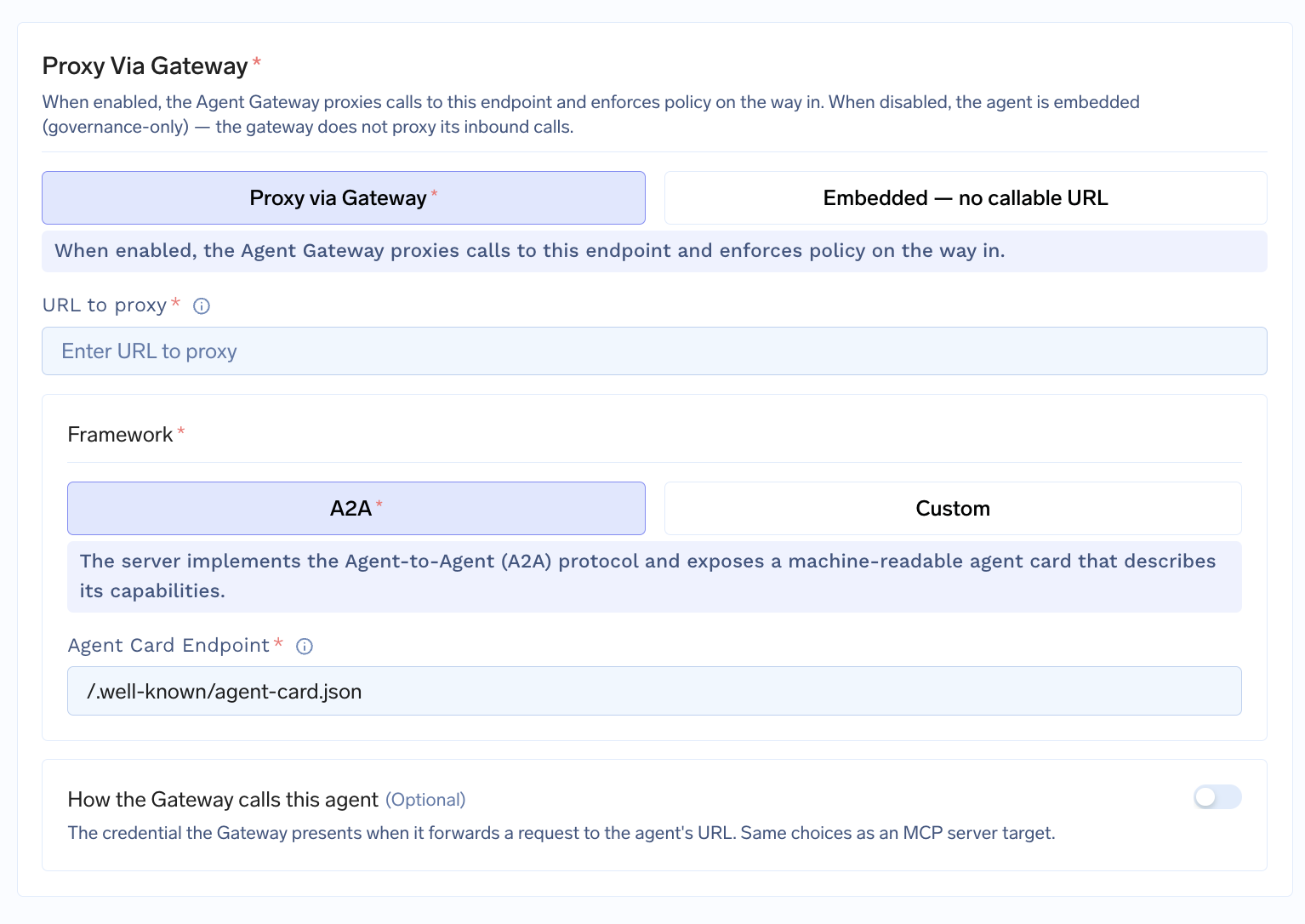
Agent identity built into the gateway that already runs your LLM and MCP traffic. Give every agent a verifiable identity, and control who calls it, what it can reach, and whose authority travels with every request.

Skills Registry gives teams a centralized system for creating, versioning, and managing reusable Agent Skills that can be attached across agents without duplicating prompts or operational logic.

One identity, wherever your agents run
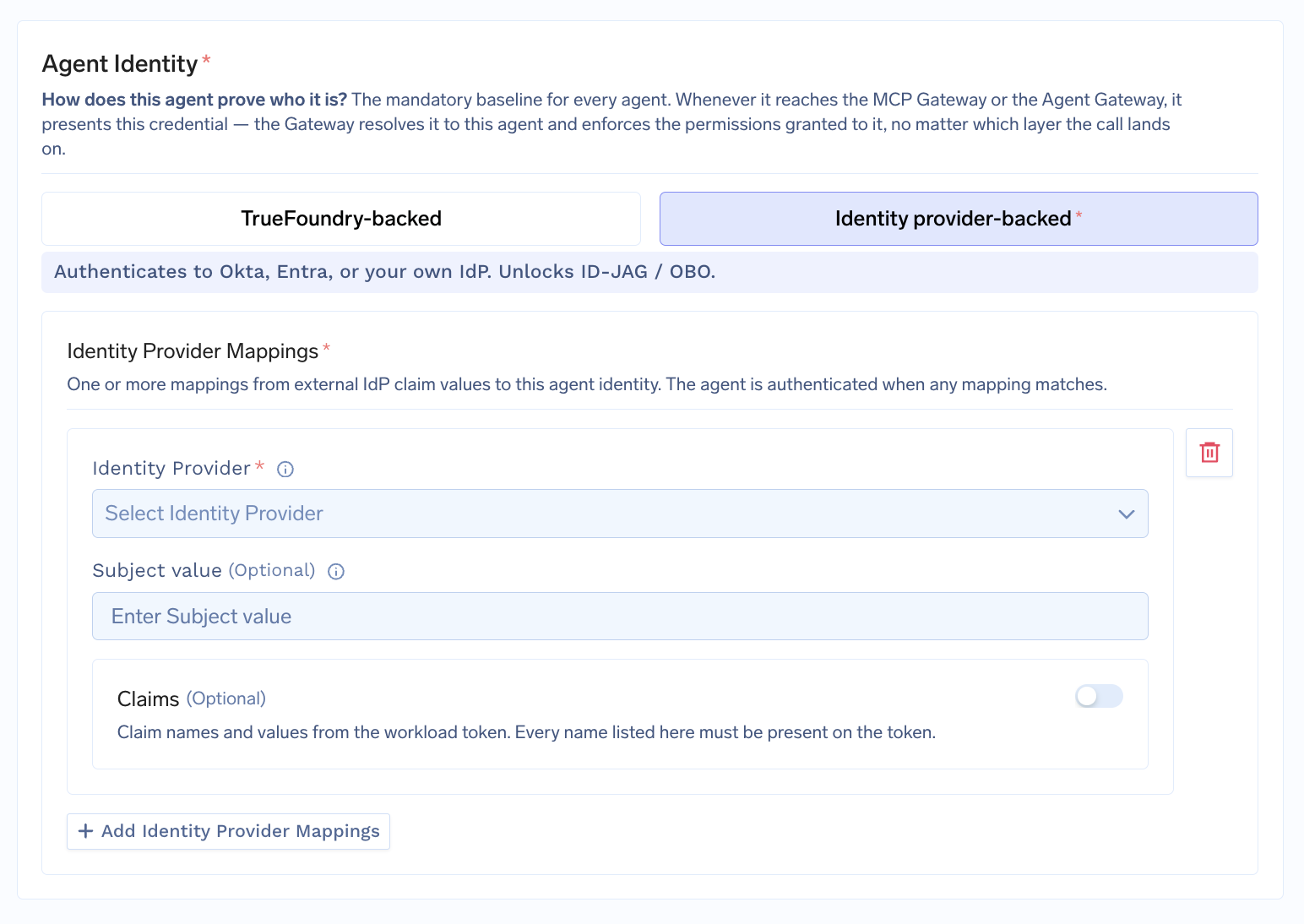
Treat every agent as a first-class non-human identity. Register agents from AWS Bedrock AgentCore, Vertex AI, LangGraph, or your own services without rewriting them, and back each one with TrueFoundry or the IdP you already use.

Agent authentication that travels across every hop
When agents call other agents, the user behind the request no longer disappears. Pass tokens through or exchange them on behalf of the user, so the last tool in the chain knows exactly who it’s acting for, with zero auth code in your agents.

Agent authorization on both sides of every call
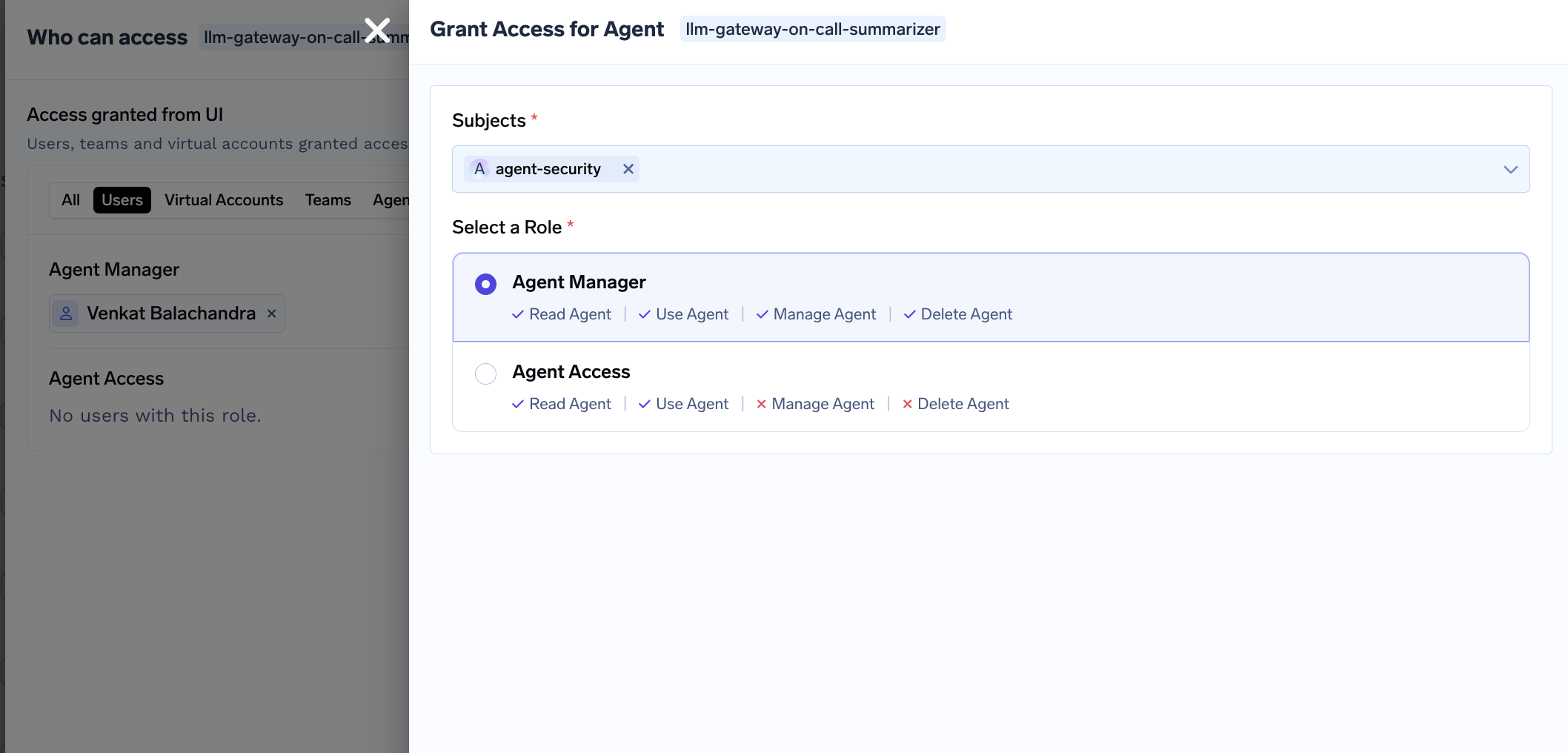
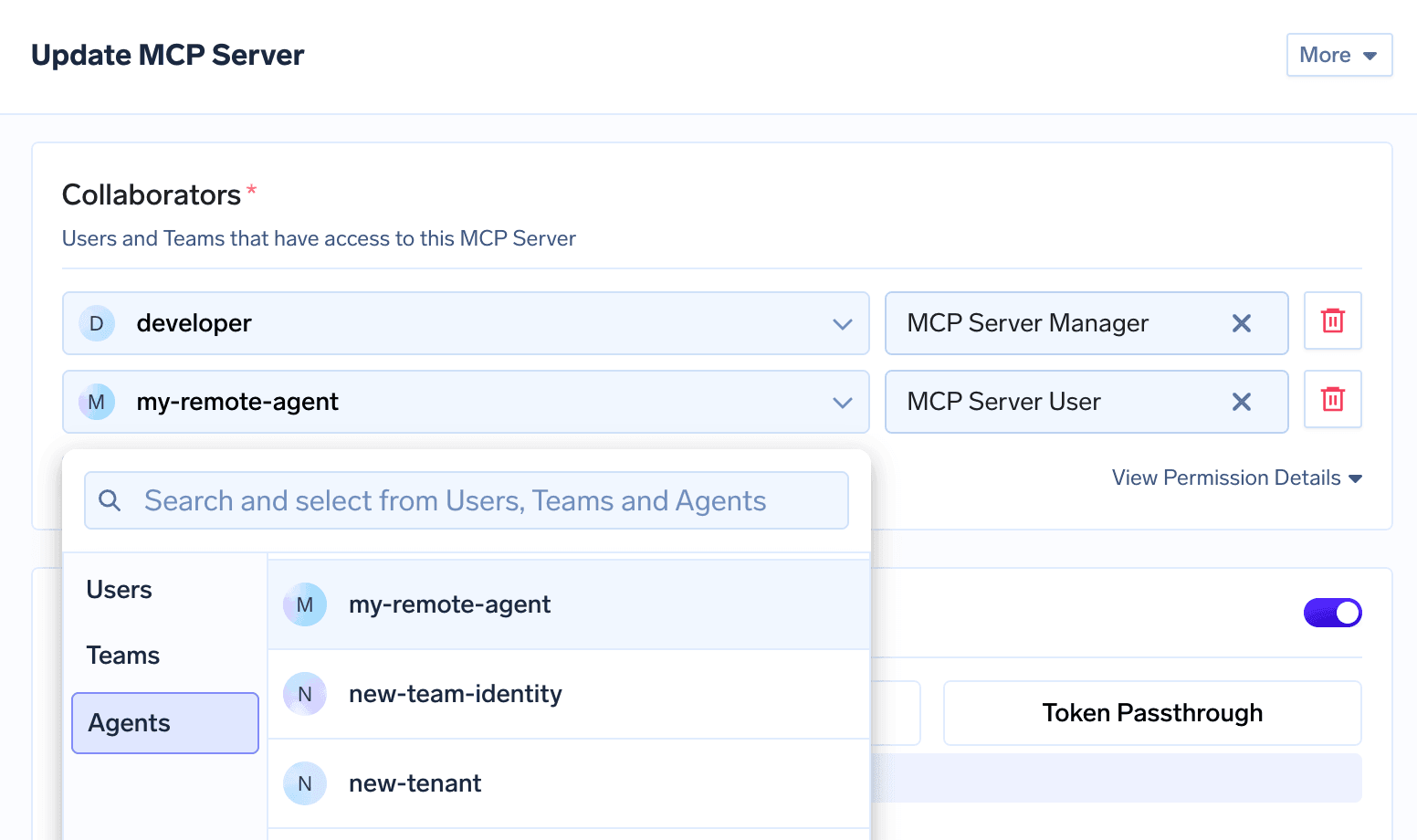
Decide who can call each agent, and what each agent can call, from models and MCP servers to other agents. Every agent gets an accountable owner, and revoking access takes effect on the very next request.

One control plane, not another silo

Agent Identity runs on the same gateway as your LLM and MCP traffic. Apply the same RBAC, guardrails, and traces, so security teams can follow a request from the first app to the last tool.

Made for Real-World AI at Scale

99.99%

uptime

Centralized failovers, routing, and guardrails ensure your AI apps stay online, even when model providers don’t.

10B+

Requests processed/month

Scalable, high-throughput inference for production AI.

30%

Average cost optimization

Smart routing, batching, and budget controls reduce token waste.

Enterprise-Ready

Your data and models are securely housed within your cloud / on-prem infrastructure
  • Green circle with a white checkmark symbol inside, indicating confirmation or approval status icon.

    Compliance & Security

    SOC 2, HIPAA, and GDPR standards to ensure robust data protection
  • Green circle with a white checkmark symbol inside, indicating confirmation or approval status icon.

    Governance & Access Control

    SSO + Role-Based Access Control (RBAC) & Audit Logging
  • Green circle with a white checkmark symbol inside, indicating confirmation or approval status icon.

    Enterprise Support & Reliability

    24/7 support with SLA-backed response SLAs
Deploy TrueFoundry in any environment

VPC, on-prem, air-gapped, or across multiple clouds.

No data leaves your domain. Enjoy complete sovereignty, isolation, and enterprise-grade compliance wherever TrueFoundry runs

Cloud deployment options including On-Prem, Multi-Cloud, Air-gapped, and AWS, Google Cloud Platform.

TrueFoundry’s AI Gateway standardized how every team interacts with LLMs, embeddings, and RAG components. Instead of scattered integrations, we now control access, routing policies, and safety guardrails centrally. The ability to optimize for cost or latency without changing applications has been a game-changer. It’s made our AI architecture cleaner, more secure, and far easier to scale.

Smiling man with beard and short dark hair in a collared shirt and blazer.
Indroneel G.
Head of IT, Siemens Healthineers

Frequently asked questions

What is AI agent identity?

 AI agent identity is a verifiable credential that tells every system which agent is calling it. In TrueFoundry, each registered agent gets exactly one identity, and the gateway uses it to enforce access, carry user context downstream, and record every action.

Agent identity vs human identity: what’s the difference?

People sign in and act for themselves. Agents act autonomously, at machine speed, and often on behalf of someone else. Agent identity has to name the agent, carry the user it acts for, and replace the shared keys that can’t tell agents apart.

What is agentic IAM, and what problems does it solve?

Agentic IAM is identity and access management built for AI agents. It replaces shared keys with one identity per agent, keeps user context intact across multi-agent chains, and gives security one place to see, control, and audit every agent.

How is TrueFoundry different from other agent identity tools?

Cloud and IdP agent identity mostly covers agents in its own ecosystem and lives in the directory. TrueFoundry works with the IdP you already use and enforces identity in the request path, across every cloud and framework your agents run on.

How does agent authentication work across multiple agents?

For each hop, you choose how identity is passed: forward the caller’s token, let the agent act as itself, or exchange the token on behalf of the user. The gateway handles the exchange, so downstream tools can apply that user’s permissions.

How does TrueFoundry verify an agent’s identity?

Every agent is registered in the Agent Registry with one identity. On each call, the gateway validates the agent’s token, issued by TrueFoundry or your IdP and matched to the registered agent, then checks its access grants before forwarding the request.
Grey wavy lines on white background, abstract wave pattern with multiple curved lines intersecting smoothly.

GenAI infra- simple, faster, cheaper

Trusted by 30+ enterprises and Fortune 500 companies

Take a quick product tour
Start Product Tour
Product Tour