


احصل على وصول فوري إلى بيئة TrueFoundry مباشرة. انشر النماذج، ووجّه حركة مرور LLM، واستكشف المنصة بالكامل — بيئة الاختبار الخاصة بك جاهزة في ثوانٍ، ولا يلزم وجود بطاقة ائتمان.


What Is Zero-Shot Learning and Why Does It Matter?

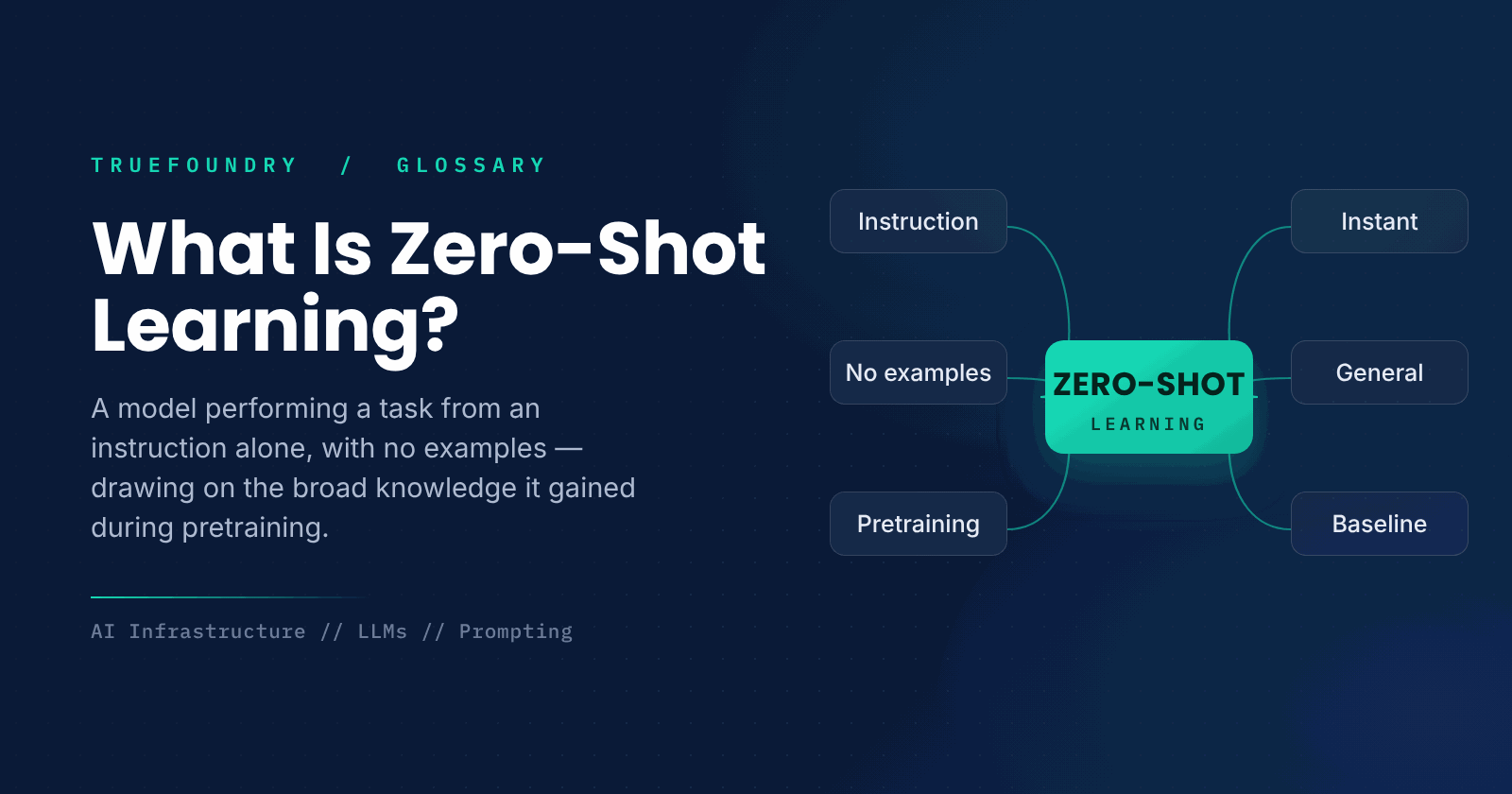
Ask a large language model to translate a sentence, classify a review, or summarize a paragraph, and it usually just does it, even though no one trained it on your exact task. That ability to handle a task from a plain description, with no examples, is zero-shot learning, and it is one of the reasons modern models feel so general.
The idea runs counter to classic machine learning, where a model could only do what it was trained on. Large models, pretrained on vast and varied data, accumulate enough general knowledge that they can follow a new instruction on the fly. You tell the model what you want in words, and it maps that request onto what it already knows.
This guide explains what zero-shot learning is, how it works with language models, how it compares to few-shot and fine-tuning, and when to rely on it.
What is zero-shot learning?
Zero-shot learning is the ability of a model to correctly perform a task for which it was given no task-specific training examples. With large language models, it means providing only an instruction, a description of what to do, and letting the model generate a response based on the general capabilities it acquired during pretraining.
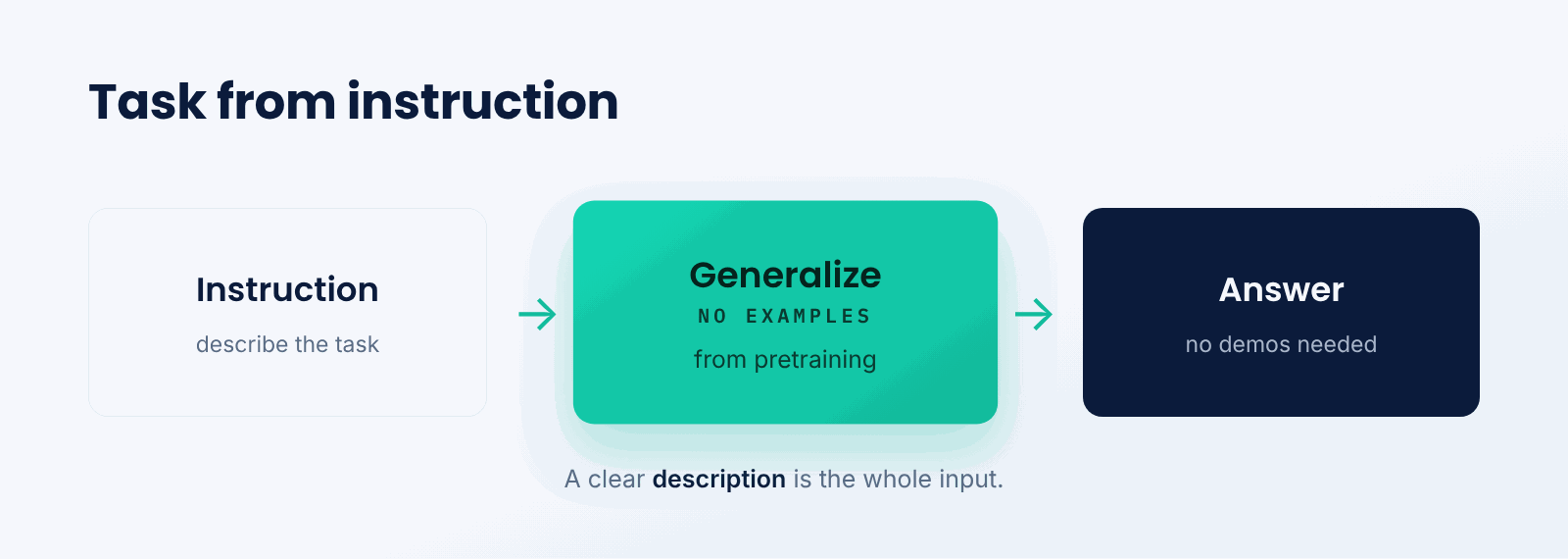
Think of it like asking a knowledgeable generalist a question in an area they have broad familiarity with. You do not have to show them worked examples; a clear description of the task is enough for them to apply what they already know. A large model behaves the same way when you describe a task it has never seen in that exact form.
The key idea is generalization from instruction alone. Because the model has absorbed patterns across a huge range of tasks during pretraining, a well-phrased instruction is often enough to trigger the right behavior, without a single example.
How does zero-shot learning work with LLMs?
With language models, zero-shot learning is simply a matter of instruction in the prompt.
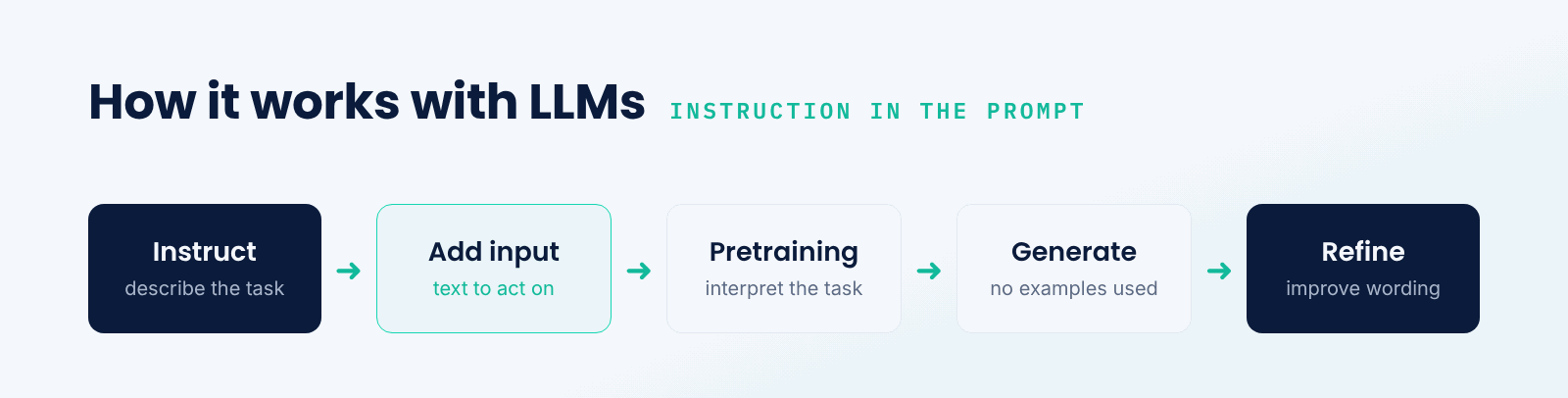
- Write an instruction. Clearly describe the task you want performed.
- Add the input. Provide the specific text or data to act on.
- Rely on pretraining. The model interprets the task from its general knowledge.
- Generate. It produces a response without any examples to follow.
- Refine the wording. Improve the instruction if the output misses the mark.
Because there are no examples, the instruction carries all the weight. Clear, specific wording that states the task, the format, and any constraints makes a large difference to zero-shot quality, which is why prompt phrasing matters so much in this setting.
Zero-shot vs. few-shot vs. fine-tuning
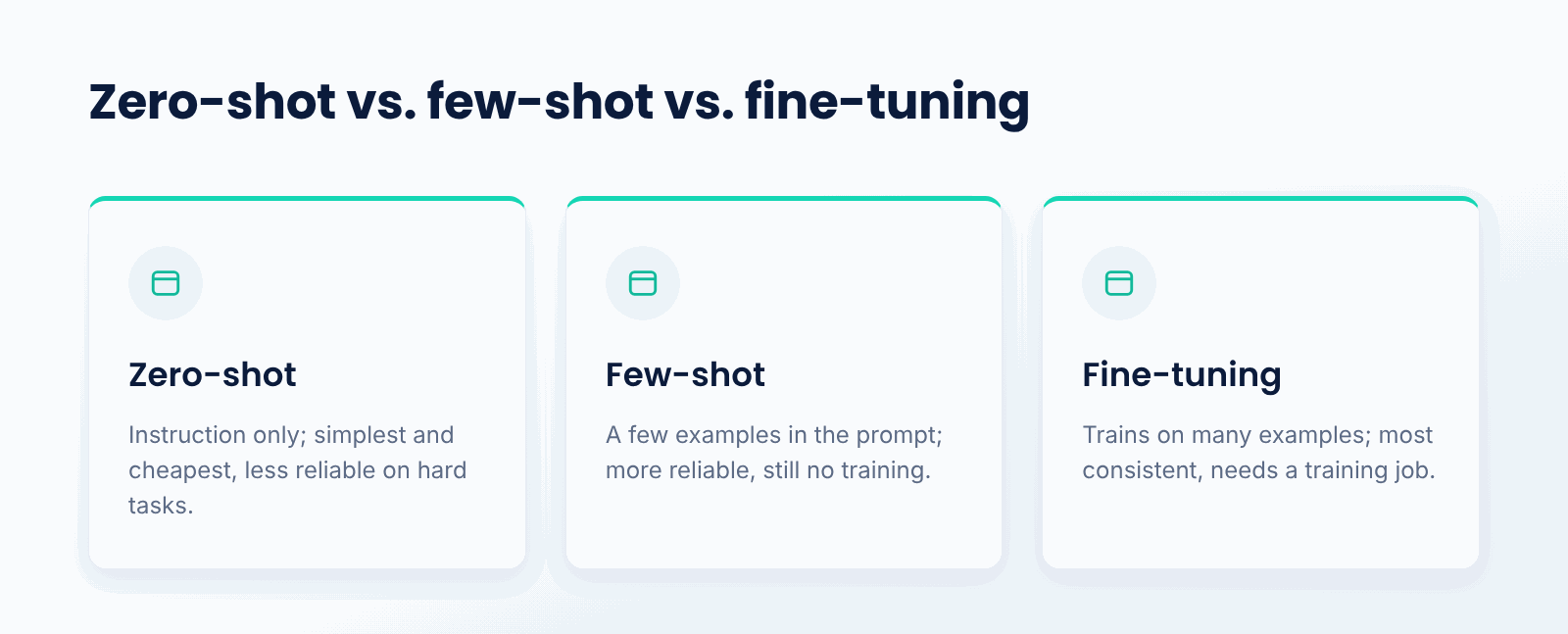
Zero-shot uses only an instruction. Few-shot adds a handful of examples in the prompt to illustrate the task. Fine-tuning trains the model on many examples so the behavior is built into its weights. They trade increasing effort and example data for increasing reliability and consistency on a specific task.
Zero-shot is the simplest and cheapest, and for many tasks it is enough. When it falls short, adding a few examples often closes the gap, and when a task is run at scale or needs maximum consistency, fine-tuning is the next step. The right choice depends on how hard the task is and how much reliability you need.
Why does zero-shot learning matter?
- Speed. You can attempt a task instantly, with no setup.
- No data. It needs no examples and no labeled dataset.
- Generality. One model handles a vast range of tasks from instructions.
- Simplicity. The prompt is just a description of what you want.
- Baseline. It is the natural first thing to try before adding complexity.
What are the tradeoffs?
- Reliability. Without examples, output can be inconsistent or off-format.
- Instruction sensitivity. Results depend heavily on how the task is phrased.
- Hard tasks. Complex or unusual tasks may need examples to succeed.
- Less control. You cannot shape behavior as precisely as with examples or tuning.
When should you use zero-shot learning?
Use it as your first approach for almost any task, since it costs nothing to try and often works. It is ideal for simple, well-understood tasks, for quick experiments, and for cases where you have no examples to provide and want an immediate result.
If zero-shot output is inconsistent or misses the format you need, move to few-shot by adding examples, and to fine-tuning if the task is high-volume or demands tight consistency. Zero-shot is the baseline from which you add only as much complexity as the task actually requires.
Key points about zero-shot learning
- It performs a task from an instruction alone, with no examples.
- It relies on knowledge learned during pretraining.
- The instruction's clarity strongly shapes the result.
- It is the fastest and cheapest approach to try.
- It is less reliable than few-shot on tasks that need illustration.
- It is the natural baseline before adding examples or fine-tuning.
Conclusion
Zero-shot learning lets a model perform a task from a plain instruction, with no examples, by drawing on the broad knowledge it gained in pretraining. It is the fastest and cheapest way to try a task and works for a remarkable range of them, which is central to why large language models feel so general. Its main limits are reliability and sensitivity to how the instruction is phrased.
TrueFoundry helps teams build and serve LLM applications, from simple zero-shot prompts to few-shot and fine-tuned workflows as tasks grow more demanding. Zero-shot learning is usually the first and simplest step on that path.
Govern, Deploy and Trace AI in Your Own Infrastructure
Frequently Asked Questions
What is zero-shot learning in simple terms?
It is teaching a model to perform some action based on a bare description, without any prior examples. In other words, you instruct the model on what needs to be done, and the model uses the general knowledge it gained through pretraining to generate output, even for a task it was never specifically trained on.
How is zero-shot different from few-shot learning?
Zero-shot provides the model with the instruction alone. In few-shot, some examples are provided in addition to the instruction. Examples help clarify the behavior and make it more reliable, which makes zero-shot simpler, but few-shot more successful on tasks that benefit from demonstration.
Why does the instruction matter so much in zero-shot?
Since there are no examples, the instruction includes all the information needed for the task to be completed. Precise wording that specifies the task, the desired format, and any constraints has a significant impact on the quality of the output, which is why prompt phrasing is so important.
When does zero-shot learning fail?
For complicated, unusual, or format-specific tasks, where a plain instruction is insufficient to produce consistent results and the output becomes inconsistent or off-target. In such situations, adding a few examples or fine-tuning usually helps.
Should I start with zero-shot?
Most often yes. It is free to attempt and generally works, which makes it the natural baseline. Should the results not be accurate or formatted well enough, you add examples or fine-tune, adding only as much complexity as the task actually needs.


- © 2022 ENSEMBLE Technologies



اشترك في نشرتنا الإخبارية
أحدث الأخبار والمقالات والموارد تصلك مباشرة إلى بريدك الوارد


