


احصل على وصول فوري إلى بيئة TrueFoundry مباشرة. انشر النماذج، ووجّه حركة مرور LLM، واستكشف المنصة بالكامل — بيئة الاختبار الخاصة بك جاهزة في ثوانٍ، ولا يلزم وجود بطاقة ائتمان.


What Is LoRA and How Does It Work?

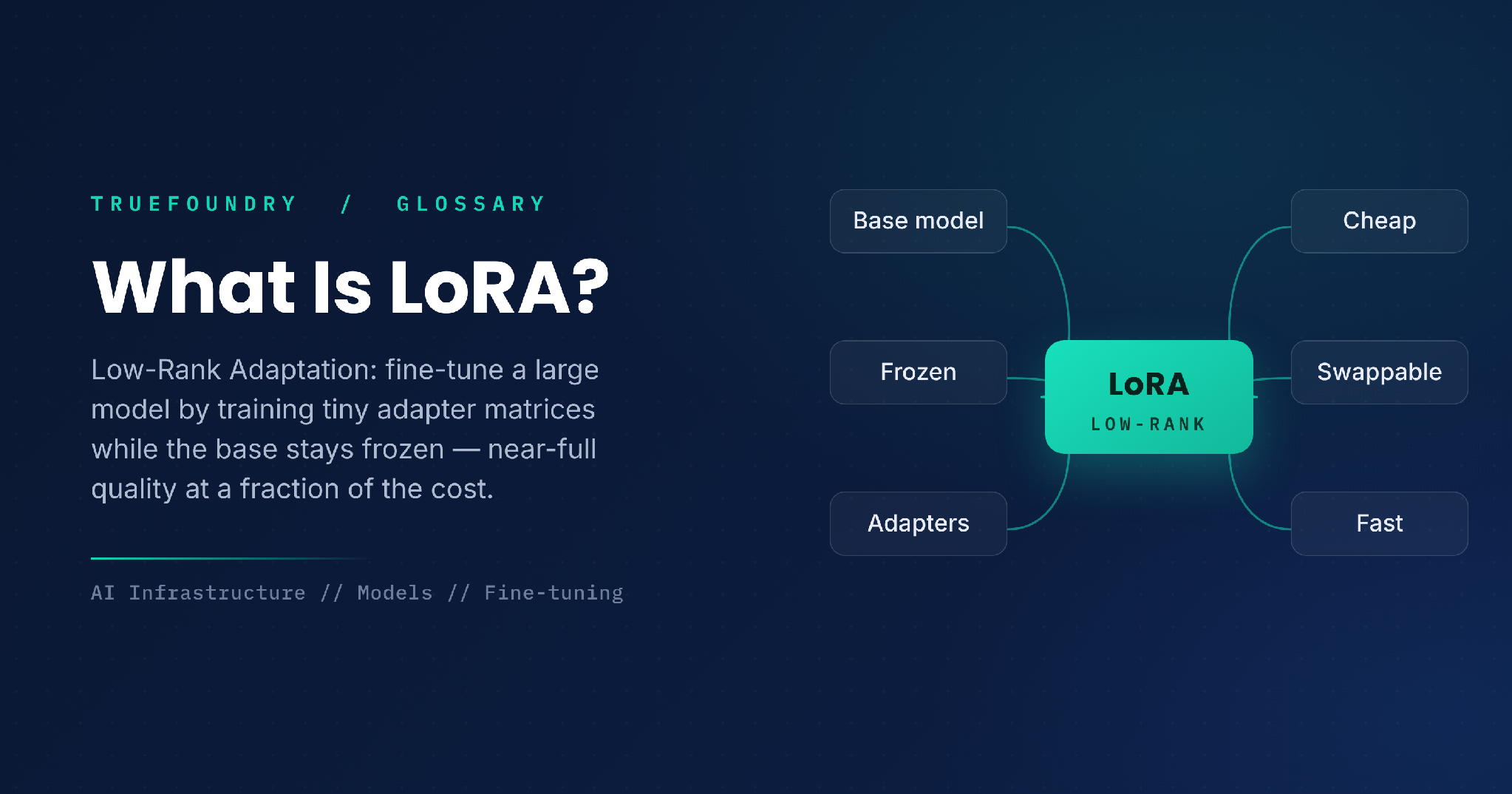
Fine-tuning a large language model the traditional way is expensive. You update every one of its billions of weights, which needs enough memory to hold the model, its gradients, and optimizer state all at once, plus a full copy of the model saved for each task you tune. For most teams, that is out of reach. LoRA is the technique that made fine-tuning large models practical again.
Its insight is simple: you do not need to change every weight to adapt a model. LoRA freezes the original model and trains a tiny set of new parameters alongside it, capturing the adjustment in a compact form. The result is fine-tuning at a fraction of the memory and storage, with quality close to the full approach.
This guide explains what LoRA is, how it works, how it compares with full fine-tuning, and when to use it.
What is LoRA?
LoRA, short for Low-Rank Adaptation, is a parameter-efficient fine-tuning method. Rather than updating a model's weight matrices directly, it adds a small pair of low-rank matrices to selected layers and trains only those. The base model's weights stay frozen, so the number of trainable parameters drops from billions to a few million.
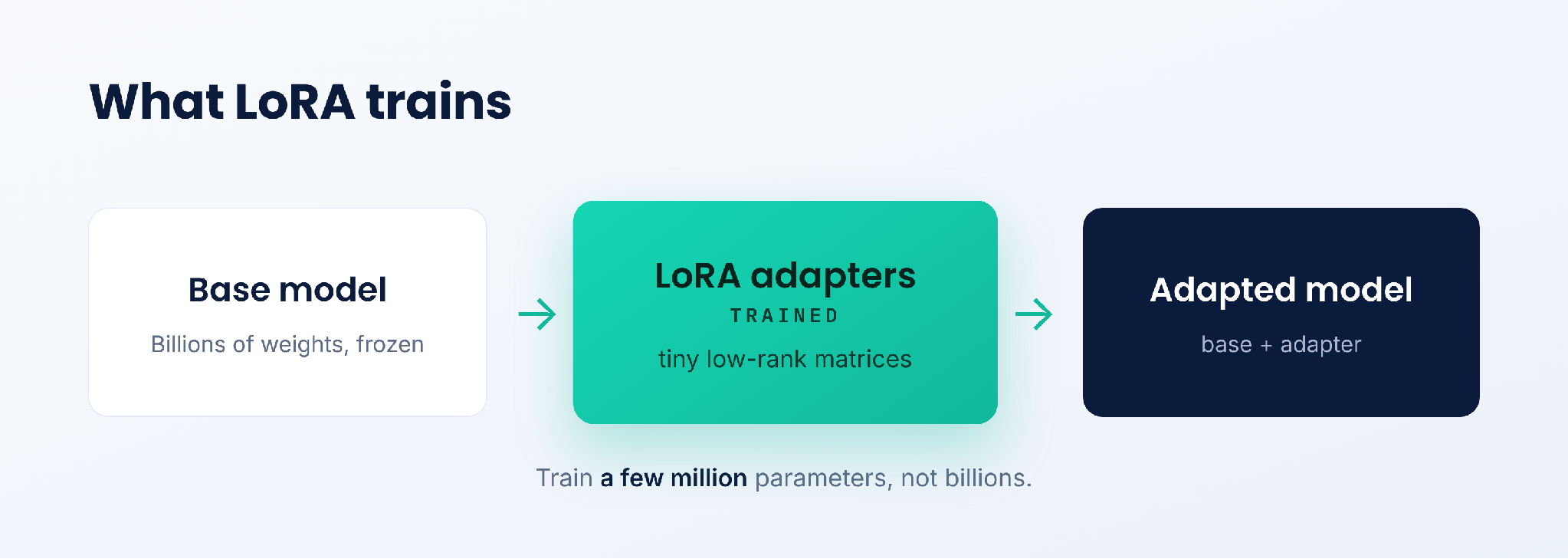
Think of editing a long printed book. Full fine-tuning is like reprinting the entire book to change a few chapters. LoRA is like adding a thin set of sticky notes that adjust the parts you care about, while the original pages stay untouched. The notes are small and easy to swap, but reading the book with them applied gives you the revised version.
The key idea is that the change a task requires is usually small and low-rank, meaning it can be captured by a compact pair of matrices instead of a full-size update. That is why LoRA works so well while training so little.
How does LoRA work?
LoRA inserts trainable adapters into a frozen model and tunes only them.
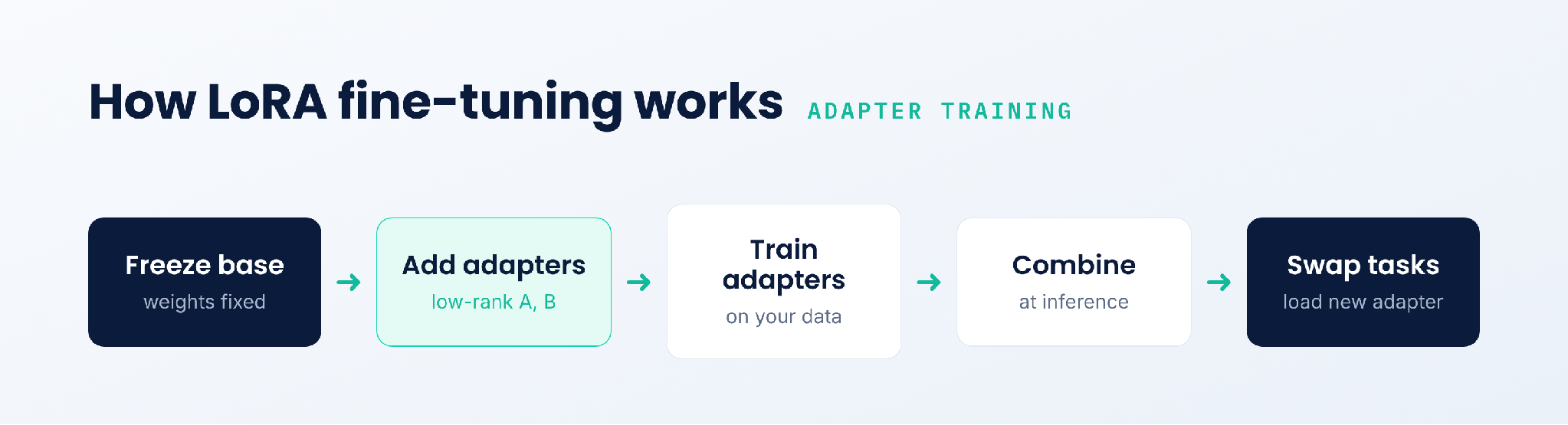
- Freeze the base model. The original weights are kept fixed and are never updated during training.
- Add low-rank adapters. For chosen layers, two small matrices are inserted whose product approximates a weight update.
- Train only the adapters. Learning updates just those small matrices on your task's data, which is cheap and fast.
- Combine at inference. The adapter's contribution is added to the frozen weights, producing the adapted behavior.
- Swap or stack adapters. Because adapters are small, you can switch tasks by loading a different one, or merge it into the base.
Since only the small matrices are trained, memory use drops sharply and each fine-tuned result is just a few megabytes rather than a full model copy. That is what makes training and storing many task-specific variants affordable.
LoRA vs. full fine-tuning
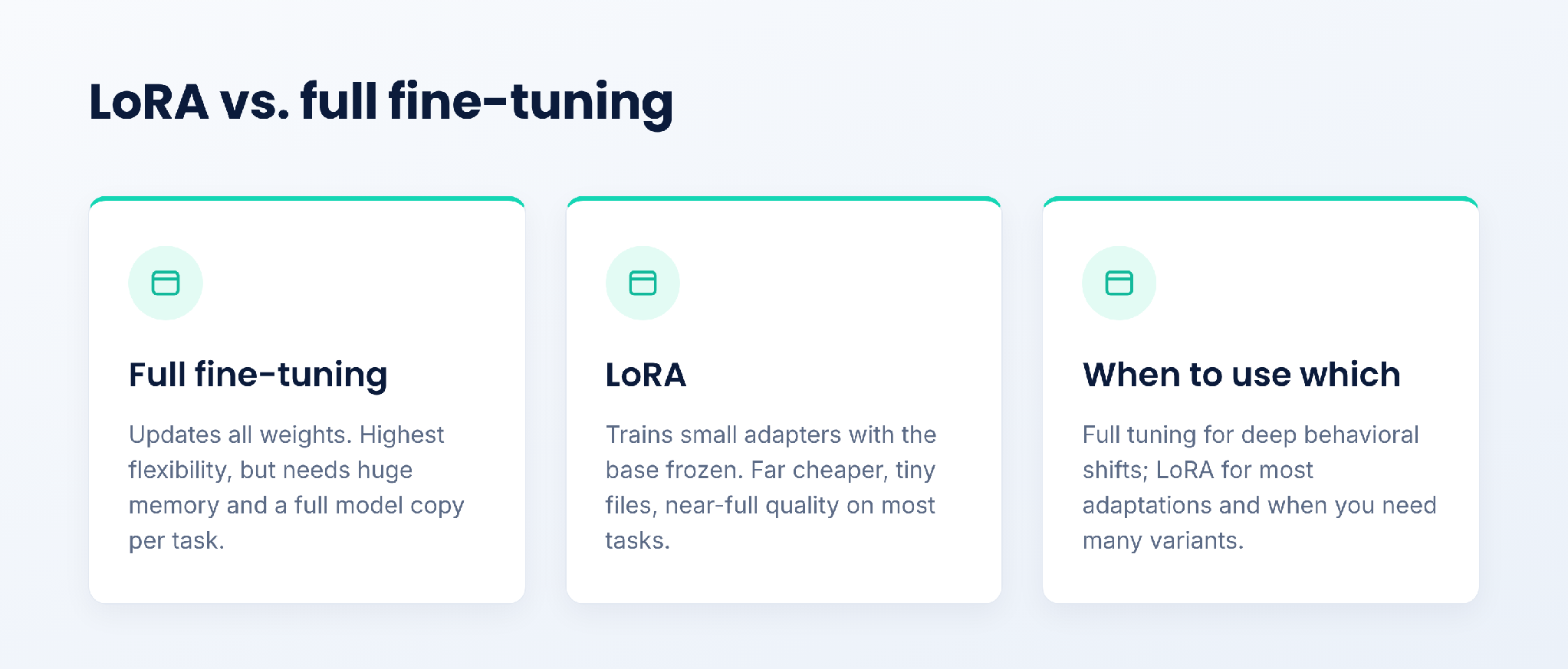
Full fine-tuning updates every weight, which gives maximum flexibility but demands enough memory to train the whole model and a full copy saved per task. LoRA freezes the base and trains only small adapters, cutting trainable parameters and memory by orders of magnitude and producing tiny adapter files. On most tasks the quality is very close to full fine-tuning, which is why LoRA has become the default way to adapt large models.
Full fine-tuning still has a place when a task demands a deep shift in the model's behavior and you have the resources for it. But for the large majority of adaptations, LoRA delivers nearly the same result at a small fraction of the cost, and it lets you keep many lightweight variants of one base model.
What are the benefits of LoRA?
- Far less memory. Freezing the base and training small adapters fits fine-tuning on much smaller hardware.
- Tiny artifacts. A LoRA adapter is a few megabytes, versus a full multi-gigabyte model copy per task.
- Fast and cheap. Training far fewer parameters means quicker runs and lower cost.
- Swappable behavior. You can switch tasks by loading a different adapter on the same base model.
- Near-full quality. On most tasks LoRA matches full fine-tuning closely despite training a fraction of the weights.
What are the limits of LoRA?
- Not always equal to full tuning. For tasks needing a deep change in behavior, full fine-tuning can still edge ahead.
- Rank and placement matter. The adapter's size and which layers it targets affect quality and need tuning.
- Serving many adapters adds complexity. Hot-swapping adapters per request requires runtime support.
- Still needs good data. LoRA makes training cheap, but a poor dataset produces a poor result regardless.
When should you use LoRA?
LoRA is the right default whenever you want to adapt a large model to your data without the cost of full fine-tuning. Specializing a model for a domain, a tone, or a specific task, especially when you need several variants, is exactly where it shines.
Reserve full fine-tuning for cases that demand a deep behavioral shift and where you have the hardware and budget. For most teams and most tasks, LoRA gets you most of the benefit at a small fraction of the cost and storage.
Best practices for using LoRA
- Start with a modest rank and increase it only if the task needs more capacity.
- Apply adapters to the attention layers first, which is often where they help most.
- Curate a clean, representative dataset, since data quality still drives the result.
- Keep adapters separate from the base so you can swap tasks without duplicating the model.
- Use a quantized base with LoRA, often called QLoRA, to fine-tune very large models on limited hardware.
- Serve adapters behind an engine and gateway that can load and route them efficiently.
Govern, Deploy and Trace AI in Your Own Infrastructure
Frequently Asked Questions
What is LoRA in simple terms?
LoRA is an inexpensive method of fine-tuning large models. Rather than modifying the entire set of model weights, it freezes the weights of the large model and trains small additional matrices, so you adapt the model while training only a tiny fraction of it.
How is LoRA different from full fine-tuning?
Full fine-tuning tunes all the weights and requires a complete copy of the model for each new task. LoRA keeps the base model intact and only tunes small adapters, saving enormous amounts of memory and storage while matching full tuning closely on most tasks.
What is a LoRA adapter?
It is the tiny pair of low-rank matrices that LoRA trains and stores, only a couple of megabytes in size. You apply it on top of the frozen base model to obtain the adapted behavior, and you can replace it with another.
Does LoRA reduce model quality?
Almost never. In most cases LoRA does about as well as full fine-tuning. Where large changes are required to the way the model operates, full fine-tuning can still have an advantage.
What is QLoRA?
QLoRA is a combination of LoRA and a quantized base model, so the frozen weights require far less memory. QLoRA lets us fine-tune very large models even on limited hardware, while keeping LoRA's efficiency.


- © 2022 ENSEMBLE Technologies



اشترك في نشرتنا الإخبارية
أحدث الأخبار والمقالات والموارد تصلك مباشرة إلى بريدك الوارد


