


احصل على وصول فوري إلى بيئة TrueFoundry مباشرة. انشر النماذج، ووجّه حركة مرور LLM، واستكشف المنصة بالكامل — بيئة الاختبار الخاصة بك جاهزة في ثوانٍ، ولا يلزم وجود بطاقة ائتمان.


What Is API Key Management and How Does It Work?

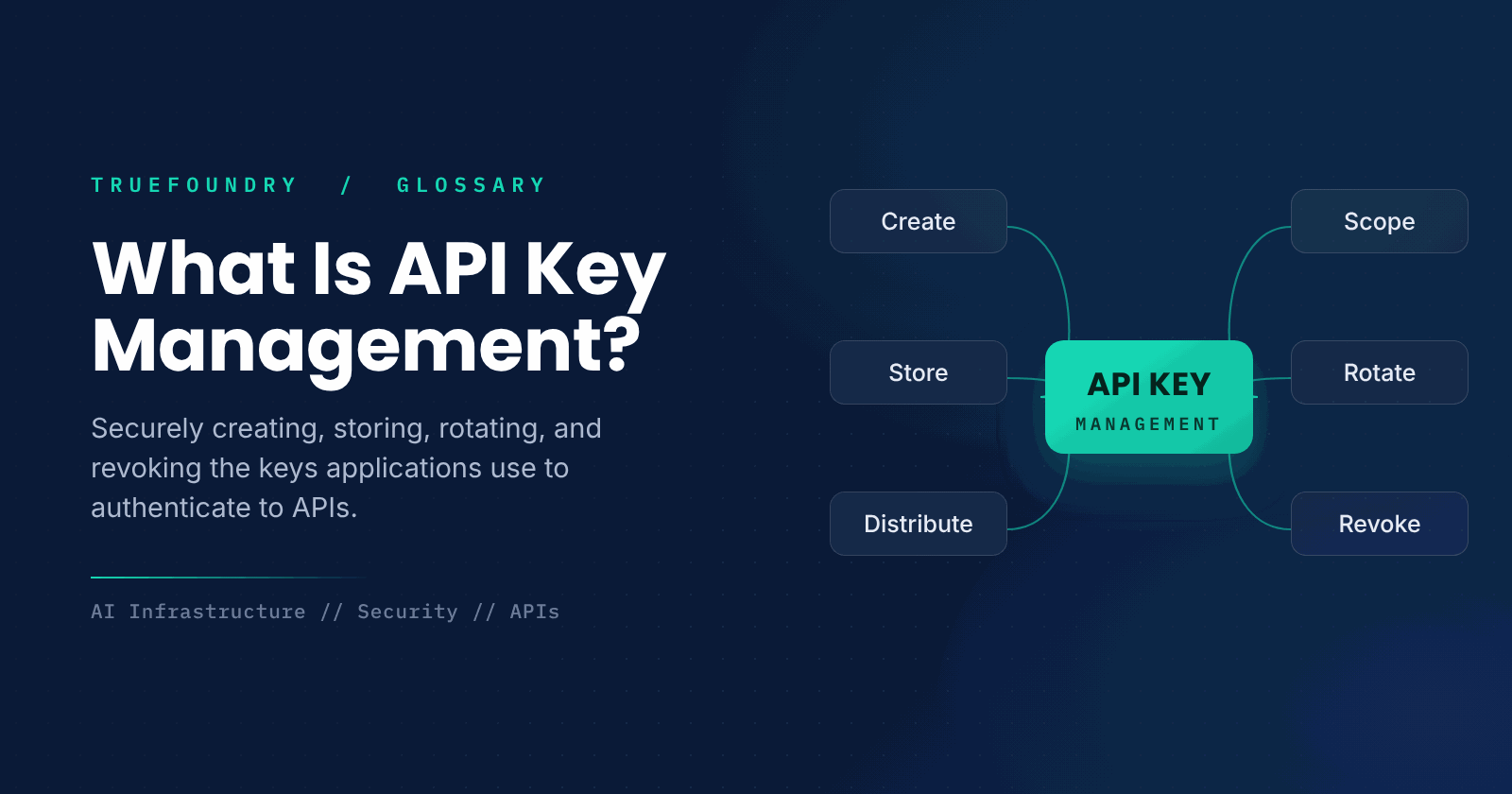
Almost every API, including the ones behind large language models, uses a key to decide who is calling and whether they are allowed to. That key is a secret, and if it leaks, anyone who has it can run up your bill or reach your data. API key management is the set of practices that keeps those secrets safe across their whole life, from creation to revocation.
It is easy to treat a key as something you paste once and forget, but that is exactly how keys end up hard-coded in repositories, shared in chat, and leaked. Good key management replaces that with deliberate handling: keys stored securely, scoped tightly, rotated regularly, and revocable instantly.
This guide explains what API key management is, how it works, the main practices, and why it matters, especially for AI applications calling multiple providers.
What is API key management?
API key management is the process of handling the full lifecycle of API keys, the secret tokens that applications present to authenticate to an API. It covers generating keys, storing them securely, distributing them to the systems that need them, controlling what each can do, rotating them on a schedule, and revoking them when they are no longer needed or are compromised.
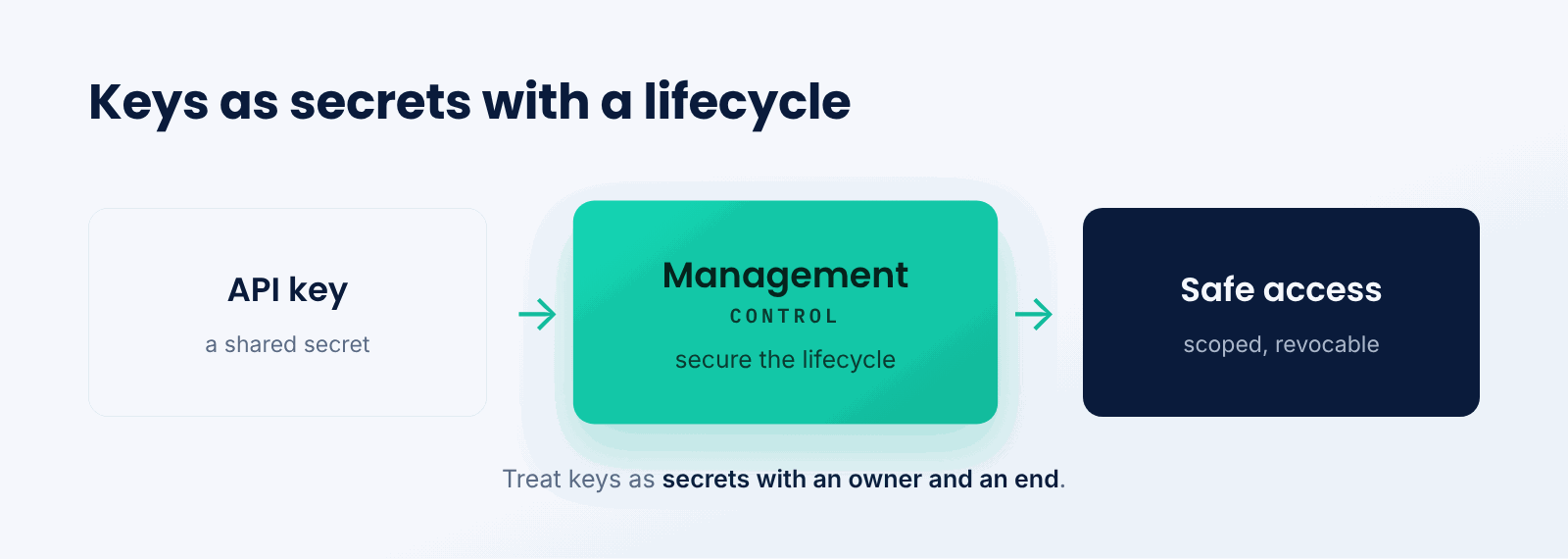
Think of an API key like a physical key to a building. You would not leave copies lying around, give everyone the master, or keep using a key after it was lost. You would track who has which key, limit what each opens, and change the locks when one goes missing. API key management applies that same care to digital keys.
The key idea is treating keys as sensitive secrets with a lifecycle, not as static strings. Each key has an origin, a scope, an owner, and an end, and managing all of that is what keeps access under control.
How does API key management work?
Keys move through a lifecycle, and management applies controls at each stage.
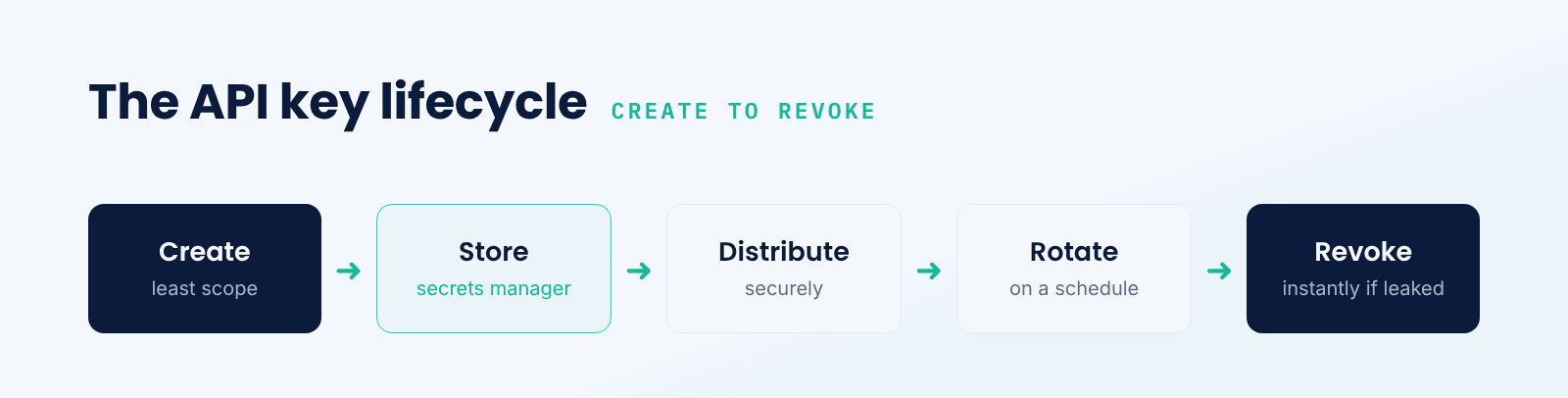
- Create. A key is generated with the minimum scope and permissions it needs.
- Store. The key is kept in a secrets manager, never in code or plain config.
- Distribute. It is delivered securely to the systems that need it, not shared casually.
- Rotate. Keys are replaced on a schedule so an old leaked key stops working.
- Revoke. A compromised or unused key is disabled immediately to cut off access.
The two stages people most often skip are rotation and revocation, and they are the ones that contain damage. A key that is rotated regularly and can be revoked instantly limits how much a leak can cost you.
Secure storage vs. scoping vs. rotation
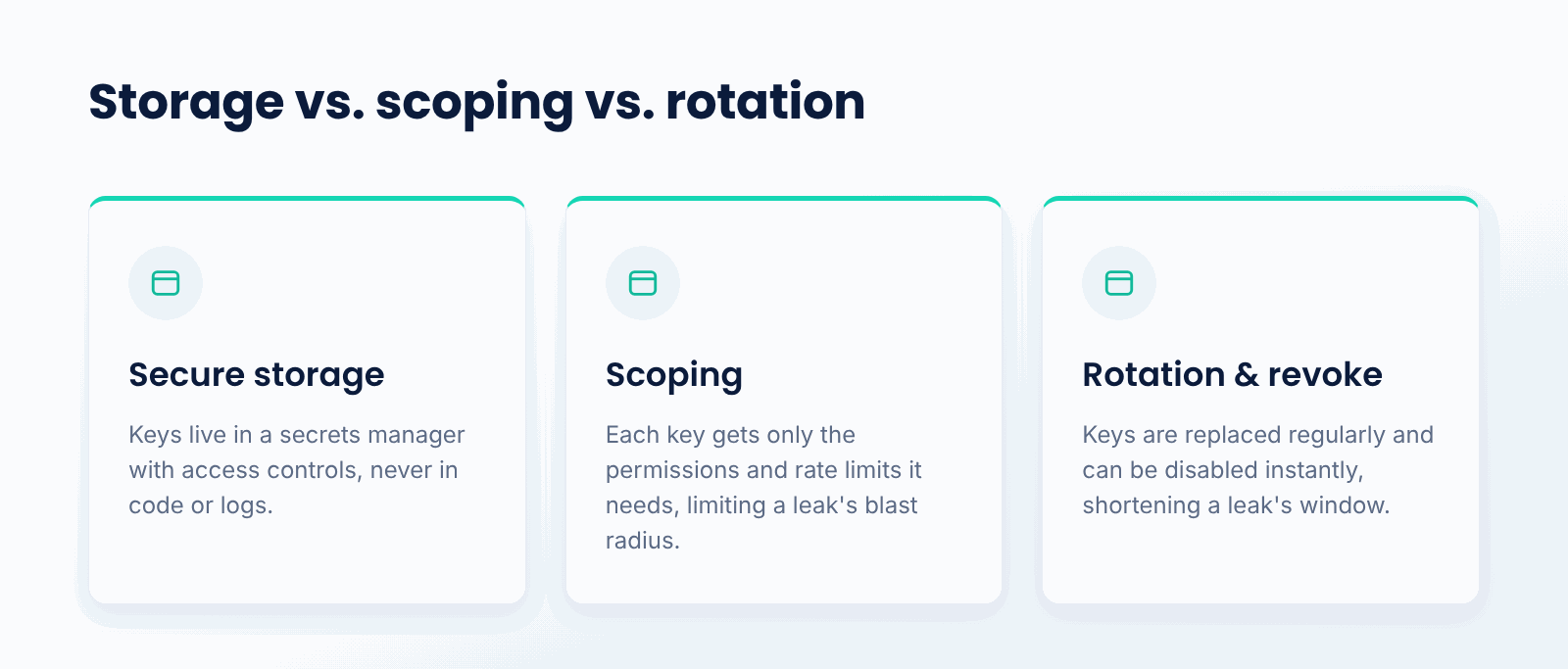
Three practices do most of the work. Secure storage keeps keys in a dedicated secrets manager with access controls, so they are never exposed in code or logs. Scoping and least privilege give each key only the permissions and rate limits it needs, so a leak cannot do everything. Rotation and revocation replace keys regularly and allow instant disabling, so a compromised key has a short, controllable window.
They reinforce each other. Storage reduces the chance of a leak, scoping limits the blast radius if one happens, and rotation plus revocation shortens how long a leaked key is useful. Together they turn key security from hope into control.
Why does API key management matter?
- Prevents leaks. Proper storage keeps keys out of code and logs where they get exposed.
- Limits damage. Scoping and rate limits cap what a compromised key can do.
- Controls cost. For AI APIs, a leaked key can run up large bills fast.
- Enables revocation. You can cut off a compromised key without redeploying everything.
- Supports compliance. Managed keys with audit trails meet security requirements.
What are the challenges?
- Sprawl. Many keys across many services and providers are hard to track.
- Hard-coding. Keys end up in repos or config despite best intentions.
- Rotation friction. Changing keys without downtime takes planning.
- Visibility. Knowing which key is used where, and by whom, is not automatic.
When do you need API key management?
You need it as soon as your application uses any API key, which is nearly always, and it becomes critical once you have multiple keys, multiple services, or keys that access paid or sensitive resources. For AI applications calling several model providers, disciplined key management is essential.
A single throwaway key in a personal experiment needs little ceremony. But anything in production, handling real cost or data, needs keys that are stored securely, scoped tightly, and revocable on demand.
Best practices for API key management
- Never hard-code keys; store them in a dedicated secrets manager.
- Give each key the least scope and lowest rate limits it needs.
- Rotate keys on a regular schedule and after any suspected exposure.
- Make revocation fast so a compromised key can be killed instantly.
- Monitor key usage to spot anomalies and unexpected spending.
- Use a gateway so keys to many providers are managed and rotated in one place.
Conclusion
API key management is the secure handling of API keys across their whole lifecycle, creating, storing, distributing, rotating, and revoking them. By keeping keys out of code, scoping them tightly, and making them rotatable and revocable, it limits the damage any single leak can do. For AI applications where a leaked key means both data exposure and runaway cost, disciplined key management is a core security practice.
TrueFoundry's AI Gateway lets teams manage API keys to many model providers centrally, with scoping, rotation, and usage monitoring in one place, so applications never hold raw provider keys. As AI usage spreads across providers, central key management is how teams keep that access secure and controllable.
Govern, Deploy and Trace AI in Your Own Infrastructure
Frequently Asked Questions
What is API key management in simple terms?
It handles the secret keys your applications use to call APIs, safely across their whole lifecycle: creating them, storing them securely, rotating them regularly, and revoking them when needed, so they do not leak or get misused.
Why should API keys not be hard-coded?
Because keys written into code end up in repositories, logs, and shared files where they get exposed. A leaked key lets anyone call the API as you. Keys belong in a secrets manager, injected at runtime, never written into code.
What is key rotation?
Rotation is replacing keys with new ones on a regular schedule. It means that even if an old key leaked without your knowledge, it stops working after rotation, limiting how long any compromised key stays useful.
Why does API key management matter for AI apps?
Because AI APIs are metered and can be expensive, a leaked key can run up large bills quickly, as well as expose data. Managing keys tightly, with scoping and fast revocation, limits both the cost and the exposure.
How does a gateway help with key management?
A gateway holds the provider keys centrally and gives applications their own scoped access instead. Keys can be rotated, revoked, and monitored in one place, so individual apps never hold raw provider keys and access stays controllable.


- © 2022 ENSEMBLE Technologies



اشترك في نشرتنا الإخبارية
أحدث الأخبار والمقالات والموارد تصلك مباشرة إلى بريدك الوارد


