

Prerequisites for Installation
- Kubernetes Cluster: K8s cluster 1.27+.
- Dynamic Storage Provisioning: Support for dynamic PVC provisioning using block volumes (e.g., AWS EBS, Azure Disk, GCP Persistent Disk, Longhorn, OpenEBS).
-
Domain to map the ingress of the AI Gateway along with certificate for the domain. (also any ingress controller or istio gateway you are using)
This Domain will be referred as Gateway Endpoint Host in our documentation.
- TrueFoundry SaaS Account: Sign up and create a new tenant on TrueFoundry SaaS by logging in to TrueFoundry. You will receive an invitation on your email to verify your email and login.
While signing up, you will sign up by entering your company name. This company name will be used as the tenant name. Your control plane URL will be
https://<YOUR_COMPANY_NAME>.truefoundry.cloud. If your company name is example-company, then your control plane URL will be https://example-company.truefoundry.cloud.- Egress access to TrueFoundry SaaS:
- Control Plane:
https://<CONTROL_PLANE_URL>(for example,https://example-company.truefoundry.cloud)
- Control Plane:
- Image Pull Secret: Image pull secret from TrueFoundry team to enable pulling the truefoundry images from the private registry.
Installation Instructions
1
Create Gateway Endpoint in TrueFoundry SaaS
Create an entry for Gateway Endpoints by logging into the TrueFoundry SaaS platform.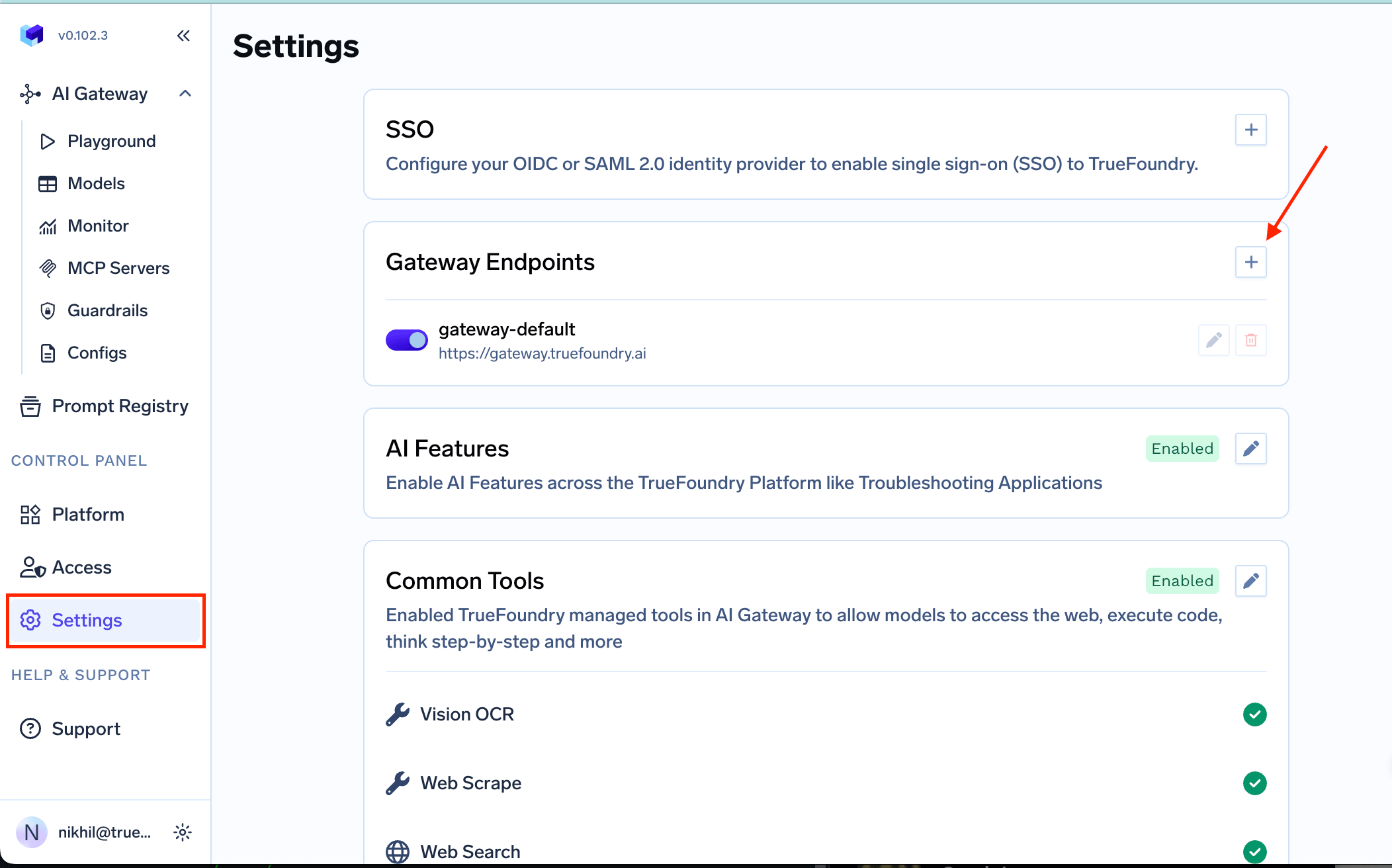
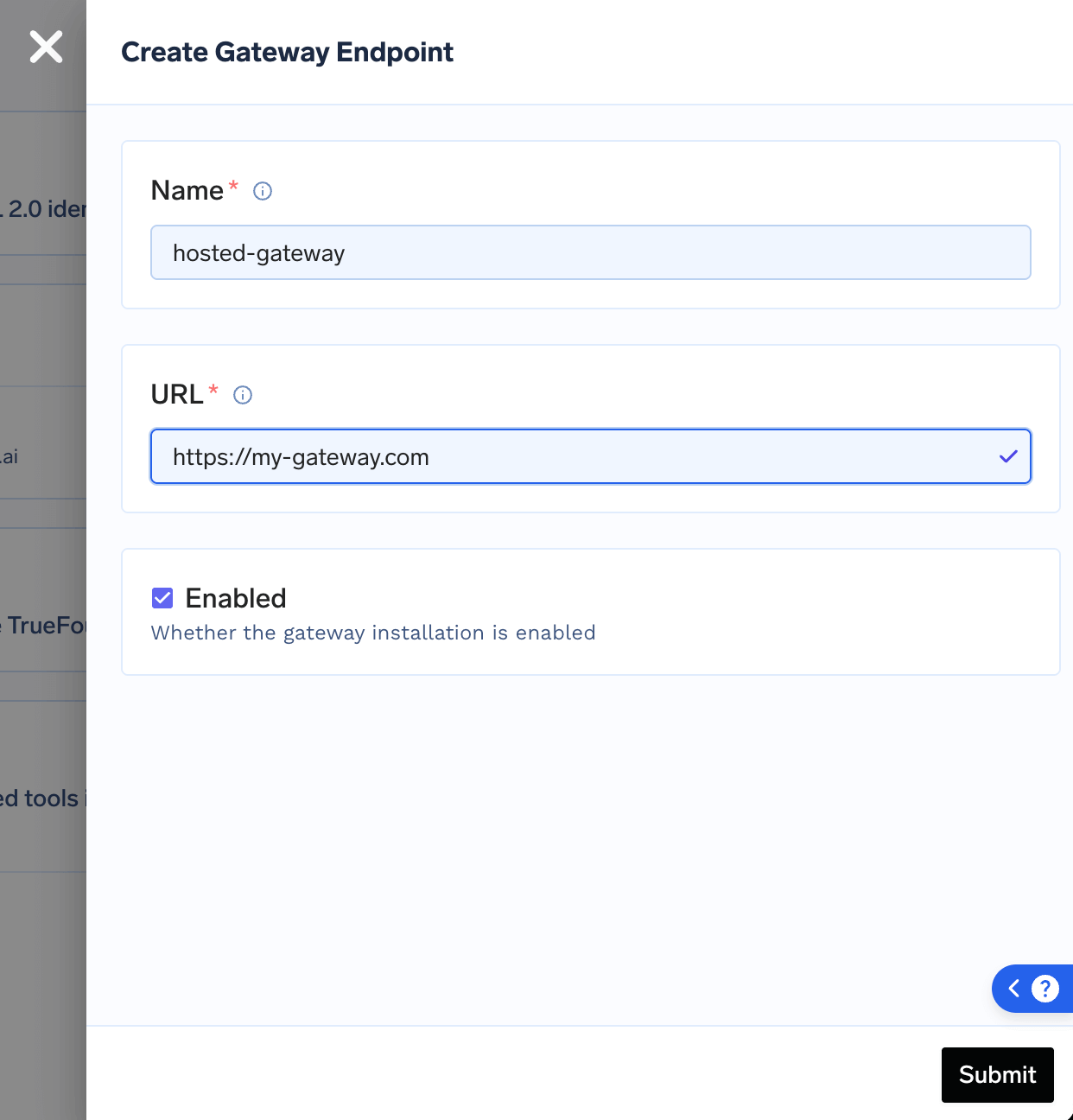
- Navigate to Settings -> Gateway Endpoints
- Create a new gateway endpoint with a unique name
- Enter the URL where you will be deploying your gateway
The AI Gateway installation name you provide here will be used in the next step to generate the
GatewayToken.2
Generate the AI GatewayToken
The
GatewayToken is used by the AI Gateway service running in your infrastructure to authenticate with the TrueFoundry control-plane. To generate it, you need to call a control-plane API using a Personal Access Token from a user with the tenant-admin role. This is a one-time call — once you have the GatewayToken, you do not need to call this API again.Once you have the
GatewayToken, proceed to create the Kubernetes secrets needed for the AI Gateway helm chart installation.3
Create Kubernetes Secrets
We will create two secrets in this step:
- Store the
GatewayToken - Store the Image Pull Secret
Create Kubernetes Secret for GatewayToken
Create Kubernetes Secret for GatewayToken
We need to create a Kubernetes secret containing the Apply the secret to the Kubernetes cluster (Assuming you are installing the AI Gateway plane in the
GatewayToken obtained in the previous step.
The helm chart expects this token under the key name TFY_API_KEY.truefoundry-creds.yaml
truefoundry namespace)Create Kubernetes Secret for Image Pull Secret
Create Kubernetes Secret for Image Pull Secret
We need to create a Image Pull Secret to enable pulling the truefoundry images from the private registry.Apply the secret to the Kubernetes cluster (Assuming you are installing the AI Gateway plane in the
truefoundry-image-pull-secret.yaml
truefoundry namespace)4
Create Helm Chart Values file
Create a values file as given below and replace the following values:You can find full list of supported values here.
- CONTROL_PLANE_URL: Your control plane URL in the format
company-name.truefoundry.cloud(without thehttps://prefix). For example, if your company name isexample-company, then useexample-company.truefoundry.cloud. - TENANT_NAME: The tenant name (same as the company name you used to create your account on TrueFoundry SaaS)
- GATEWAY_ENDPOINT_HOST: The domain where you will expose the AI Gateway endpoint (e.g.,
gateway.example.com)
truefoundry-values.yaml
Managed agents (opt-in, 0.162.x+)To enable TrueFoundry Managed Agents on this gateway plane, set a unique
gatewayId for this install and keep Redis enabled. Each gateway plane needs its own gatewayId. Skip this if you are not using managed agents. Leave gatewayId unset in that case.5
Install the Helm Chart
Install the TrueFoundry Helm chart using the values file created in the previous step:
6
Verify the Deployment
Verify that all pods are running:You can verify the deployment by checking the health of the AI Gateway endpoint by running the following command:A successful response indicates that the AI Gateway plane is deployed and running correctly.
Accessing the AI Gateway
You can now access the AI Gateway endpoint from the TrueFoundry SaaS UI by selecting the AI Gateway endpoint from the dropdown in Playground as shown below: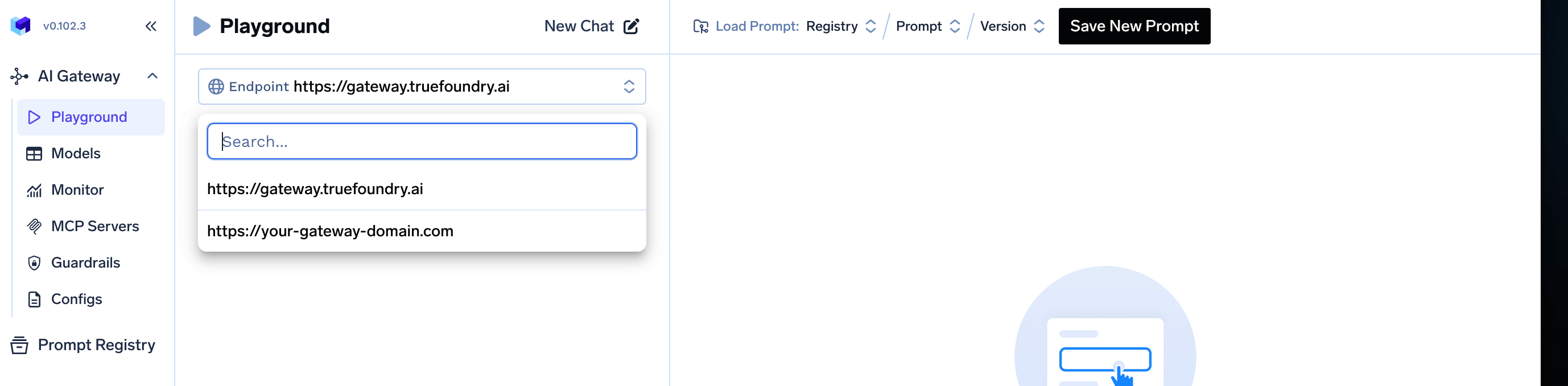
https://<GATEWAY_ENDPOINT_HOST> and can be used to make LLM inference requests through the TrueFoundry AI Gateway.
FAQ
How to use HTTPRoute to route traffic using Kubernetes Gateway API?
How to use HTTPRoute to route traffic using Kubernetes Gateway API?
The Then apply:
tfy-llm-gateway Helm chart supports the Kubernetes Gateway API as an alternative to standard Ingress resources. Use HTTPRoute when your cluster uses a Gateway API-compatible controller (e.g. Envoy Gateway, Istio, NGINX Gateway Fabric, GKE Gateway).Add the following to your truefoundry-values.yaml, setting parentRefs to point to your existing Gateway:truefoundry-values.yaml
- Only one routing method should be enabled at a time. Disable
ingress.enabledandistio.virtualservice.enabledwhen usinghttpRoute. - The
sectionNamemust match a named listener on yourGatewayresource. Omit it if your Gateway has a single unnamed listener. - TLS termination is handled by the parent
Gateway— no TLS configuration is needed on theHTTPRouteitself.
How to identity the requests coming from this Gateway in AI Monitoring?
How to identity the requests coming from this Gateway in AI Monitoring?
The Then apply:
tfy-llm-gateway Helm chart supports DEFAULT_GATEWAY_METADATA in env to add default metadata to all the AI Gateway requests helping us use these metadata as filter in AI Monitoring Request Traces and Metrics.Add the following to your truefoundry-values.yaml, setting env.DEFAULT_GATEWAY_METADATA to point to your existing Gateway:truefoundry-values.yaml