> ## Documentation Index
> Fetch the complete documentation index at: https://www.truefoundry.com/llms.txt
> Use this file to discover all available pages before exploring further.
# Sticky Routing
> Pin user requests using consistent hash based routing
Imagine a situation where a user is performing some expensive calculation in a request and wants to do so repeatedly over a bunch of API calls. Some of these expensive calculations might have some common computation that you might want to cache between requests. In such a case, you would like to route all the requests from a specific user to a specific replica.
One such example is **Prefix Caching** with model servers like [vLLM](https://docs.vllm.ai/en/stable/automatic_prefix_caching/apc.html) and [SGLang](https://lmsys.org/blog/2024-01-17-sglang/#backend-automatic-kv-cache-reuse-with-radixattention) where generating the next reply in a converstation can benefit from the cached computation of the conversation history so far and result in significantly lower latencies.
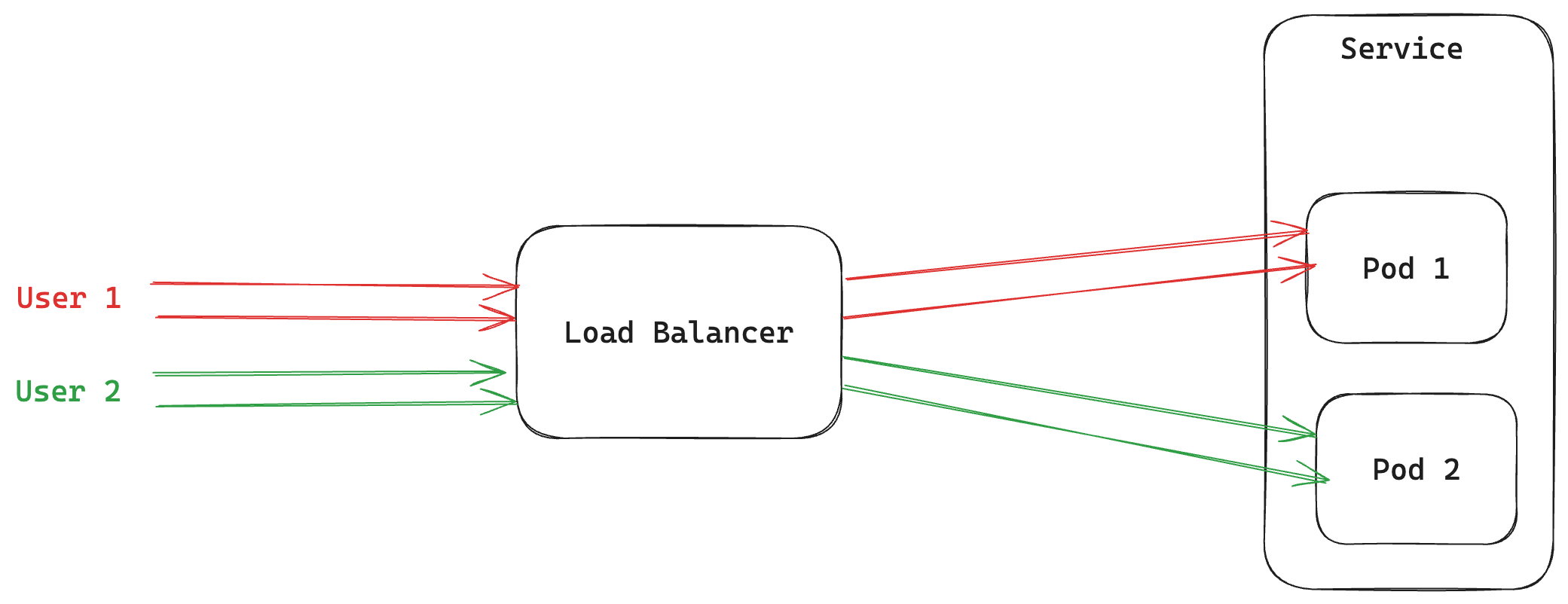 User 1's requests are always routed to Pod 1 while User 2's requests are always routed to Pod 2
### Pods can be transitory and sticky routing is best-effort basis
It is important to remember that Kubernetes pods and nodes can be short lived and can be re-scheduled due to external events. It is not advised to put any critical stateful logic in Services.
Considering this, sticky routing is best effort basis. In the event of a pinned pod getting deleted / evicted, all sessions pinned to that pod will be re-assigned randomly to other pods. Similarly, in the event of a scale up or scale down, the sessions **might** be re-assigned to evenly distribute the load.
## Enabling Sticky Routing
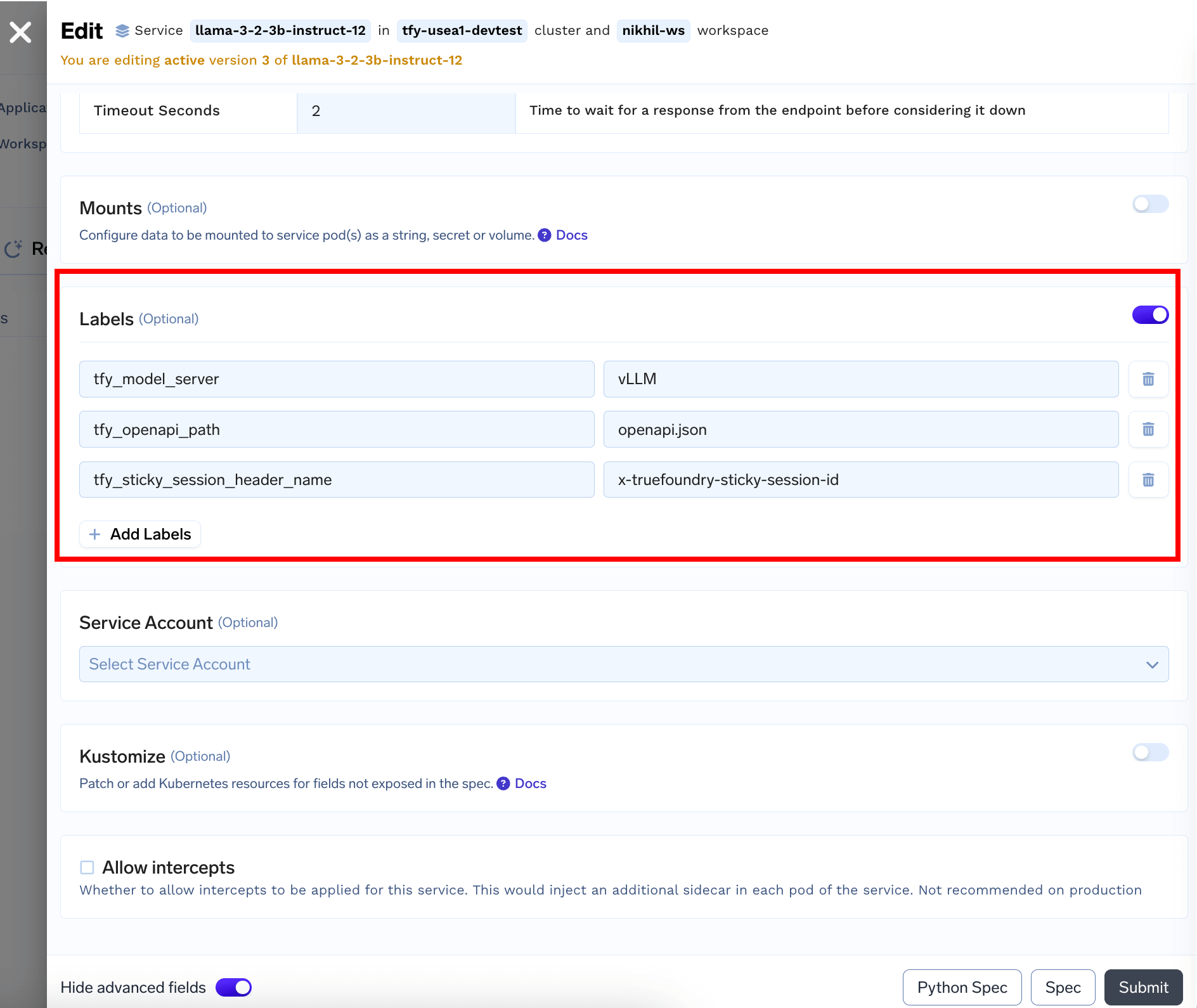
To enable sticky routing, first in the Service `labels` section add a `special` label `tfy_sticky_session_header_name`and add a header name against it. For e.g. `x-truefoundry-sticky-session-id`
User 1's requests are always routed to Pod 1 while User 2's requests are always routed to Pod 2
### Pods can be transitory and sticky routing is best-effort basis
It is important to remember that Kubernetes pods and nodes can be short lived and can be re-scheduled due to external events. It is not advised to put any critical stateful logic in Services.
Considering this, sticky routing is best effort basis. In the event of a pinned pod getting deleted / evicted, all sessions pinned to that pod will be re-assigned randomly to other pods. Similarly, in the event of a scale up or scale down, the sessions **might** be re-assigned to evenly distribute the load.
## Enabling Sticky Routing
To enable sticky routing, first in the Service `labels` section add a `special` label `tfy_sticky_session_header_name`and add a header name against it. For e.g. `x-truefoundry-sticky-session-id`
 ### Passing the header when making requests
Now, your clients can send this header with a unique value for a "session". For e.g. this value can be a conversation id or user id, anything that identifies a unique session that can benefit from stickyness.
For e.g.
```swift cURL lines theme={"dark"}
curl -X POST https://my-service.example.com/v1/chat/completions \
-H 'Content-Type: application/json' \
-H 'x-truefoundry-sticky-session-id: session-id-qnfjk' \
-d '{"messages": [{"role": "user", "content": "Hi"}]}'
```
```python Python lines theme={"dark"}
import requests
response = requests.post(
"https://my-service.example.com/v1/chat/completions",
headers={"x-truefoundry-sticky-session-id": "session-id-qnfjk"},
json={"messages": [{"role": "user", "content": "Hi"}]}
}
response.raise_for_status()
print(response.json())
```
```python OpenAI SDK lines theme={"dark"}
from openai import OpenAI
client = OpenAI(
base_url="https://my-service.example.com/v1",
api_key="",
default_headers={"x-truefoundry-sticky-session-id": "session-id-qnfjk"},
)
```
After the first request, any request that has header `x-truefoundry-sticky-session-id: session-id-qnfjk` will be routed to the same pod the first request was routed to.
### What happens if header is not added?
The request will be routed according to default load balancing policy (random / round robin / least load)
***
### Passing the header when making requests
Now, your clients can send this header with a unique value for a "session". For e.g. this value can be a conversation id or user id, anything that identifies a unique session that can benefit from stickyness.
For e.g.
```swift cURL lines theme={"dark"}
curl -X POST https://my-service.example.com/v1/chat/completions \
-H 'Content-Type: application/json' \
-H 'x-truefoundry-sticky-session-id: session-id-qnfjk' \
-d '{"messages": [{"role": "user", "content": "Hi"}]}'
```
```python Python lines theme={"dark"}
import requests
response = requests.post(
"https://my-service.example.com/v1/chat/completions",
headers={"x-truefoundry-sticky-session-id": "session-id-qnfjk"},
json={"messages": [{"role": "user", "content": "Hi"}]}
}
response.raise_for_status()
print(response.json())
```
```python OpenAI SDK lines theme={"dark"}
from openai import OpenAI
client = OpenAI(
base_url="https://my-service.example.com/v1",
api_key="",
default_headers={"x-truefoundry-sticky-session-id": "session-id-qnfjk"},
)
```
After the first request, any request that has header `x-truefoundry-sticky-session-id: session-id-qnfjk` will be routed to the same pod the first request was routed to.
### What happens if header is not added?
The request will be routed according to default load balancing policy (random / round robin / least load)
***