> ## Documentation Index
> Fetch the complete documentation index at: https://www.truefoundry.com/llms.txt
> Use this file to discover all available pages before exploring further.
# Set up Microsoft 365 MCP Server
> Add TrueFoundry's managed Microsoft 365 MCP server so agents can read and send Outlook email, manage Calendar events, browse OneDrive, query SharePoint, and interact with Teams, all through governed, per-user OAuth access.
[Microsoft 365](https://www.microsoft.com/microsoft-365) is a productivity suite spanning Outlook, Calendar, OneDrive, SharePoint, and Teams. TrueFoundry provisions it as a [TrueFoundry Managed MCP](/docs/ai-gateway/mcp/tfy-managed-mcp-server) - the platform manages the server URL, auth, scopes and credentials, so your agents can use Microsoft 365 without any configuration or infrastructure setup on your end.
TrueFoundry hosts its own Microsoft 365 MCP server that acts as a **stateless proxy** between the TrueFoundry MCP Gateway and the Microsoft Graph API. Unlike Slack or GitHub, Microsoft does not provide a single public MCP endpoint. TrueFoundry deploys and maintains this server on your behalf.
## Using Microsoft 365 through the MCP Gateway
The [TrueFoundry MCP Gateway](/docs/ai-gateway/mcp/mcp-overview) centralizes access to Microsoft 365 - agents connect through one endpoint instead of maintaining separate server configurations per client. As a [TrueFoundry Managed MCP](/docs/ai-gateway/mcp/tfy-managed-mcp-server), Microsoft 365's URL, outbound auth, scopes, and credentials are owned and kept current by the platform.
When you use Microsoft 365 MCP server through the Gateway, TrueFoundry provides:
* **Authentication** — Clients [authenticate inbound](/docs/ai-gateway/mcp/mcp-gateway-auth-security#inbound-authentication) to the Gateway with a Personal Access Token, Virtual Account, or IDE OAuth flow. For outbound access, each user authorizes their own Microsoft 365 account via the [OAuth2 Authorization Code flow](/docs/ai-gateway/mcp/mcp-gateway-auth-security#outbound-authentication) with PKCE.
* **Access control** — [Collaborators and role-based policies](/docs/ai-gateway/mcp/mcp-gateway-auth-security#access-control) define who can use the server and which tools they can invoke. Enable or disable individual Microsoft 365 tools from the server detail page.
* **Observability** — Tool calls are traced with caller identity, tool name, inputs, and latency. Monitor server- and tool-level usage in [MCP Metrics](/docs/ai-gateway/analytics-mcp-metrics) and export traces to your observability stack via OpenTelemetry.
* **Guardrails** — Apply [pre-tool and post-tool guardrails](/docs/ai-gateway/guardrails-overview) on MCP tool calls. Pre-tool checks run before execution and can block the call; post-tool checks run on the response before it returns to the agent.
## Prerequisites
* A TrueFoundry account with permission to add MCP servers.
* A Microsoft account, either a **work or school (organization)** account or a **personal** account (`@outlook.com`, `@hotmail.com`, `@live.com`). See [Account type support](#account-type-support) below for the differences.
* For organization accounts, a Microsoft Entra ID **Global Administrator** to grant one-time tenant-wide admin consent, if your tenant restricts third-party apps. You do **not** need to register your own Azure app; TrueFoundry's managed multi-tenant app is used.
### Account type support
The available tools depend on the type of Microsoft account you connect:
| Account type | Supported tools |
| ---------------------------------------------------------- | --------------------------------------------------------------------------------------- |
| **Organization** (work or school) | All tools, including **Teams** and **SharePoint** |
| **Personal** (`@outlook.com`, `@hotmail.com`, `@live.com`) | All tools **except Teams and SharePoint**, which are not available on personal accounts |
## Adding Microsoft 365 MCP server to TrueFoundry
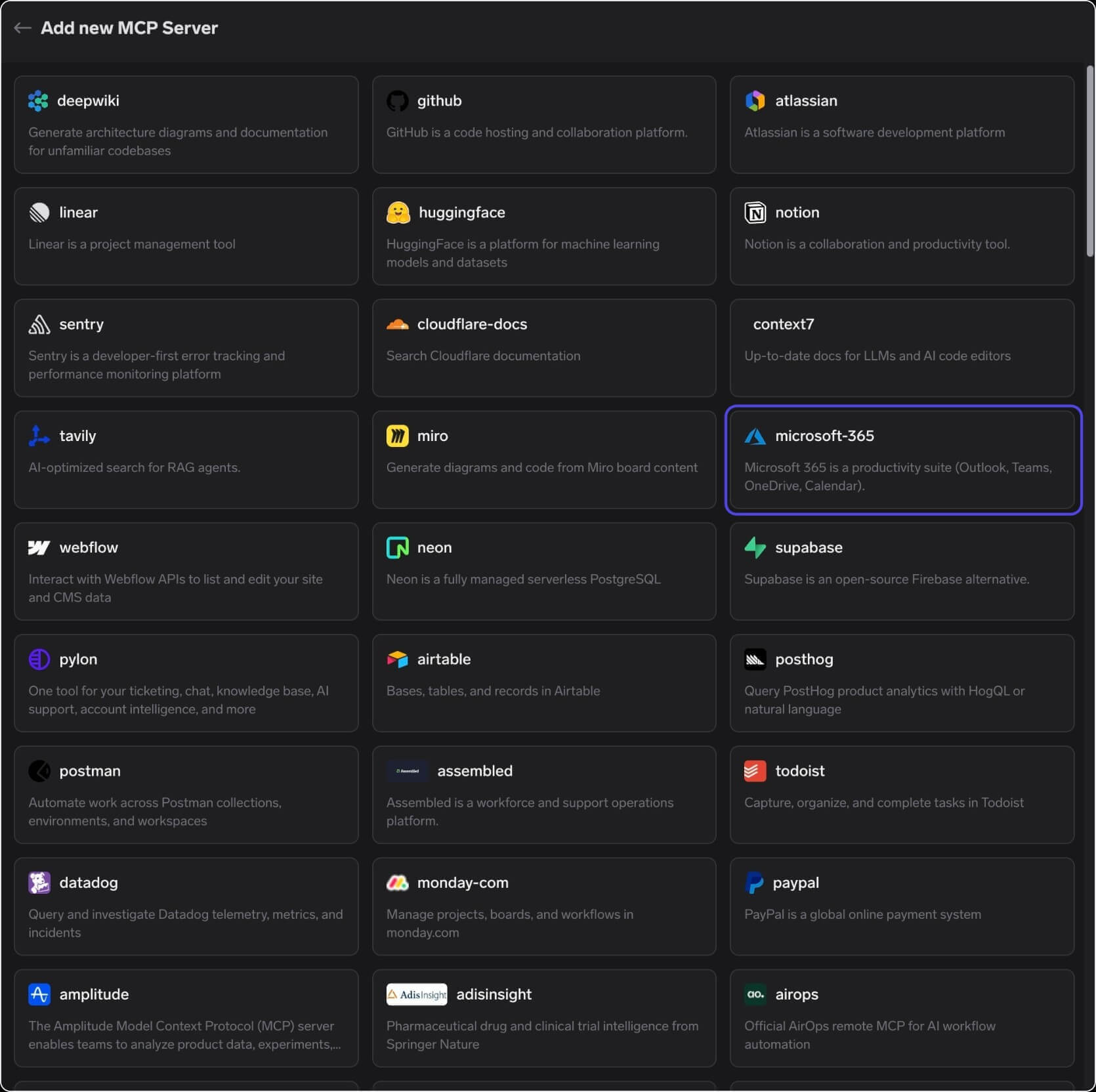
Navigate to **MCP Servers** in the TrueFoundry sidebar and click **Add new MCP Server**. On the next screen, select **Connect TrueFoundry Managed MCPs** - this opens the catalog of pre-vetted, fully configured MCP servers managed by TrueFoundry.
Find the **microsoft-365** card in the catalogue (described as "Microsoft 365 is a productivity suite (Outlook, Teams, OneDrive, Calendar).") and click **+ Add**. TrueFoundry provisions the server with all URLs, OAuth configuration, and scopes already set, and opens the microsoft-365 MCP server detail page.
 On the server's **Tools** tab, click **Connect Now**. A "Connect via TrueFoundry Gateway" popup appears showing the MCP Gateway URL and redirect URL. Sign in with your Microsoft 365 work or school account and approve the requested permissions to complete the OAuth 2.0 flow.
If your tenant requires admin consent, a Microsoft Entra Global Administrator must approve the app once for the tenant. After that, individual users can connect with their own accounts. The authorization is between your account and Microsoft directly.
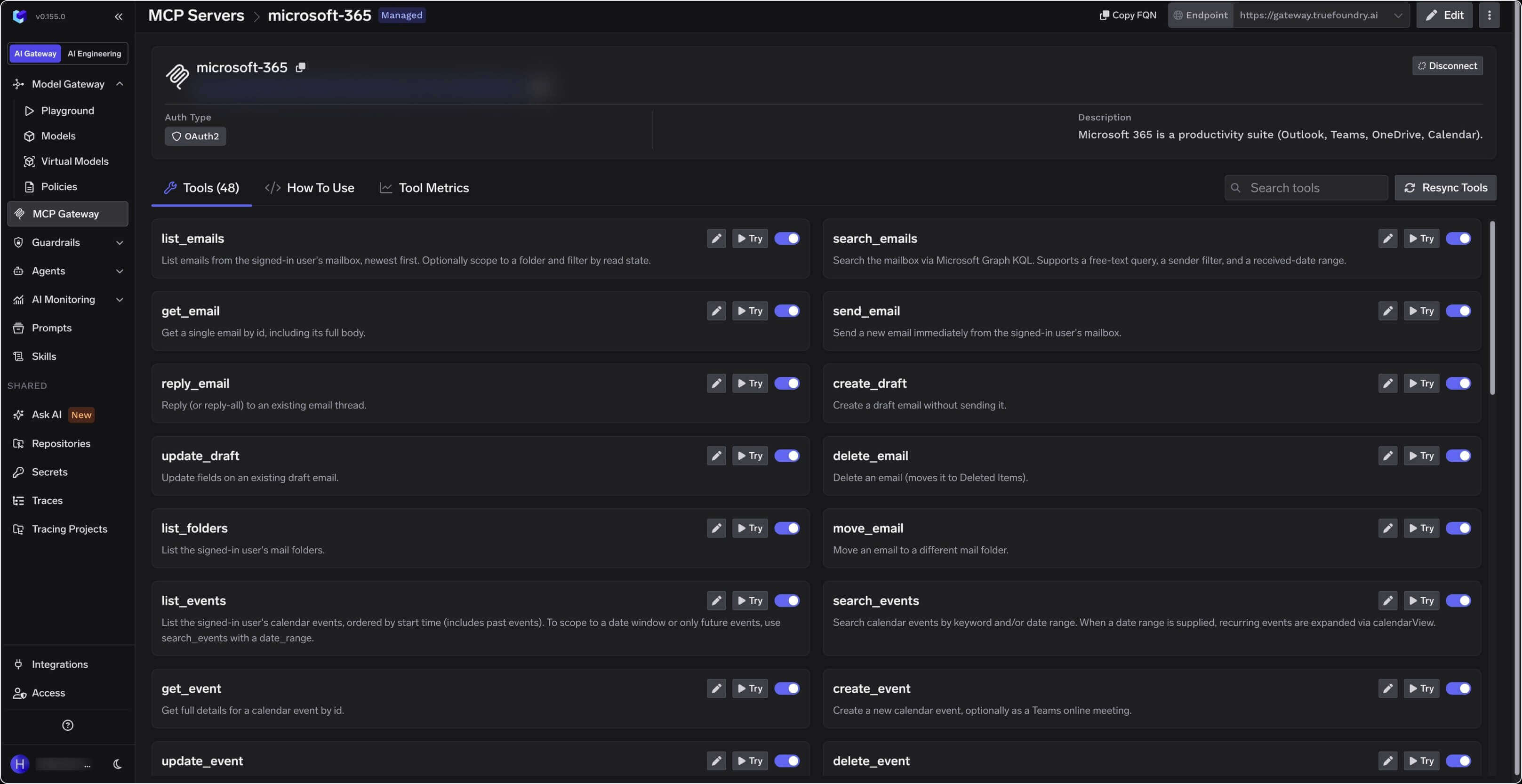
After connecting, the **Tools** tab lists the Microsoft 365 tools across Outlook email, Calendar, OneDrive, SharePoint, and Teams. Click **Try** on any tool to test it and inspect the JSON output before using it in an agent. The **Auth Type** shows `OAuth2`.
On the server's **Tools** tab, click **Connect Now**. A "Connect via TrueFoundry Gateway" popup appears showing the MCP Gateway URL and redirect URL. Sign in with your Microsoft 365 work or school account and approve the requested permissions to complete the OAuth 2.0 flow.
If your tenant requires admin consent, a Microsoft Entra Global Administrator must approve the app once for the tenant. After that, individual users can connect with their own accounts. The authorization is between your account and Microsoft directly.
After connecting, the **Tools** tab lists the Microsoft 365 tools across Outlook email, Calendar, OneDrive, SharePoint, and Teams. Click **Try** on any tool to test it and inspect the JSON output before using it in an agent. The **Auth Type** shows `OAuth2`.
 ## Connecting to an MCP Client
Open the **How To Use** tab on the microsoft-365 server detail page for your tenant-specific Gateway URL and ready-to-paste client snippets - don't build the endpoint manually.
The tab includes snippets for Claude Code, VS Code, Claude Web, Claude Desktop, Cursor, Windsurf, Codex, and the Python and TypeScript MCP SDKs. Use **Show API Key** if your client requires a Gateway token in a header.
## Using the Tool Playground
Before deploying an agent, you can test any Microsoft 365 MCP server tool directly in TrueFoundry:
On the microsoft-365 MCP server detail page, click **Try** next to any tool - for example a read-only Calendar tool like `list_calendar_events`.
Provide the tool's inputs. For a calendar listing, this is typically a date or time range; for a mail search, a query or folder.
Click **Execute Tool** and inspect the JSON output in the right panel.
You can also attach the Microsoft 365 MCP server directly to an agent from **AI Engineering → Agents**: create or open an agent, add `microsoft-365` under **MCP Servers** (choosing **All tools** or a subset), and send a prompt like *"Summarize my unread emails from this week and list my meetings for tomorrow."* The agent calls the relevant Outlook and Calendar tools on your behalf.
## Tool Metrics
The **Tool Metrics** tab on the microsoft-365 server detail page tracks how agents use each tool:
* **Invocation count** - which tools are called most often
* **Latency** - how long each tool takes to respond
* **Error rates** - which tools are failing in production
See [MCP Metrics](/docs/ai-gateway/analytics-mcp-metrics) for server- and tool-level dashboards across your Gateway.
## Disabling Individual Tools
On the **Tools** tab, toggle off any Microsoft 365 tools your agents don't need:
* **Disabled tools** are hidden from MCP clients and cannot be invoked.
* **Enabled tools** remain available to agents as usual.
For example, disable `send_email` or `delete_email` to keep an agent read-only.
## Connecting to an MCP Client
Open the **How To Use** tab on the microsoft-365 server detail page for your tenant-specific Gateway URL and ready-to-paste client snippets - don't build the endpoint manually.
The tab includes snippets for Claude Code, VS Code, Claude Web, Claude Desktop, Cursor, Windsurf, Codex, and the Python and TypeScript MCP SDKs. Use **Show API Key** if your client requires a Gateway token in a header.
## Using the Tool Playground
Before deploying an agent, you can test any Microsoft 365 MCP server tool directly in TrueFoundry:
On the microsoft-365 MCP server detail page, click **Try** next to any tool - for example a read-only Calendar tool like `list_calendar_events`.
Provide the tool's inputs. For a calendar listing, this is typically a date or time range; for a mail search, a query or folder.
Click **Execute Tool** and inspect the JSON output in the right panel.
You can also attach the Microsoft 365 MCP server directly to an agent from **AI Engineering → Agents**: create or open an agent, add `microsoft-365` under **MCP Servers** (choosing **All tools** or a subset), and send a prompt like *"Summarize my unread emails from this week and list my meetings for tomorrow."* The agent calls the relevant Outlook and Calendar tools on your behalf.
## Tool Metrics
The **Tool Metrics** tab on the microsoft-365 server detail page tracks how agents use each tool:
* **Invocation count** - which tools are called most often
* **Latency** - how long each tool takes to respond
* **Error rates** - which tools are failing in production
See [MCP Metrics](/docs/ai-gateway/analytics-mcp-metrics) for server- and tool-level dashboards across your Gateway.
## Disabling Individual Tools
On the **Tools** tab, toggle off any Microsoft 365 tools your agents don't need:
* **Disabled tools** are hidden from MCP clients and cannot be invoked.
* **Enabled tools** remain available to agents as usual.
For example, disable `send_email` or `delete_email` to keep an agent read-only.