> ## Documentation Index
> Fetch the complete documentation index at: https://www.truefoundry.com/llms.txt
> Use this file to discover all available pages before exploring further.
# Set up Firecrawl MCP Server
> Connect Firecrawl, a web scraping platform, as a remote MCP server on the TrueFoundry MCP Gateway so agents can scrape, crawl, map, and extract web content.
[Firecrawl](https://www.firecrawl.dev) is a web scraping platform that turns websites into clean, structured, LLM-ready data. Register its official remote MCP server on the TrueFoundry MCP Gateway so your agents can scrape, crawl, map, search, and extract web content through governed access.
## Using Firecrawl through the MCP Gateway
The [TrueFoundry MCP Gateway](/docs/ai-gateway/mcp/mcp-overview) centralizes access to Firecrawl - agents connect through one endpoint instead of maintaining separate server configurations per client.
When you use Firecrawl MCP server through the AI Gateway, TrueFoundry provides:
* **Authentication** — Clients [authenticate inbound](/docs/ai-gateway/mcp/mcp-gateway-auth-security#inbound-authentication) to the AI Gateway with a Personal Access Token, Virtual Account, or IDE OAuth flow. For outbound access, the AI Gateway injects the configured Firecrawl API key on requests.
* **Tool-level access control** — You can selectively enable or disable individual Firecrawl tools from the TrueFoundry UI.
* **Access control** — [Collaborators and role-based policies](/docs/ai-gateway/mcp/mcp-gateway-auth-security#access-control) define who can use the server and which tools they can invoke. Enable or disable individual Firecrawl tools from the server detail page.
* **Observability** — Tool calls are traced with caller identity, tool name, inputs, and latency. Monitor server- and tool-level usage in [MCP Metrics](/docs/ai-gateway/analytics-mcp-metrics) and export traces to your observability stack via OpenTelemetry.
* **Guardrails** — Apply [pre-tool and post-tool guardrails](/docs/ai-gateway/guardrails-overview) on MCP tool calls.
## Prerequisites
* A TrueFoundry account with permission to add MCP servers.
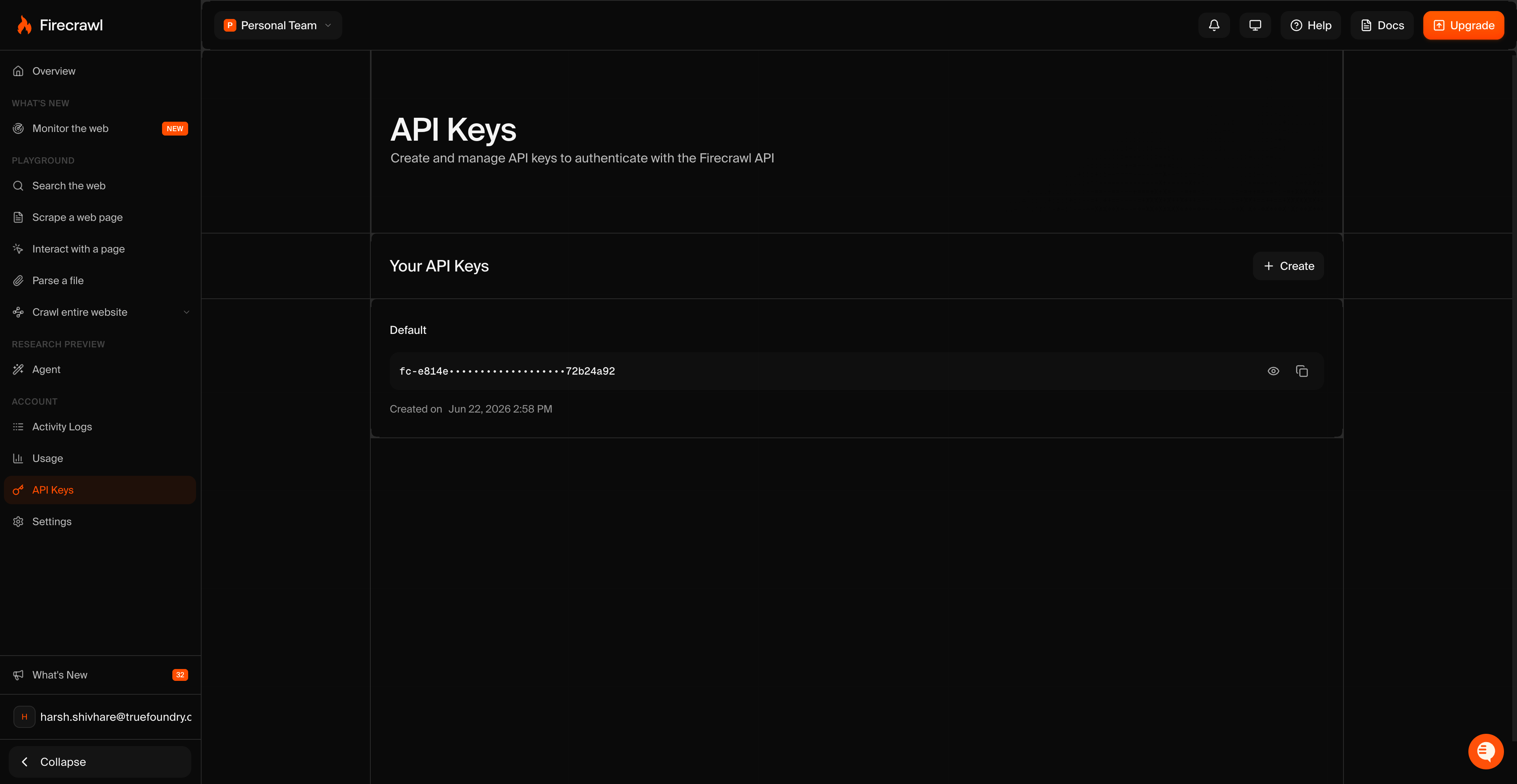
* A Firecrawl API key. Sign in at [firecrawl.dev](https://www.firecrawl.dev), open the **API Keys** page from the dashboard, and copy your key (it looks like `fc-xxxxxxxx`). Use **Create** to generate a new key if you don't have one yet.
 ## Adding Firecrawl MCP server to TrueFoundry
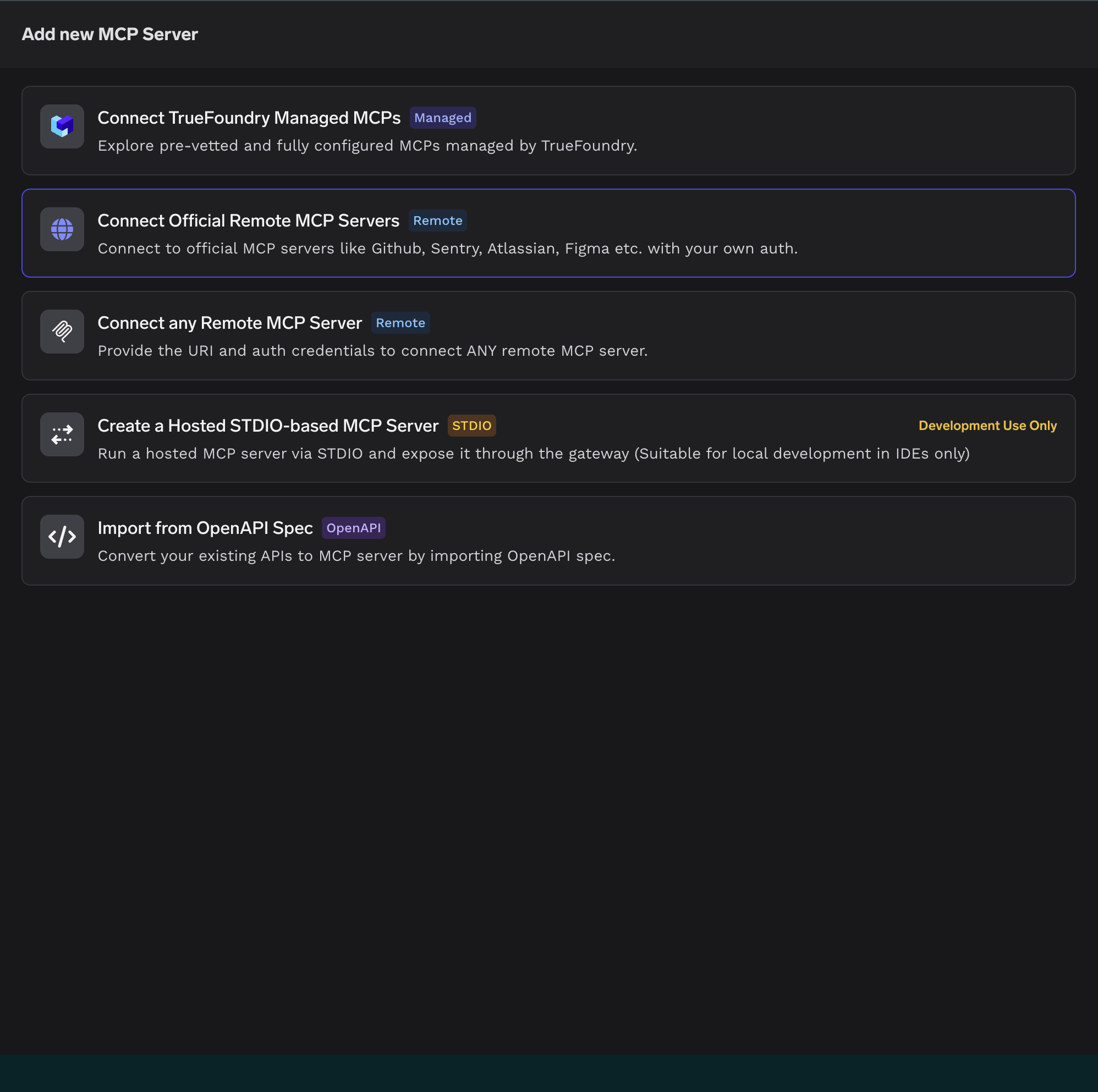
Navigate to **MCP Servers** in the TrueFoundry sidebar and click **Add new MCP Server**. On the next screen, select **Connect Official Remote MCP Servers** - this lists official, vetted remote MCP servers that you connect with your own auth.
## Adding Firecrawl MCP server to TrueFoundry
Navigate to **MCP Servers** in the TrueFoundry sidebar and click **Add new MCP Server**. On the next screen, select **Connect Official Remote MCP Servers** - this lists official, vetted remote MCP servers that you connect with your own auth.
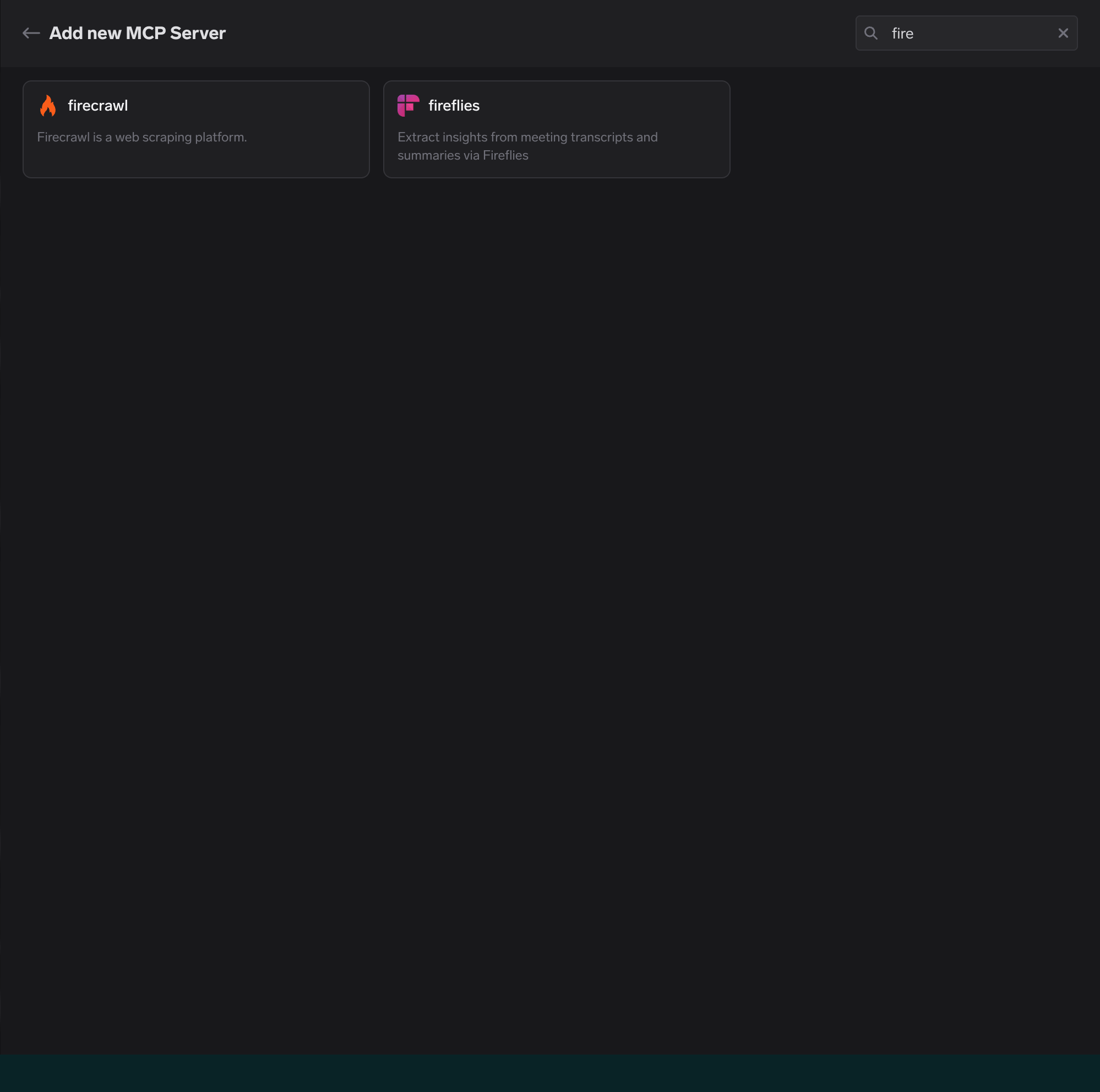
 Type `firecrawl` in the search box, find **firecrawl** in the catalogue, and click **+ Add**. TrueFoundry opens the Firecrawl MCP server detail page with the server URL pre-filled.
 TrueFoundry pre-fills the server details for Firecrawl:
| Field | Value |
| --------------- | ------------------------------------ |
| **Name** | `firecrawl` |
| **Description** | Firecrawl is a web scraping platform |
| **URL** | `https://mcp.firecrawl.dev/mcp` |
Add **Collaborators** - the users and teams that can use or manage this server - and assign each an **MCP Server Manager** or **MCP Server User** role.
TrueFoundry pre-fills the server details for Firecrawl:
| Field | Value |
| --------------- | ------------------------------------ |
| **Name** | `firecrawl` |
| **Description** | Firecrawl is a web scraping platform |
| **URL** | `https://mcp.firecrawl.dev/mcp` |
Add **Collaborators** - the users and teams that can use or manage this server - and assign each an **MCP Server Manager** or **MCP Server User** role.
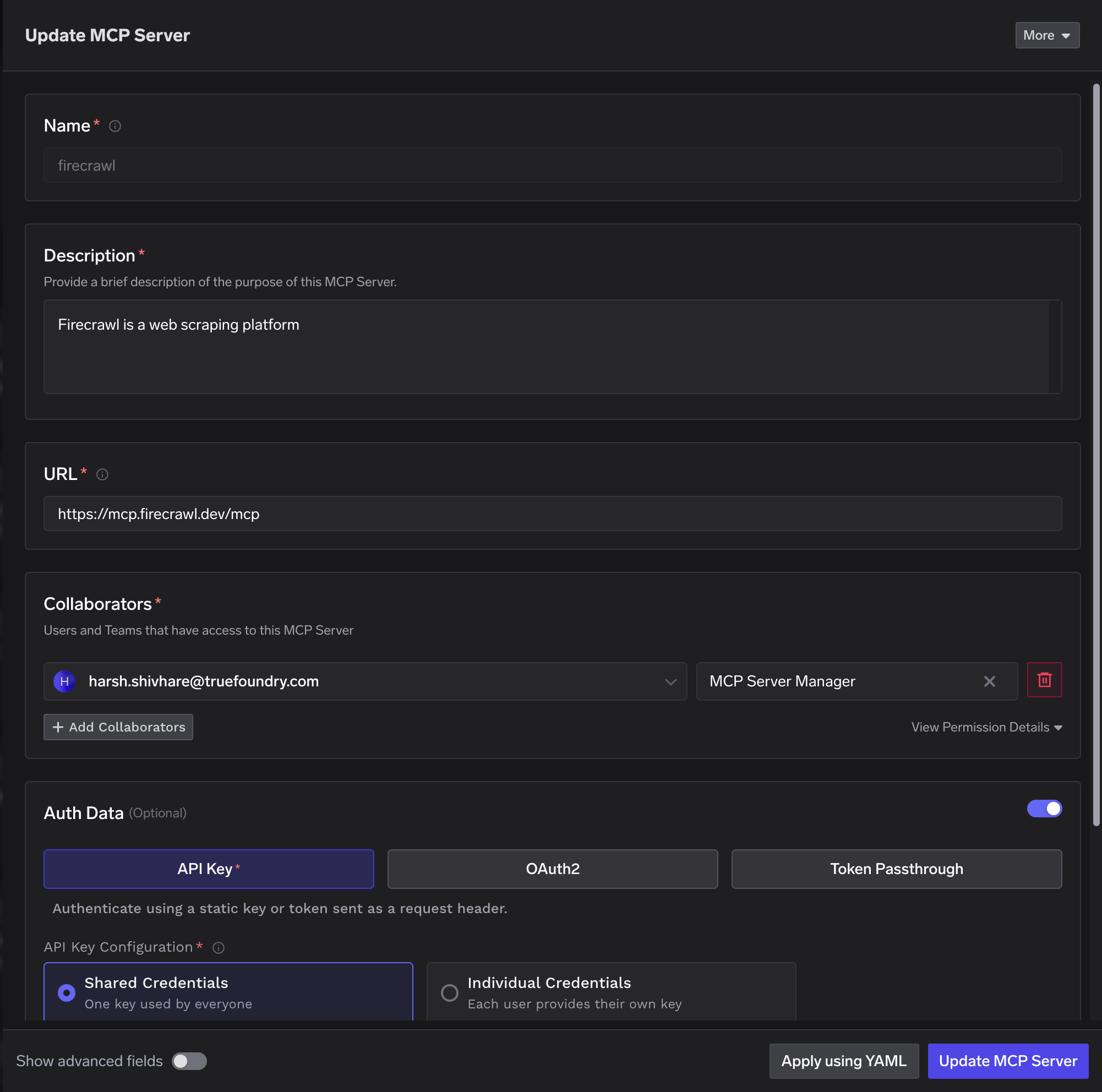 Under **Auth Data**, select **API Key**. Firecrawl authenticates with a static key sent as a request header. Choose how the key is supplied:
* **Shared Credentials** - one key used by everyone. Enter the actual header value.
* **Individual Credentials** - each user provides their own key. Use a placeholder (for example `Bearer {{API_KEY}}`) that each user fills in.
Add a header mapping the name `Authorization` to the value `Bearer fc-`, then click **Update MCP Server** to save.
Under **Auth Data**, select **API Key**. Firecrawl authenticates with a static key sent as a request header. Choose how the key is supplied:
* **Shared Credentials** - one key used by everyone. Enter the actual header value.
* **Individual Credentials** - each user provides their own key. Use a placeholder (for example `Bearer {{API_KEY}}`) that each user fills in.
Add a header mapping the name `Authorization` to the value `Bearer fc-`, then click **Update MCP Server** to save.
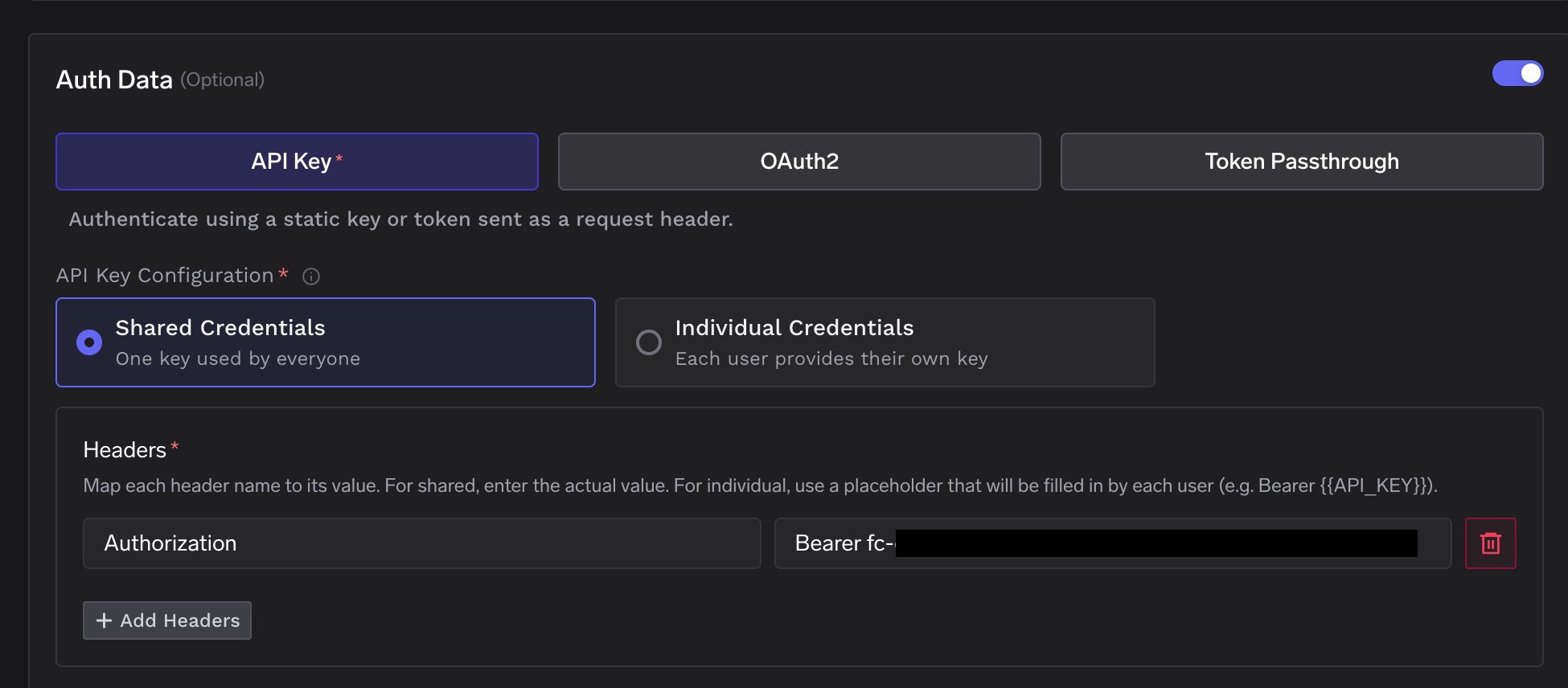 Prefer **Individual Credentials** when each user should bring their own Firecrawl key so usage and rate limits are attributed per user. Use **Shared Credentials** for a single team-wide key.
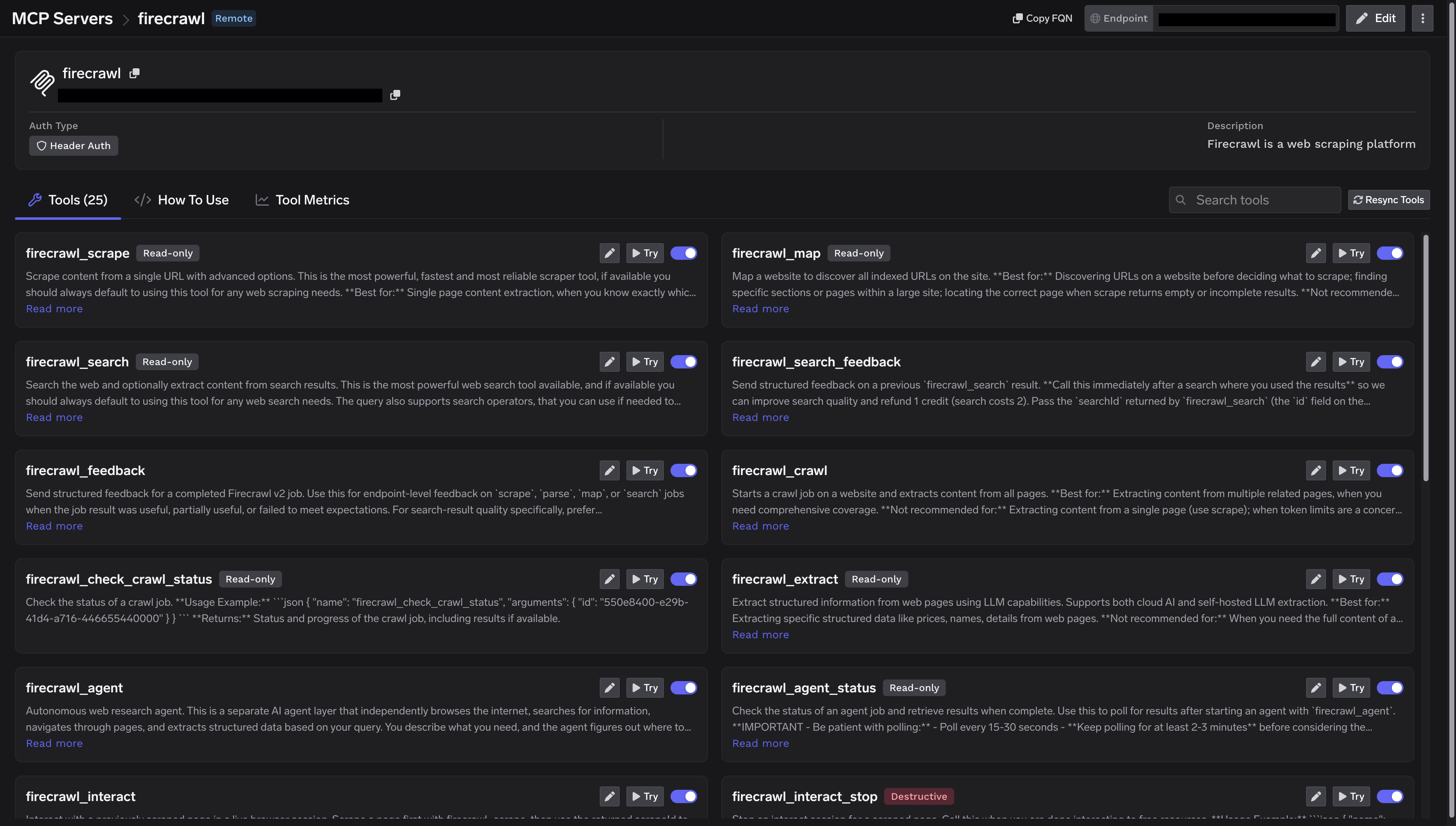
After saving, the **Tools** tab lists Firecrawl's available tools (scrape, map, crawl, search, extract, and more). Click **Try** on any tool to test it and inspect the JSON output before using it in an agent.
Prefer **Individual Credentials** when each user should bring their own Firecrawl key so usage and rate limits are attributed per user. Use **Shared Credentials** for a single team-wide key.
After saving, the **Tools** tab lists Firecrawl's available tools (scrape, map, crawl, search, extract, and more). Click **Try** on any tool to test it and inspect the JSON output before using it in an agent.
 ## Connecting to an MCP Client
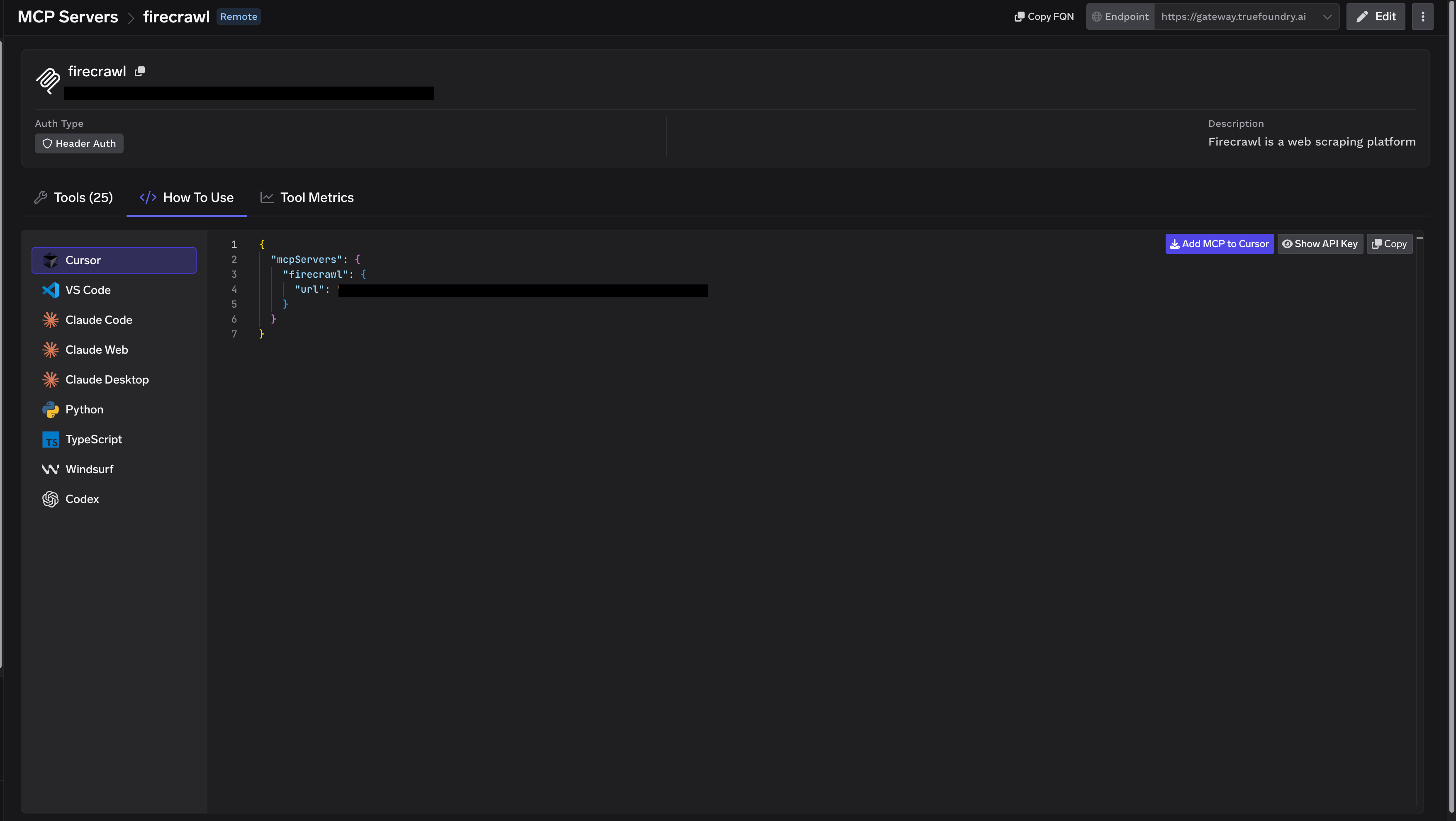
Open the **How To Use** tab on the Firecrawl server detail page for your tenant-specific Gateway URL and ready-to-paste client snippets - don't build the endpoint manually.
The tab includes snippets for Claude Code, VS Code, Claude Web, Claude Desktop, Cursor, Windsurf, Codex, and the Python and TypeScript MCP SDKs. Use **Show API Key** if your client requires a Gateway token in a header.
## Connecting to an MCP Client
Open the **How To Use** tab on the Firecrawl server detail page for your tenant-specific Gateway URL and ready-to-paste client snippets - don't build the endpoint manually.
The tab includes snippets for Claude Code, VS Code, Claude Web, Claude Desktop, Cursor, Windsurf, Codex, and the Python and TypeScript MCP SDKs. Use **Show API Key** if your client requires a Gateway token in a header.
 ## Using the Tool Playground
Before deploying an agent, you can test any Firecrawl MCP server tool directly in TrueFoundry:
On the Firecrawl MCP server detail page, click **Try** next to any tool - for example `firecrawl_scrape`.
Provide the tool's inputs, such as the `url` of the page to scrape and any format options (for example, `markdown`).
Click **Execute Tool** and inspect the JSON output in the right panel.
## Tool Metrics
The **Tool Metrics** tab on the Firecrawl server detail page tracks how agents use each tool:
* **Invocation count** - which tools are called most often
* **Latency** - how long each tool takes to respond
* **Error rates** - which tools are failing in production
See [MCP Metrics](/docs/ai-gateway/analytics-mcp-metrics) for server- and tool-level dashboards across your Gateway.
## Disabling Individual Tools
On the **Tools** tab, toggle off any Firecrawl tools your agents don't need:
* **Disabled tools** are hidden from MCP clients and cannot be invoked.
* **Enabled tools** remain available to agents as usual.
## Using the Tool Playground
Before deploying an agent, you can test any Firecrawl MCP server tool directly in TrueFoundry:
On the Firecrawl MCP server detail page, click **Try** next to any tool - for example `firecrawl_scrape`.
Provide the tool's inputs, such as the `url` of the page to scrape and any format options (for example, `markdown`).
Click **Execute Tool** and inspect the JSON output in the right panel.
## Tool Metrics
The **Tool Metrics** tab on the Firecrawl server detail page tracks how agents use each tool:
* **Invocation count** - which tools are called most often
* **Latency** - how long each tool takes to respond
* **Error rates** - which tools are failing in production
See [MCP Metrics](/docs/ai-gateway/analytics-mcp-metrics) for server- and tool-level dashboards across your Gateway.
## Disabling Individual Tools
On the **Tools** tab, toggle off any Firecrawl tools your agents don't need:
* **Disabled tools** are hidden from MCP clients and cannot be invoked.
* **Enabled tools** remain available to agents as usual.