> ## Documentation Index
> Fetch the complete documentation index at: https://www.truefoundry.com/llms.txt
> Use this file to discover all available pages before exploring further.
# Set up Browserbase MCP Server
> Connect Browserbase as an official remote MCP server on the TrueFoundry MCP Gateway so agents can drive a cloud browser, navigate pages, act, observe, extract data, and take screenshots.
[Browserbase](https://www.browserbase.com) provides cloud browsers that AI agents can control. Its official remote MCP server is built on [Stagehand](https://docs.stagehand.dev), so agents interact with pages using natural language instead of brittle selectors. Register it on the TrueFoundry MCP Gateway so your agents can open a session, navigate to any URL, act on the page, observe actionable elements, and extract structured data through governed access.
Browserbase is available in TrueFoundry's **Official Remote MCP Servers** catalog. It needs your own Browserbase API key and project ID, which you supply once when registering the server.
## Using Browserbase through the MCP Gateway
The [TrueFoundry MCP Gateway](/docs/ai-gateway/mcp/mcp-overview) centralizes access to Browserbase - agents connect through one endpoint instead of maintaining separate server configurations per client.
When you use Browserbase MCP server through the AI Gateway, TrueFoundry provides:
* **Authentication** - Clients [authenticate inbound](/docs/ai-gateway/mcp/mcp-gateway-auth-security#inbound-authentication) to the AI Gateway with a Personal Access Token, Virtual Account, or IDE OAuth flow. For outbound access, your Browserbase API key and project ID are configured once on the server and injected on outbound calls.
* **Tool-level access control** - You can selectively enable or disable individual Browserbase tools from the TrueFoundry UI.
* **Access control** - [Collaborators and role-based policies](/docs/ai-gateway/mcp/mcp-gateway-auth-security#access-control) define who can use the server and which tools they can invoke. Enable or disable individual Browserbase tools from the server detail page.
* **Observability** - Tool calls are traced with caller identity, tool name, inputs, and latency. Monitor server- and tool-level usage in [MCP Metrics](/docs/ai-gateway/analytics-mcp-metrics) and export traces to your observability stack via OpenTelemetry.
* **Guardrails** - Apply [pre-tool and post-tool guardrails](/docs/ai-gateway/guardrails-overview) on MCP tool calls.
## Prerequisites
* A TrueFoundry account with permission to add MCP servers.
* A [Browserbase account](https://www.browserbase.com).
* A Browserbase **API key** and **project ID**.
Both live on the Browserbase dashboard under **Settings → General**. Copy the **Project ID** and reveal and copy the **API key**, then paste them into the server URL when registering Browserbase in TrueFoundry.
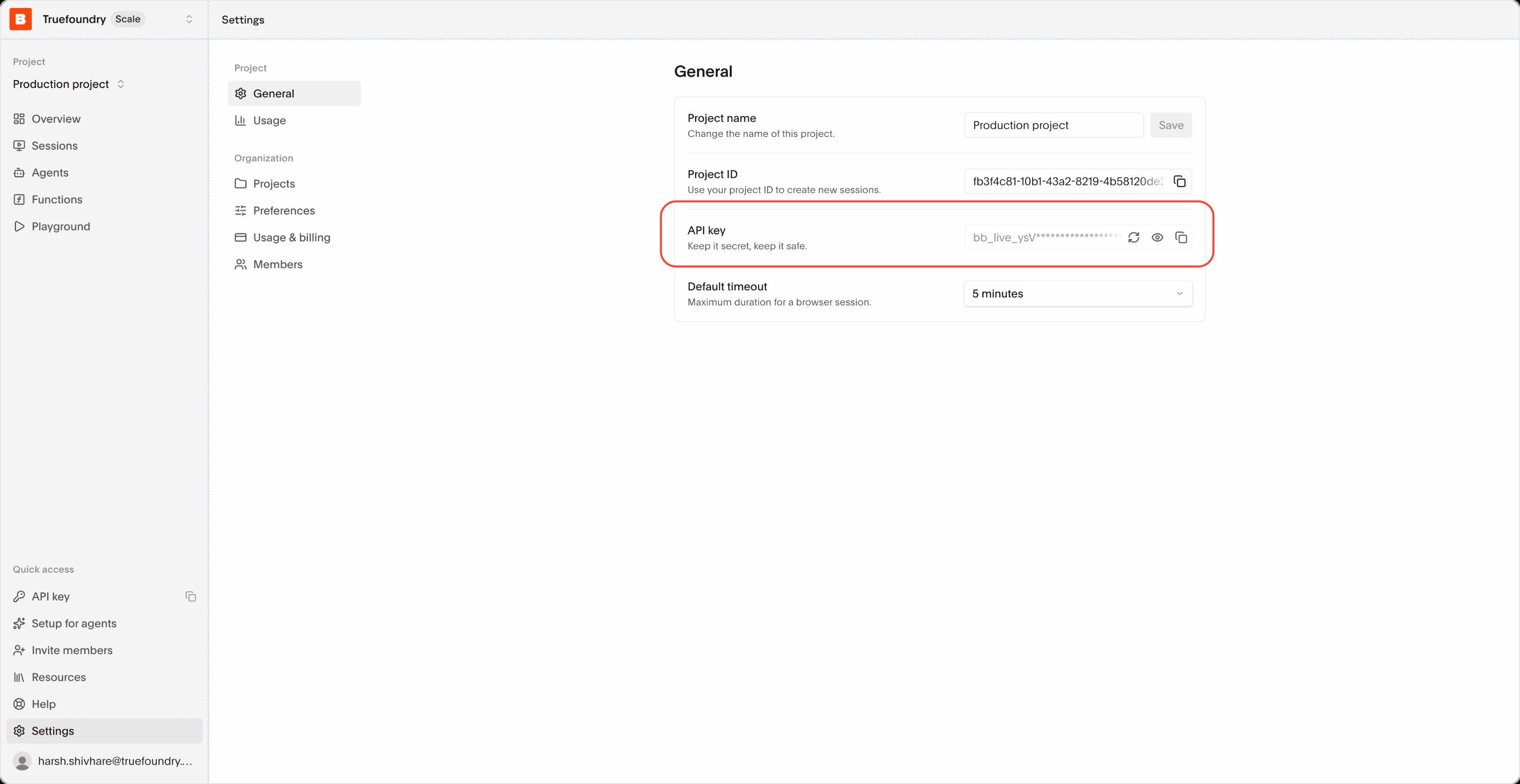 Keep the API key secret. Anyone with it can drive cloud browsers in your Browserbase project. Rotate it from this page if it is ever exposed.
## Adding Browserbase MCP server to TrueFoundry
Navigate to **MCP Servers** in the TrueFoundry sidebar and click **Add new MCP Server**. On the next screen, select **Connect Official Remote MCP Servers** - this lists official, vetted remote MCP servers that you connect with your own auth.
Find **browserbase** in the catalogue and click **+ Add**. TrueFoundry opens the Browserbase MCP server detail page with the server URL pre-filled.
TrueFoundry pre-fills the server details for Browserbase. Add your Browserbase API key and project ID to the URL:
| Field | Value |
| --------------- | ----------------------------------------------------------------------------------------------------------------- |
| **Name** | `browserbase` |
| **Description** | Cloud browser automation via Browserbase and Stagehand |
| **URL** | `https://mcp.browserbase.com/mcp?browserbaseApiKey=YOUR_BROWSERBASE_API_KEY&browserbaseProjectId=YOUR_PROJECT_ID` |
Add **Collaborators** - the users and teams that can use or manage this server - and assign each an **MCP Server Manager** or **MCP Server User** role. Because the credentials travel in the URL, leave **Auth Data** toggled off. Click **Update MCP Server** to save.
Prefer configuration as code? Click **Apply using YAML** and paste the spec in [Configuring the server URL](#configuring-the-server-url) below.
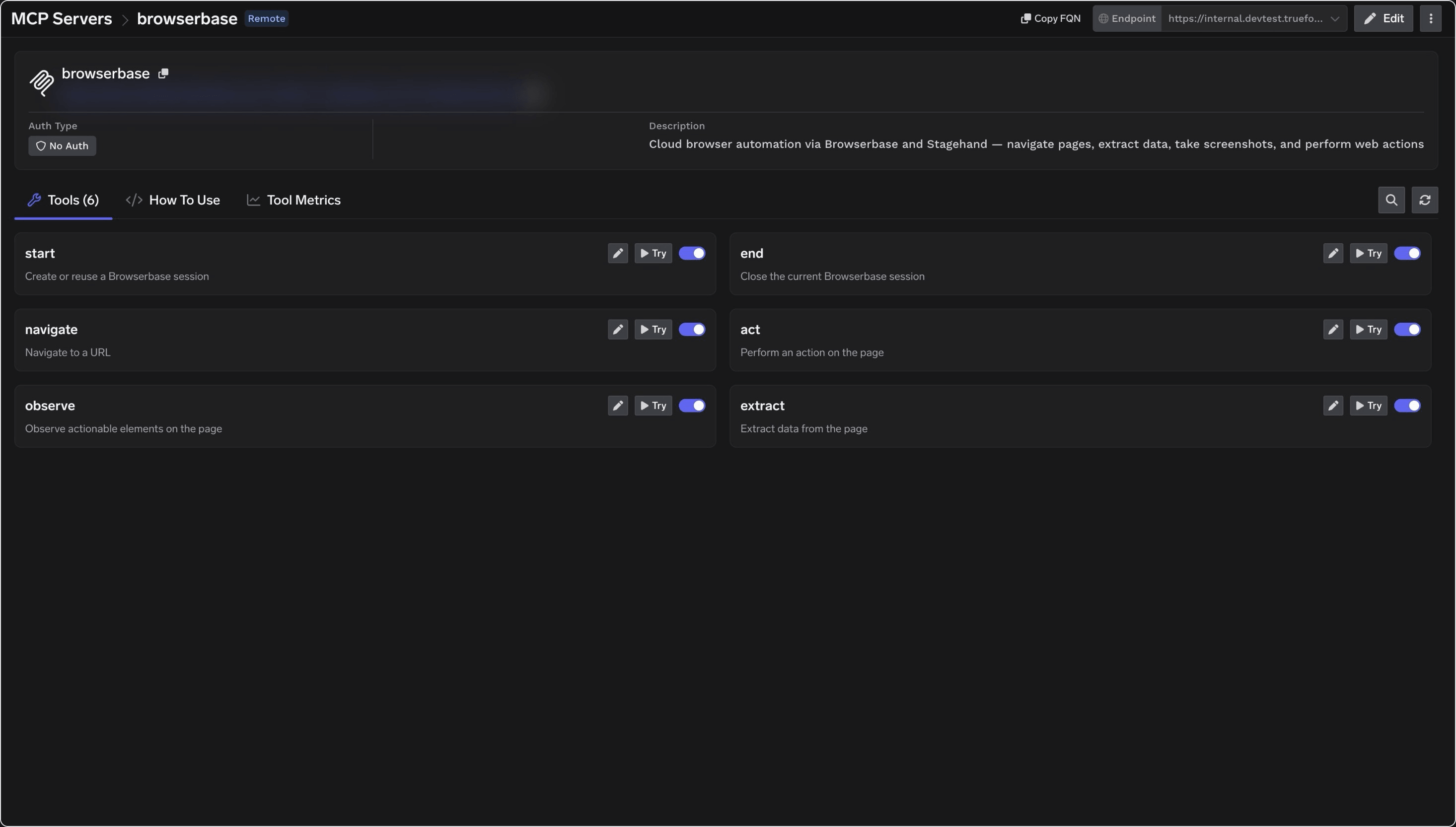
After saving, the **Tools** tab lists Browserbase's available tools (`start`, `end`, `navigate`, `act`, `observe`, and `extract`). Click **Try** on any tool to test it and inspect the JSON output before using it in an agent.
Keep the API key secret. Anyone with it can drive cloud browsers in your Browserbase project. Rotate it from this page if it is ever exposed.
## Adding Browserbase MCP server to TrueFoundry
Navigate to **MCP Servers** in the TrueFoundry sidebar and click **Add new MCP Server**. On the next screen, select **Connect Official Remote MCP Servers** - this lists official, vetted remote MCP servers that you connect with your own auth.
Find **browserbase** in the catalogue and click **+ Add**. TrueFoundry opens the Browserbase MCP server detail page with the server URL pre-filled.
TrueFoundry pre-fills the server details for Browserbase. Add your Browserbase API key and project ID to the URL:
| Field | Value |
| --------------- | ----------------------------------------------------------------------------------------------------------------- |
| **Name** | `browserbase` |
| **Description** | Cloud browser automation via Browserbase and Stagehand |
| **URL** | `https://mcp.browserbase.com/mcp?browserbaseApiKey=YOUR_BROWSERBASE_API_KEY&browserbaseProjectId=YOUR_PROJECT_ID` |
Add **Collaborators** - the users and teams that can use or manage this server - and assign each an **MCP Server Manager** or **MCP Server User** role. Because the credentials travel in the URL, leave **Auth Data** toggled off. Click **Update MCP Server** to save.
Prefer configuration as code? Click **Apply using YAML** and paste the spec in [Configuring the server URL](#configuring-the-server-url) below.
After saving, the **Tools** tab lists Browserbase's available tools (`start`, `end`, `navigate`, `act`, `observe`, and `extract`). Click **Try** on any tool to test it and inspect the JSON output before using it in an agent.
 ## Configuring the server URL
Browserbase reads the project from the `browserbaseProjectId` query parameter and authenticates with your API key. The simplest option for the TrueFoundry catalog is to pass both in the URL:
```
https://mcp.browserbase.com/mcp?browserbaseApiKey=YOUR_BROWSERBASE_API_KEY&browserbaseProjectId=YOUR_PROJECT_ID
```
The equivalent YAML for the **Apply using YAML** option:
```yaml theme={"dark"}
url: >-
https://mcp.browserbase.com/mcp?browserbaseApiKey=YOUR_BROWSERBASE_API_KEY&browserbaseProjectId=YOUR_PROJECT_ID
name: browserbase
type: mcp-server/remote
description: >-
Cloud browser automation via Browserbase and Stagehand, navigate pages,
extract data, take screenshots, and perform web actions
collaborators:
- role_id: mcp-server-manager
subject: user:you@your-company.com
```
Browserbase also accepts the API key as an HTTP header, `Authorization: Bearer YOUR_BROWSERBASE_API_KEY` or `x-bb-api-key: YOUR_BROWSERBASE_API_KEY`. The `browserbaseApiKey` query parameter shown above is Browserbase's fallback for clients that can't send custom headers. Keep the project ID (`browserbaseProjectId`) in the URL either way.
Your Browserbase API key grants access to your cloud browsers and any credentials in your Browserbase projects. Treat it as a secret, restrict who has the **MCP Server Manager** role, and rotate the key from the Browserbase dashboard if it is exposed.
## Connecting to an MCP Client
Open the **How To Use** tab on the Browserbase server detail page for your tenant-specific Gateway URL and ready-to-paste client snippets - don't build the endpoint manually.
The tab includes snippets for Claude Code, VS Code, Claude Web, Claude Desktop, Cursor, Windsurf, Codex, and the Python and TypeScript MCP SDKs. Use **Show API Key** if your client requires a Gateway token in a header.
## Using the Tool Playground
Before deploying an agent, you can test any Browserbase MCP server tool directly in TrueFoundry:
On the Browserbase MCP server detail page, click **Try** next to any tool - for example `start`.
Provide the tool's inputs. A quick end-to-end check: run `start`, then `navigate` to a URL, then `extract` to confirm the session drives a real cloud browser.
Click **Execute Tool** and inspect the JSON output in the right panel.
## Tool Metrics
The **Tool Metrics** tab on the Browserbase server detail page tracks how agents use each tool:
* **Invocation count** - which tools are called most often
* **Latency** - how long each tool takes to respond
* **Error rates** - which tools are failing in production
See [MCP Metrics](/docs/ai-gateway/analytics-mcp-metrics) for server- and tool-level dashboards across your Gateway.
## Disabling Individual Tools
On the **Tools** tab, toggle off any Browserbase tools your agents don't need:
* **Disabled tools** are hidden from MCP clients and cannot be invoked.
* **Enabled tools** remain available to agents as usual.
For example, disable `act` for read-only research agents that should only `navigate`, `observe`, and `extract`.
## Configuring the server URL
Browserbase reads the project from the `browserbaseProjectId` query parameter and authenticates with your API key. The simplest option for the TrueFoundry catalog is to pass both in the URL:
```
https://mcp.browserbase.com/mcp?browserbaseApiKey=YOUR_BROWSERBASE_API_KEY&browserbaseProjectId=YOUR_PROJECT_ID
```
The equivalent YAML for the **Apply using YAML** option:
```yaml theme={"dark"}
url: >-
https://mcp.browserbase.com/mcp?browserbaseApiKey=YOUR_BROWSERBASE_API_KEY&browserbaseProjectId=YOUR_PROJECT_ID
name: browserbase
type: mcp-server/remote
description: >-
Cloud browser automation via Browserbase and Stagehand, navigate pages,
extract data, take screenshots, and perform web actions
collaborators:
- role_id: mcp-server-manager
subject: user:you@your-company.com
```
Browserbase also accepts the API key as an HTTP header, `Authorization: Bearer YOUR_BROWSERBASE_API_KEY` or `x-bb-api-key: YOUR_BROWSERBASE_API_KEY`. The `browserbaseApiKey` query parameter shown above is Browserbase's fallback for clients that can't send custom headers. Keep the project ID (`browserbaseProjectId`) in the URL either way.
Your Browserbase API key grants access to your cloud browsers and any credentials in your Browserbase projects. Treat it as a secret, restrict who has the **MCP Server Manager** role, and rotate the key from the Browserbase dashboard if it is exposed.
## Connecting to an MCP Client
Open the **How To Use** tab on the Browserbase server detail page for your tenant-specific Gateway URL and ready-to-paste client snippets - don't build the endpoint manually.
The tab includes snippets for Claude Code, VS Code, Claude Web, Claude Desktop, Cursor, Windsurf, Codex, and the Python and TypeScript MCP SDKs. Use **Show API Key** if your client requires a Gateway token in a header.
## Using the Tool Playground
Before deploying an agent, you can test any Browserbase MCP server tool directly in TrueFoundry:
On the Browserbase MCP server detail page, click **Try** next to any tool - for example `start`.
Provide the tool's inputs. A quick end-to-end check: run `start`, then `navigate` to a URL, then `extract` to confirm the session drives a real cloud browser.
Click **Execute Tool** and inspect the JSON output in the right panel.
## Tool Metrics
The **Tool Metrics** tab on the Browserbase server detail page tracks how agents use each tool:
* **Invocation count** - which tools are called most often
* **Latency** - how long each tool takes to respond
* **Error rates** - which tools are failing in production
See [MCP Metrics](/docs/ai-gateway/analytics-mcp-metrics) for server- and tool-level dashboards across your Gateway.
## Disabling Individual Tools
On the **Tools** tab, toggle off any Browserbase tools your agents don't need:
* **Disabled tools** are hidden from MCP clients and cannot be invoked.
* **Enabled tools** remain available to agents as usual.
For example, disable `act` for read-only research agents that should only `navigate`, `observe`, and `extract`.