> ## Documentation Index
> Fetch the complete documentation index at: https://www.truefoundry.com/llms.txt
> Use this file to discover all available pages before exploring further.
# Routing Config
> Global YAML-based routing configuration for TrueFoundry AI Gateway
For new setups, we recommend using **[Virtual Models](/docs/ai-gateway/virtual-model)** to configure routing. Virtual models provide the same routing strategies, retries, and fallbacks, with clearer per-model ownership, access control, and a simpler configuration experience. The global routing configuration described on this page remains functional for existing deployments.
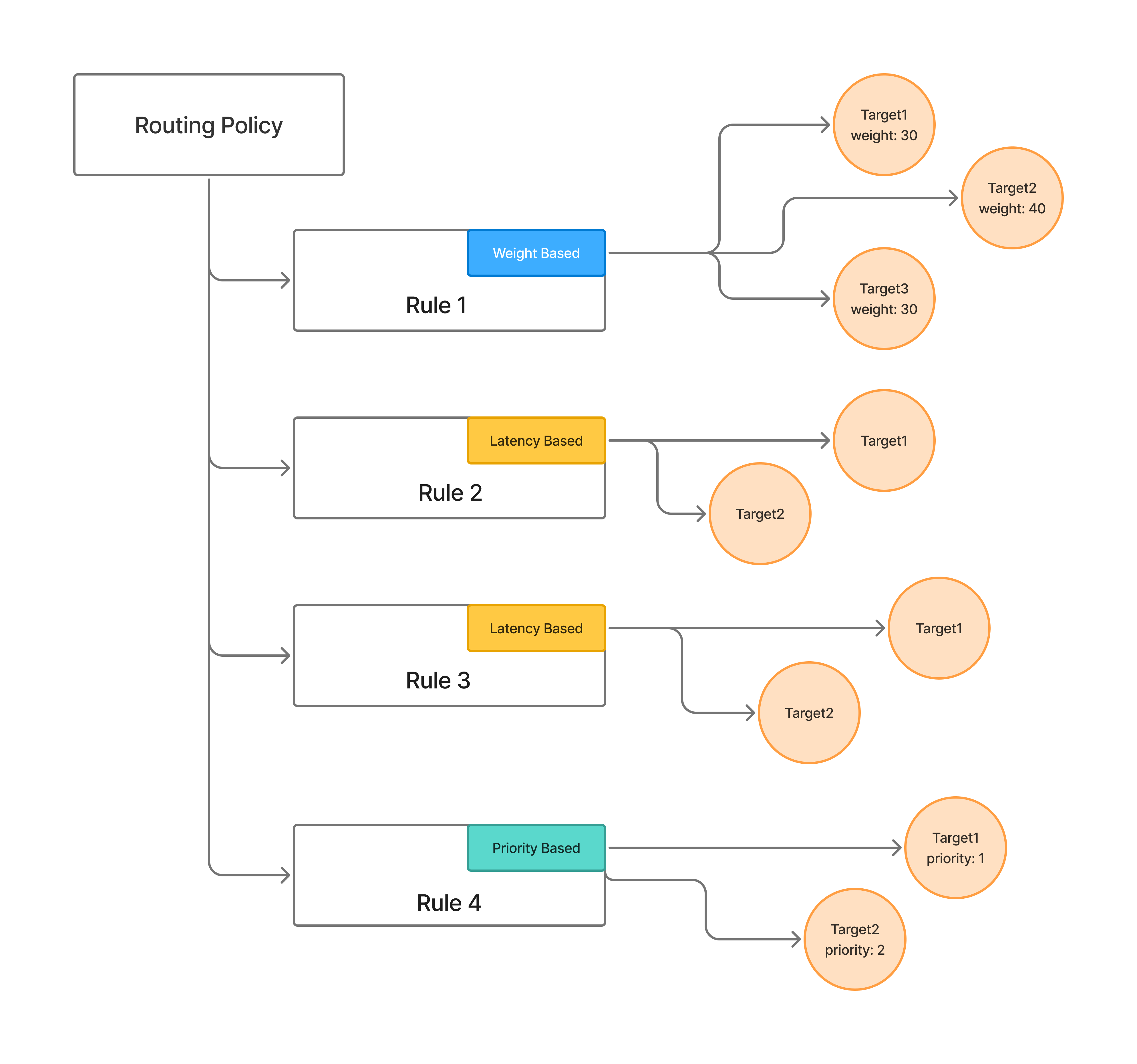
The global routing configuration lets you define load balancing, fallback, and retry rules as a YAML file applied at the tenant level. Rules are evaluated **in order** for each incoming request — the **first matching rule** wins and subsequent rules are ignored.
 ## Configuration structure
```yaml YAML theme={"dark"}
name: string # e.g. "loadbalancing-config"
type: gateway-load-balancing-config
rules:
- id: string # unique rule identifier
type: weight-based-routing | latency-based-routing | priority-based-routing
when:
subjects: string[] # optional: user:..., team:..., virtualaccount:...
models: string[] # required: model names to match
metadata: object # optional: must match X-TFY-METADATA
load_balance_targets:
- target: string # model identifier in the gateway
weight: integer # 0–100, sum 100 (weight-based only)
priority: integer # lower = higher priority (priority-based only)
retry_config:
attempts: integer # default: 0
delay: integer # ms, default: 100
on_status_codes: string[] # default: ["429", "500", "502", "503"]
fallback_status_codes: string[] # default: ["401", "403", "404", "408", "429", "500", "502", "503"]
fallback_candidate: boolean # default: true
override_params: object # e.g. temperature, max_tokens, prompt_version_fqn
```
### Key fields
**`when`** — Defines which requests a rule applies to. The `subjects`, `models`, and `metadata` fields are combined with **AND** logic. If a request doesn't match one rule's `when` block, the next rule is evaluated.
* `subjects` — Filter by user, team, or virtual account (for example `user:john-doe`, `team:engineering`, `virtualaccount:acct_123`).
* `models` — Rule matches if the request model name is in this list.
* `metadata` — Rule matches if the request's `X-TFY-METADATA` header contains these key-value pairs.
**`type`** — The routing strategy for this rule:
* **`weight-based-routing`** — Distribute traffic by assigned weights that sum to 100.
* **`latency-based-routing`** — Automatically route to the target with the lowest recent latency (time per output token).
* **`priority-based-routing`** — Route to the highest priority (lowest number) healthy target, falling back to the next on failure.
For details on how each strategy behaves (latency algorithm, SLA cutoff, unhealthy detection), see [Virtual Models — Routing Strategies](/docs/ai-gateway/virtual-model#routing-strategies). The strategies work identically whether configured here or on a virtual model.
**`load_balance_targets`** — The list of models eligible for routing in this rule. Per-target options:
* **Retry configuration** — `attempts`, `delay`, and `on_status_codes` for retries on the same target.
* **Fallback configuration** — `fallback_status_codes` to trigger trying another target, and `fallback_candidate` to control whether a target can receive fallback traffic.
* **Override parameters** — Per-target request parameters like `temperature`, `max_tokens`, or `prompt_version_fqn` for model-specific prompts.
For Anthropic streaming requests, fallback can trigger on `overloaded_error` before output starts. The gateway waits for the first non-empty stream chunk; if an `overloaded_error` is returned before that first chunk, it falls back to the next eligible target. See [Anthropic Stream Overload Fallback](/docs/ai-gateway/anthropic-stream-overload-fallback) for implementation details.
`prompt_version_fqn` override does not work with agents (when using MCP/tools). It is supported for standard chat completion requests.
## Common configurations
```yaml theme={"dark"}
name: loadbalancing-config
type: gateway-load-balancing-config
rules:
- id: priority-rate-limit
type: priority-based-routing
when:
models:
- gpt-4
load_balance_targets:
- target: azure/gpt4
priority: 0
fallback_status_codes: ["429"]
- target: openai/gpt4
priority: 1
fallback_status_codes: ["429"]
- target: anthropic/claude-3-opus
priority: 2
```
```yaml theme={"dark"}
name: loadbalancing-config
type: gateway-load-balancing-config
rules:
- id: gpt4-canary
type: weight-based-routing
when:
models:
- gpt-4
load_balance_targets:
- target: azure/gpt4-v1
weight: 90
- target: azure/gpt4-v2
weight: 10
```
```yaml theme={"dark"}
name: loadbalancing-config
type: gateway-load-balancing-config
rules:
- id: priority-failover
type: priority-based-routing
when:
models:
- gpt-4
load_balance_targets:
- target: onprem/llama
priority: 0
fallback_status_codes: ["429", "500", "502", "503"]
- target: bedrock/llama
priority: 1
retry_config:
attempts: 2
delay: 100
```
```yaml theme={"dark"}
name: loadbalancing-config
type: gateway-load-balancing-config
rules:
- id: performance-optimized
type: latency-based-routing
when:
models:
- gpt-4
load_balance_targets:
- target: azure/gpt4
retry_config:
attempts: 1
- target: openai/gpt4
retry_config:
attempts: 1
```
```yaml theme={"dark"}
name: loadbalancing-config
type: gateway-load-balancing-config
rules:
- id: dev-environment
type: weight-based-routing
when:
models:
- gpt-4
metadata:
environment: development
load_balance_targets:
- target: openai-dev/gpt4
weight: 100
- id: prod-environment
type: latency-based-routing
when:
models:
- gpt-4
metadata:
environment: production
load_balance_targets:
- target: azure-prod/gpt4
- target: openai-prod/gpt4
```
```yaml theme={"dark"}
name: loadbalancing-config
type: gateway-load-balancing-config
rules:
- id: model-specific-prompts
type: weight-based-routing
when:
models:
- gpt-4
load_balance_targets:
- target: openai/gpt4
weight: 70
override_params:
prompt_version_fqn: chat_prompt:internal/my-app/gpt4-optimized-prompt:1
- target: anthropic/claude-3-opus
weight: 30
override_params:
prompt_version_fqn: chat_prompt:internal/my-app/claude-optimized-prompt:1
```
```yaml theme={"dark"}
name: loadbalancing-config
type: gateway-load-balancing-config
rules:
- id: apac-user-proximity
type: priority-based-routing
when:
models:
- gpt-4
metadata:
- region: apac
load_balance_targets:
- target: azure/gpt4-southeast-asia
priority: 0
- target: openai/gpt4
priority: 1
- id: booking-app-routing
type: priority-based-routing
when:
subjects:
- virtualaccount:booking-app
load_balance_targets:
- target: openai/gpt4
priority: 0
retry_config:
attempts: 2
delay: 100
- target: azure/gpt4
priority: 0
retry_config:
attempts: 1
- target: bedrock/claude
priority: 1
override_params:
temperature: 0.5
```
## Where to configure
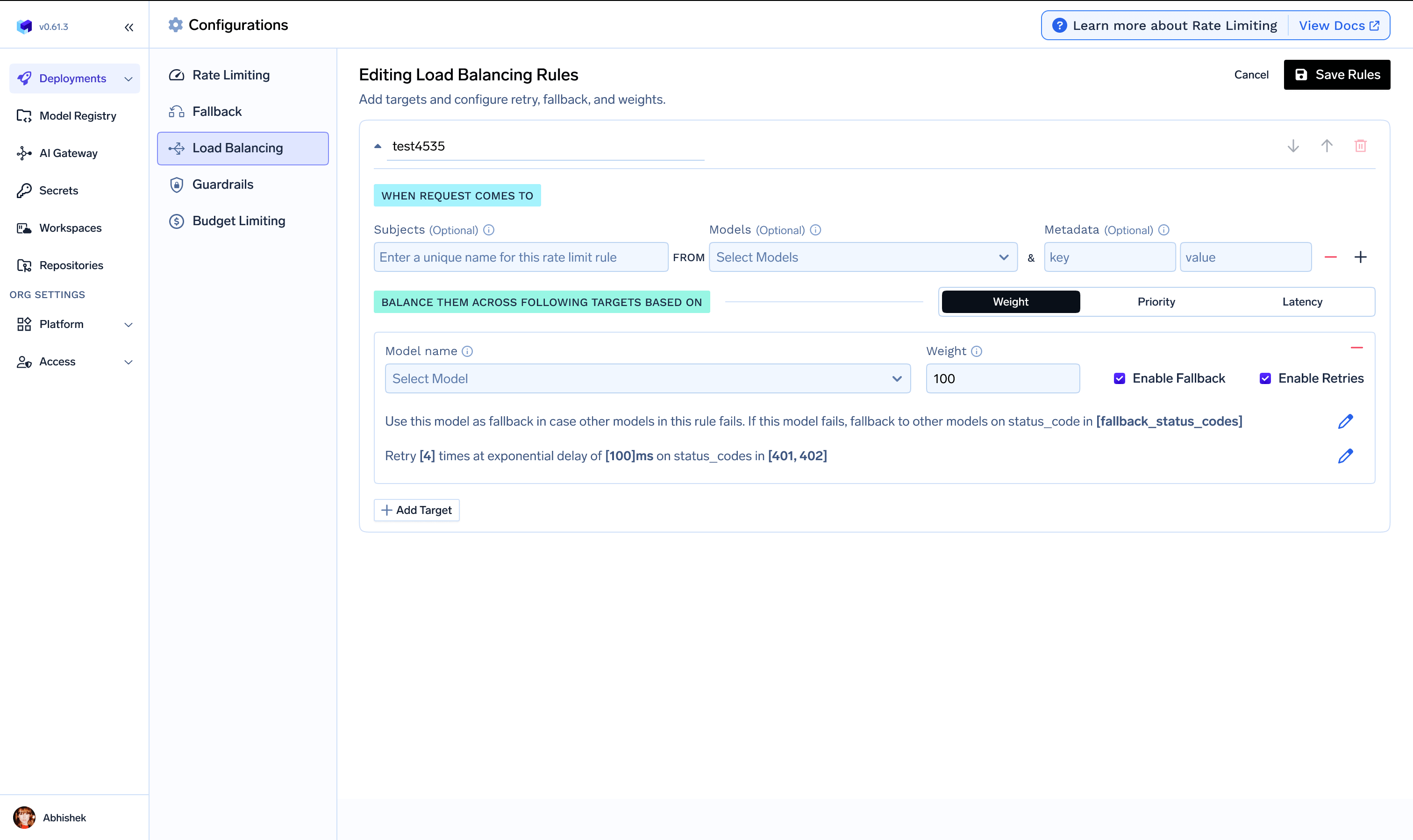
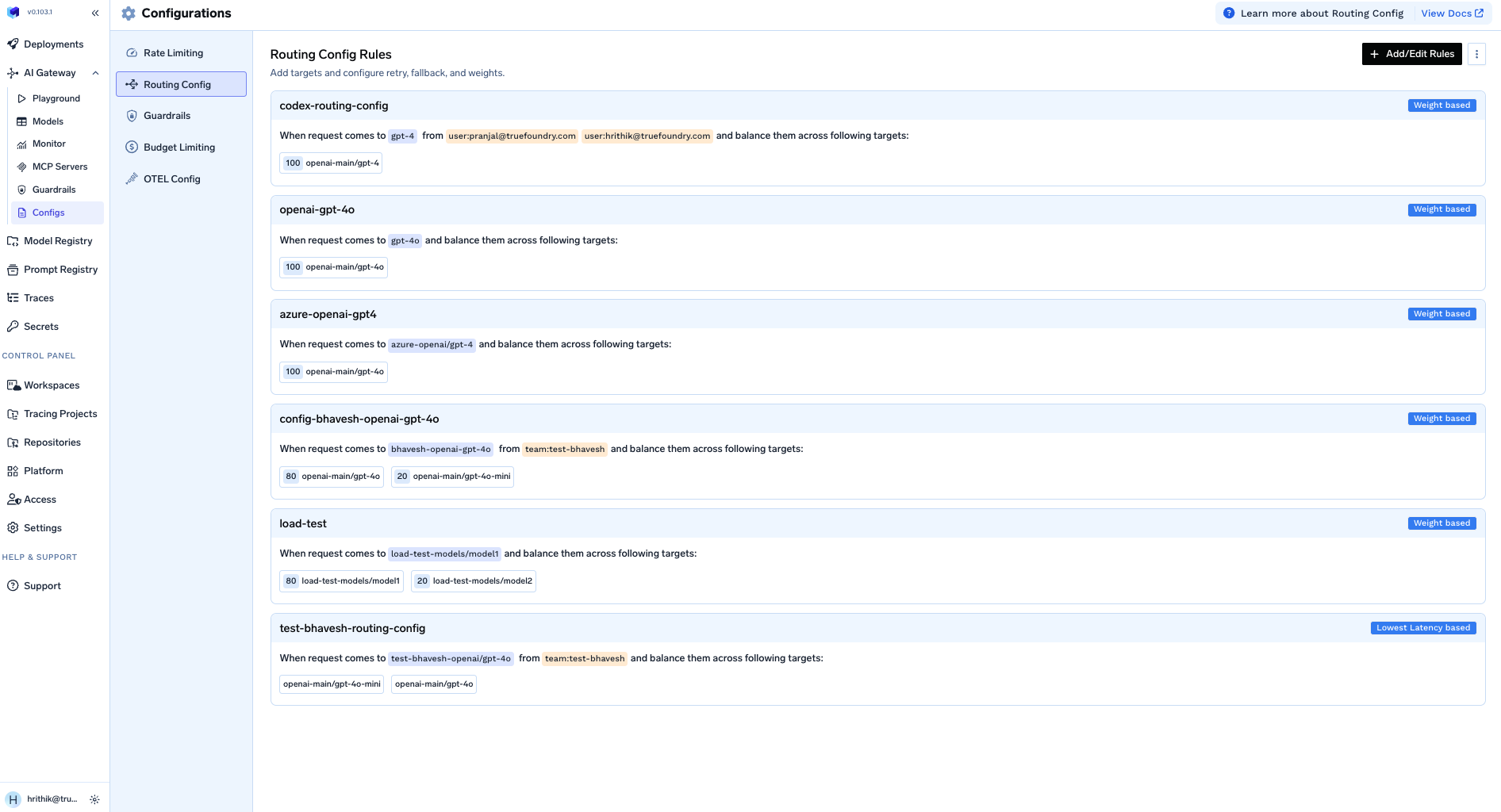
The configuration is managed under **AI Gateway → Configs → Routing Config** in the UI. You can also store the YAML in your Git repository and apply it with the `tfy apply` command to enforce a PR review process.
## Configuration structure
```yaml YAML theme={"dark"}
name: string # e.g. "loadbalancing-config"
type: gateway-load-balancing-config
rules:
- id: string # unique rule identifier
type: weight-based-routing | latency-based-routing | priority-based-routing
when:
subjects: string[] # optional: user:..., team:..., virtualaccount:...
models: string[] # required: model names to match
metadata: object # optional: must match X-TFY-METADATA
load_balance_targets:
- target: string # model identifier in the gateway
weight: integer # 0–100, sum 100 (weight-based only)
priority: integer # lower = higher priority (priority-based only)
retry_config:
attempts: integer # default: 0
delay: integer # ms, default: 100
on_status_codes: string[] # default: ["429", "500", "502", "503"]
fallback_status_codes: string[] # default: ["401", "403", "404", "408", "429", "500", "502", "503"]
fallback_candidate: boolean # default: true
override_params: object # e.g. temperature, max_tokens, prompt_version_fqn
```
### Key fields
**`when`** — Defines which requests a rule applies to. The `subjects`, `models`, and `metadata` fields are combined with **AND** logic. If a request doesn't match one rule's `when` block, the next rule is evaluated.
* `subjects` — Filter by user, team, or virtual account (for example `user:john-doe`, `team:engineering`, `virtualaccount:acct_123`).
* `models` — Rule matches if the request model name is in this list.
* `metadata` — Rule matches if the request's `X-TFY-METADATA` header contains these key-value pairs.
**`type`** — The routing strategy for this rule:
* **`weight-based-routing`** — Distribute traffic by assigned weights that sum to 100.
* **`latency-based-routing`** — Automatically route to the target with the lowest recent latency (time per output token).
* **`priority-based-routing`** — Route to the highest priority (lowest number) healthy target, falling back to the next on failure.
For details on how each strategy behaves (latency algorithm, SLA cutoff, unhealthy detection), see [Virtual Models — Routing Strategies](/docs/ai-gateway/virtual-model#routing-strategies). The strategies work identically whether configured here or on a virtual model.
**`load_balance_targets`** — The list of models eligible for routing in this rule. Per-target options:
* **Retry configuration** — `attempts`, `delay`, and `on_status_codes` for retries on the same target.
* **Fallback configuration** — `fallback_status_codes` to trigger trying another target, and `fallback_candidate` to control whether a target can receive fallback traffic.
* **Override parameters** — Per-target request parameters like `temperature`, `max_tokens`, or `prompt_version_fqn` for model-specific prompts.
For Anthropic streaming requests, fallback can trigger on `overloaded_error` before output starts. The gateway waits for the first non-empty stream chunk; if an `overloaded_error` is returned before that first chunk, it falls back to the next eligible target. See [Anthropic Stream Overload Fallback](/docs/ai-gateway/anthropic-stream-overload-fallback) for implementation details.
`prompt_version_fqn` override does not work with agents (when using MCP/tools). It is supported for standard chat completion requests.
## Common configurations
```yaml theme={"dark"}
name: loadbalancing-config
type: gateway-load-balancing-config
rules:
- id: priority-rate-limit
type: priority-based-routing
when:
models:
- gpt-4
load_balance_targets:
- target: azure/gpt4
priority: 0
fallback_status_codes: ["429"]
- target: openai/gpt4
priority: 1
fallback_status_codes: ["429"]
- target: anthropic/claude-3-opus
priority: 2
```
```yaml theme={"dark"}
name: loadbalancing-config
type: gateway-load-balancing-config
rules:
- id: gpt4-canary
type: weight-based-routing
when:
models:
- gpt-4
load_balance_targets:
- target: azure/gpt4-v1
weight: 90
- target: azure/gpt4-v2
weight: 10
```
```yaml theme={"dark"}
name: loadbalancing-config
type: gateway-load-balancing-config
rules:
- id: priority-failover
type: priority-based-routing
when:
models:
- gpt-4
load_balance_targets:
- target: onprem/llama
priority: 0
fallback_status_codes: ["429", "500", "502", "503"]
- target: bedrock/llama
priority: 1
retry_config:
attempts: 2
delay: 100
```
```yaml theme={"dark"}
name: loadbalancing-config
type: gateway-load-balancing-config
rules:
- id: performance-optimized
type: latency-based-routing
when:
models:
- gpt-4
load_balance_targets:
- target: azure/gpt4
retry_config:
attempts: 1
- target: openai/gpt4
retry_config:
attempts: 1
```
```yaml theme={"dark"}
name: loadbalancing-config
type: gateway-load-balancing-config
rules:
- id: dev-environment
type: weight-based-routing
when:
models:
- gpt-4
metadata:
environment: development
load_balance_targets:
- target: openai-dev/gpt4
weight: 100
- id: prod-environment
type: latency-based-routing
when:
models:
- gpt-4
metadata:
environment: production
load_balance_targets:
- target: azure-prod/gpt4
- target: openai-prod/gpt4
```
```yaml theme={"dark"}
name: loadbalancing-config
type: gateway-load-balancing-config
rules:
- id: model-specific-prompts
type: weight-based-routing
when:
models:
- gpt-4
load_balance_targets:
- target: openai/gpt4
weight: 70
override_params:
prompt_version_fqn: chat_prompt:internal/my-app/gpt4-optimized-prompt:1
- target: anthropic/claude-3-opus
weight: 30
override_params:
prompt_version_fqn: chat_prompt:internal/my-app/claude-optimized-prompt:1
```
```yaml theme={"dark"}
name: loadbalancing-config
type: gateway-load-balancing-config
rules:
- id: apac-user-proximity
type: priority-based-routing
when:
models:
- gpt-4
metadata:
- region: apac
load_balance_targets:
- target: azure/gpt4-southeast-asia
priority: 0
- target: openai/gpt4
priority: 1
- id: booking-app-routing
type: priority-based-routing
when:
subjects:
- virtualaccount:booking-app
load_balance_targets:
- target: openai/gpt4
priority: 0
retry_config:
attempts: 2
delay: 100
- target: azure/gpt4
priority: 0
retry_config:
attempts: 1
- target: bedrock/claude
priority: 1
override_params:
temperature: 0.5
```
## Where to configure
The configuration is managed under **AI Gateway → Configs → Routing Config** in the UI. You can also store the YAML in your Git repository and apply it with the `tfy apply` command to enforce a PR review process.
 ## Migrating to virtual models
To move from global routing config to virtual models:
1. **Identify each distinct `model`** your apps send that is backed by rules here.
2. **Create a virtual model** with the same targets, strategy, weights/priorities, retries, fallbacks, and `override_params`.
3. **Point clients at the virtual model** using its full path or a [slug](/docs/ai-gateway/virtual-model-advanced#virtual-model-slugs).
4. **Remove or narrow rules** here once traffic uses the virtual model.
For rules that matched `metadata` or `subjects`, use **different virtual model names** per team or environment (for example `booking-app/gpt-prod` vs `booking-app/gpt-dev`).
See [Virtual Models](/docs/ai-gateway/virtual-model) for the full guide.
## Migrating to virtual models
To move from global routing config to virtual models:
1. **Identify each distinct `model`** your apps send that is backed by rules here.
2. **Create a virtual model** with the same targets, strategy, weights/priorities, retries, fallbacks, and `override_params`.
3. **Point clients at the virtual model** using its full path or a [slug](/docs/ai-gateway/virtual-model-advanced#virtual-model-slugs).
4. **Remove or narrow rules** here once traffic uses the virtual model.
For rules that matched `metadata` or `subjects`, use **different virtual model names** per team or environment (for example `booking-app/gpt-prod` vs `booking-app/gpt-dev`).
See [Virtual Models](/docs/ai-gateway/virtual-model) for the full guide.