> ## Documentation Index
> Fetch the complete documentation index at: https://www.truefoundry.com/llms.txt
> Use this file to discover all available pages before exploring further.
# Instructor
> Learn how to use instructor with TrueFoundry AI Gateway, including setup steps, use cases, and production-ready examples.
This guide provides instructions for integrating [Instructor](https://github.com/jxnl/instructor) with the TrueFoundry AI Gateway for structured data extraction from LLMs.
## What is Instructor?
Instructor is a Python framework for extracting structured outputs from Large Language Models (LLMs). It uses Pydantic models to define the expected output structure and ensures type-safe, validated responses.
### Key Features of Instructor
1. **Type-Safe Structured Outputs**: Instructor leverages [Pydantic models](https://docs.pydantic.dev/) to define expected output schemas, ensuring type safety and automatic validation of LLM responses. This eliminates the need for manual parsing and reduces errors in production applications.
2. **Automatic Validation and Error Handling**: Built-in validation mechanisms automatically retry failed requests and provide detailed error messages when LLM outputs don't match the expected schema. This makes applications more robust and reliable in production environments.
3. **Support for Complex Data Structures**: Instructor supports nested models, lists, enums, and other complex Pydantic types, enabling extraction of sophisticated data structures from natural language. It also supports streaming responses for real-time applications and partial extraction scenarios.
## Prerequisites
Before integrating Instructor with TrueFoundry, ensure you have:
1. **TrueFoundry Account**: Create a [TrueFoundry account](https://www.truefoundry.com/register) with at least one model provider and generate a Personal Access Token by following the instructions in [Generating Tokens](/docs/ai-gateway/authentication). For a quick setup guide, see our [Gateway Quick Start](https://docs.truefoundry.com/gateway/quick-start)
2. **Instructor Installation**: Install Instructor using pip: `pip install instructor`
3. **OpenAI Library**: Install the OpenAI Python library: `pip install openai`
4. **Pydantic**: Install Pydantic for data validation: `pip install pydantic`
## Setup Process
### Step 1: Install Dependencies
```bash lines theme={"dark"}
pip install instructor openai pydantic
```
### Step 2: Configure Instructor with TrueFoundry AI Gateway
Get your TrueFoundry AI Gateway API key, base URL, and model name from the unified code snippet in your TrueFoundry playground:
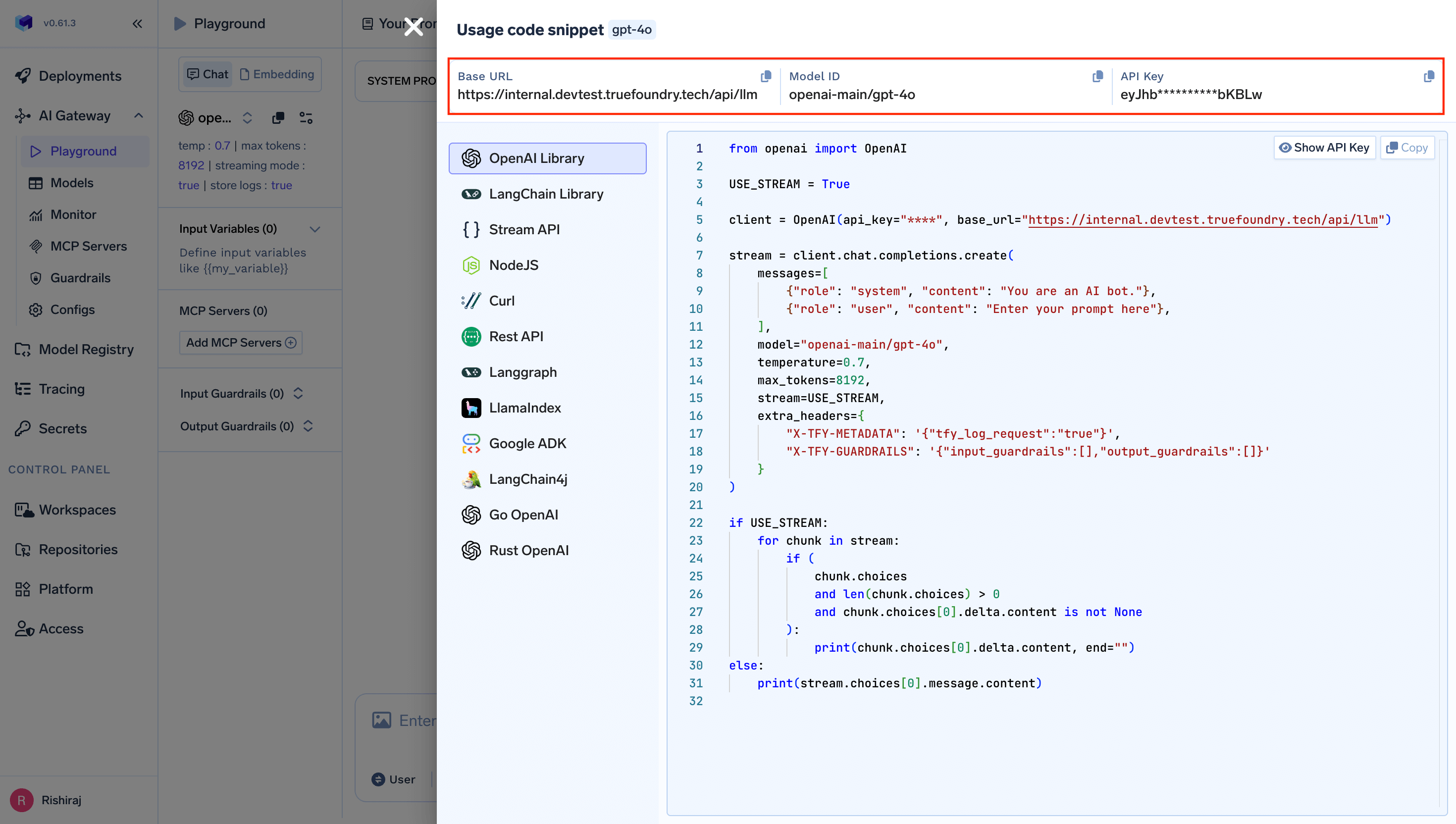 Here's how to configure Instructor to use TrueFoundry's AI Gateway:
```python lines theme={"dark"}
import instructor
from pydantic import BaseModel
from openai import OpenAI
# Configure OpenAI client to use TrueFoundry AI Gateway
client = OpenAI(
api_key="your-truefoundry-api-key", # Your TrueFoundry Personal Access Token
base_url="{GATEWAY_BASE_URL}", # Your TrueFoundry AI Gateway URL
)
# Patch the client with Instructor
instructor_client = instructor.from_openai(client)
# Define your Pydantic model for structured output
class User(BaseModel):
name: str
age: int
email: str
# Extract structured data
user_info = instructor_client.chat.completions.create(
model="openai-main/gpt-4o", # Your TrueFoundry model ID
response_model=User,
messages=[
{"role": "user", "content": "Extract user information: John Doe is 30 years old and his email is john@example.com"}
],
)
print(f"Name: {user_info.name}")
print(f"Age: {user_info.age}")
print(f"Email: {user_info.email}")
```
## Usage Examples
### Basic Structured Data Extraction
```python lines theme={"dark"}
import instructor
from pydantic import BaseModel
from openai import OpenAI
# Configure TrueFoundry AI Gateway
client = OpenAI(
api_key="your-truefoundry-api-key",
base_url="{GATEWAY_BASE_URL}",
)
instructor_client = instructor.from_openai(client)
# Define response structure
class ProductInfo(BaseModel):
name: str
price: float
category: str
in_stock: bool
# Extract product information
product = instructor_client.chat.completions.create(
model="openai-main/gpt-4o",
response_model=ProductInfo,
messages=[
{"role": "user", "content": "Extract product details: The iPhone 15 Pro costs $999, it's in the Electronics category and is currently available in stock."}
],
)
print(f"Product: {product.name}")
print(f"Price: ${product.price}")
print(f"Category: {product.category}")
print(f"In Stock: {product.in_stock}")
```
### Complex Data Structures with Lists
```python lines theme={"dark"}
import instructor
from pydantic import BaseModel
from typing import List
from openai import OpenAI
# Configure TrueFoundry AI Gateway
client = OpenAI(
api_key="your-truefoundry-api-key",
base_url="{GATEWAY_BASE_URL}",
)
instructor_client = instructor.from_openai(client)
class Task(BaseModel):
title: str
description: str
priority: str
estimated_hours: int
class ProjectPlan(BaseModel):
project_name: str
total_duration_weeks: int
tasks: List[Task]
# Extract complex project structure
project = instructor_client.chat.completions.create(
model="openai-main/gpt-4o",
response_model=ProjectPlan,
messages=[
{"role": "user", "content": """
Create a project plan for building a mobile app:
Project: Food Delivery App (8 weeks total)
Tasks:
1. UI/UX Design - Create user interface mockups and wireframes - High priority - 2 weeks
2. Backend Development - Build API and database - High priority - 3 weeks
3. Frontend Development - Build mobile app frontend - Medium priority - 2 weeks
4. Testing & QA - Test all features and fix bugs - Medium priority - 1 week
"""}
],
)
print(f"Project: {project.project_name}")
print(f"Duration: {project.total_duration_weeks} weeks")
print("\nTasks:")
for task in project.tasks:
print(f"- {task.title}: {task.description} ({task.priority} priority, {task.estimated_hours} weeks)")
```
That's it! You're now ready to use Instructor with TrueFoundry AI Gateway for robust, production-ready structured data extraction from LLMs.
Here's how to configure Instructor to use TrueFoundry's AI Gateway:
```python lines theme={"dark"}
import instructor
from pydantic import BaseModel
from openai import OpenAI
# Configure OpenAI client to use TrueFoundry AI Gateway
client = OpenAI(
api_key="your-truefoundry-api-key", # Your TrueFoundry Personal Access Token
base_url="{GATEWAY_BASE_URL}", # Your TrueFoundry AI Gateway URL
)
# Patch the client with Instructor
instructor_client = instructor.from_openai(client)
# Define your Pydantic model for structured output
class User(BaseModel):
name: str
age: int
email: str
# Extract structured data
user_info = instructor_client.chat.completions.create(
model="openai-main/gpt-4o", # Your TrueFoundry model ID
response_model=User,
messages=[
{"role": "user", "content": "Extract user information: John Doe is 30 years old and his email is john@example.com"}
],
)
print(f"Name: {user_info.name}")
print(f"Age: {user_info.age}")
print(f"Email: {user_info.email}")
```
## Usage Examples
### Basic Structured Data Extraction
```python lines theme={"dark"}
import instructor
from pydantic import BaseModel
from openai import OpenAI
# Configure TrueFoundry AI Gateway
client = OpenAI(
api_key="your-truefoundry-api-key",
base_url="{GATEWAY_BASE_URL}",
)
instructor_client = instructor.from_openai(client)
# Define response structure
class ProductInfo(BaseModel):
name: str
price: float
category: str
in_stock: bool
# Extract product information
product = instructor_client.chat.completions.create(
model="openai-main/gpt-4o",
response_model=ProductInfo,
messages=[
{"role": "user", "content": "Extract product details: The iPhone 15 Pro costs $999, it's in the Electronics category and is currently available in stock."}
],
)
print(f"Product: {product.name}")
print(f"Price: ${product.price}")
print(f"Category: {product.category}")
print(f"In Stock: {product.in_stock}")
```
### Complex Data Structures with Lists
```python lines theme={"dark"}
import instructor
from pydantic import BaseModel
from typing import List
from openai import OpenAI
# Configure TrueFoundry AI Gateway
client = OpenAI(
api_key="your-truefoundry-api-key",
base_url="{GATEWAY_BASE_URL}",
)
instructor_client = instructor.from_openai(client)
class Task(BaseModel):
title: str
description: str
priority: str
estimated_hours: int
class ProjectPlan(BaseModel):
project_name: str
total_duration_weeks: int
tasks: List[Task]
# Extract complex project structure
project = instructor_client.chat.completions.create(
model="openai-main/gpt-4o",
response_model=ProjectPlan,
messages=[
{"role": "user", "content": """
Create a project plan for building a mobile app:
Project: Food Delivery App (8 weeks total)
Tasks:
1. UI/UX Design - Create user interface mockups and wireframes - High priority - 2 weeks
2. Backend Development - Build API and database - High priority - 3 weeks
3. Frontend Development - Build mobile app frontend - Medium priority - 2 weeks
4. Testing & QA - Test all features and fix bugs - Medium priority - 1 week
"""}
],
)
print(f"Project: {project.project_name}")
print(f"Duration: {project.total_duration_weeks} weeks")
print("\nTasks:")
for task in project.tasks:
print(f"- {task.title}: {task.description} ({task.priority} priority, {task.estimated_hours} weeks)")
```
That's it! You're now ready to use Instructor with TrueFoundry AI Gateway for robust, production-ready structured data extraction from LLMs.