> ## Documentation Index
> Fetch the complete documentation index at: https://www.truefoundry.com/llms.txt
> Use this file to discover all available pages before exploring further.
# Agent Governance with Okta
> Governing agents when identities live in Okta — Cross App Access (ID-JAG), On-Behalf-Of token exchange, the Okta for AI Agents product, and how the TrueFoundry gateway drives each flow.
Use this scenario when your enterprise is standardized on Okta: users sign in through Okta, applications are registered as Okta apps, and — optionally — agents are registered as first-class identities through the **Okta for AI Agents** product. TrueFoundry validates Okta-issued tokens on the inbound side (an [identity provider-backed agent identity](/docs/ai-gateway/agents/agent-identity#where-an-identity-comes-from)) and drives the Okta token exchanges on the outbound side, so no agent or app author implements an exchange themselves.
Two status facts frame everything, because they are the most misunderstood:
* **Cross App Access (XAA)** — Okta's productization of ID-JAG — is **Early Access** as of mid-2026 (enablement is not self-service; GA targeted for FY27).
* **[Okta for AI Agents](https://www.okta.com/products/govern-ai-agent-identity/)** is a **separate, paid product** (GA April 2026). It is *not* the same thing as XAA. The distinction between "the protocol" (XAA/ID-JAG, usable on base Okta) and "the governance layer" (the paid product) is the crux of this page.
## The building blocks Okta gives you
| Building block | Role in the model | Notes |
| ---------------------------------------------------------------------------------------- | ----------------------------------------------------------------------------------------------------------- | -------------------------------------------------------------------------------------------------------------------------------------------------------------------- |
| **Okta as IdP** | Authenticates the user, issues the ID token / SAML assertion, mints the **ID-JAG**. | The identity-assertion side of every flow. |
| **Custom authorization server** | Redeems tokens and mints resource-scoped access tokens. | **OBO** (RFC 8693) runs only here — the Org AS can't (no custom scopes/claims/audience). Requires the **API Access Management** SKU. |
| **[XAA / ID-JAG](https://www.okta.com/solutions/cross-app-access/)** | Cross-app / cross-domain access brokered by Okta. | Early Access. The two-legged exchange described in [key concepts](/docs/agent-platform/agent-governance/key-concepts#across-trust-domains-id-jag--cross-app-access). |
| **[OBO (RFC 8693)](https://developer.okta.com/docs/guides/set-up-token-exchange/main/)** | Same-tenant token exchange between custom authorization servers. | GA. Carries the user forward but emits **no `act` claim** — no actor chain. |
| **[Okta for AI Agents](https://www.okta.com/products/govern-ai-agent-identity/)** | Agent registry in Universal Directory, shadow-agent discovery, secret vaulting, kill switch, certification. | Paid product. Also the *licensing gate* for agent-to-agent token exchange. |
| **OIN (Okta Integration Network)** | The catalog both apps must be listed in for XAA, with an app role of Requesting / Resource / Both. | The "Both" role lets an intermediary like a gateway sit in a chain. |
### Okta application vs. Okta AI agent
The patterns below lean on two different kinds of principal:
* **Okta application** — an app registered in Okta as an OIDC/OAuth client and (for XAA) listed in the OIN. Base Workforce Identity functionality; in an XAA exchange it plays the *requesting* or *resource* role.
* **Okta AI agent** — an autonomous agent registered as a **first-class non-human identity** in Universal Directory through the paid Okta for AI Agents product. Beyond a plain application it gets an **owner**, a managed lifecycle (onboard, certify, kill switch), optional secret vaulting, and the entitlement to perform **agent-to-agent token exchange** — the onward, per-hop ID-JAG minting that a multi-agent chain needs.
## Which pattern applies
Match your call path against this table; each pattern is detailed below. "3P" means a third party outside your Okta trust.
| Call path | Mechanism | Needs Okta for AI Agents? |
| ---------------------------------------------- | ---------------------------------------- | ------------------------- |
| Okta app → MCP server (Okta custom AS) | XAA / ID-JAG | No |
| Okta app → 3P MCP server whose AS trusts Okta | XAA / ID-JAG | No |
| Okta app → 3P MCP server, no Okta trust | Per-user OAuth (managed by the gateway) | No |
| Okta app → agent → agent → MCP server | Chained ID-JAG (agent-to-agent exchange) | **Yes** |
| Okta app → Okta app → MCP server (same tenant) | OBO — user preserved, **no actor chain** | No |
### Pattern 1 — Okta app → MCP server, via XAA
Canonical Cross App Access. The MCP Gateway mints an ID-JAG at Okta and redeems it at the MCP's authorization server for a scoped access token.
```mermaid theme={"dark"}
sequenceDiagram
participant C as Client App
participant MGW as TFY MCP Gateway
participant Okta as Okta IdP
participant RAS as MCP Authorization Server
participant MCP as MCP Server
C->>MGW: Call tool with Okta ID token
MGW->>Okta: Leg 1 token-exchange, requested=id-jag, aud=MCP authz
Okta-->>MGW: ID-JAG
MGW->>RAS: Leg 2 jwt-bearer, assertion=ID-JAG
RAS-->>MGW: Scoped access token
MGW->>MCP: Call tool with scoped token
MCP-->>MGW: Result
MGW-->>C: Result
```
* Register the **client application** as an Okta OIDC app (the *requesting* app), so a signed-in user obtains an Okta ID token.
* Register the **MCP server** as an Okta app fronted by a **custom authorization server** (the *resource* app) — the server that redeems the ID-JAG.
* Establish the **Cross App Access trust**: in the Okta Admin Console, create a managed connection from the requesting app to the resource app. (XAA is Early Access — enablement goes through Okta support, and both apps must be OIN-listed.)
On the MCP server, set **Auth Type = OAuth2**, **OAuth Provider = Okta**, **Grant Type = ID-JAG (XAA – Cross App Access)**, then fill **Resource Token URL** (the resource AS token endpoint where the ID-JAG is redeemed), **Resource Client ID / Secret** (the client the gateway authenticates the redemption with), and **Issuer URI** (the resource AS issuer — the ID-JAG `audience`).
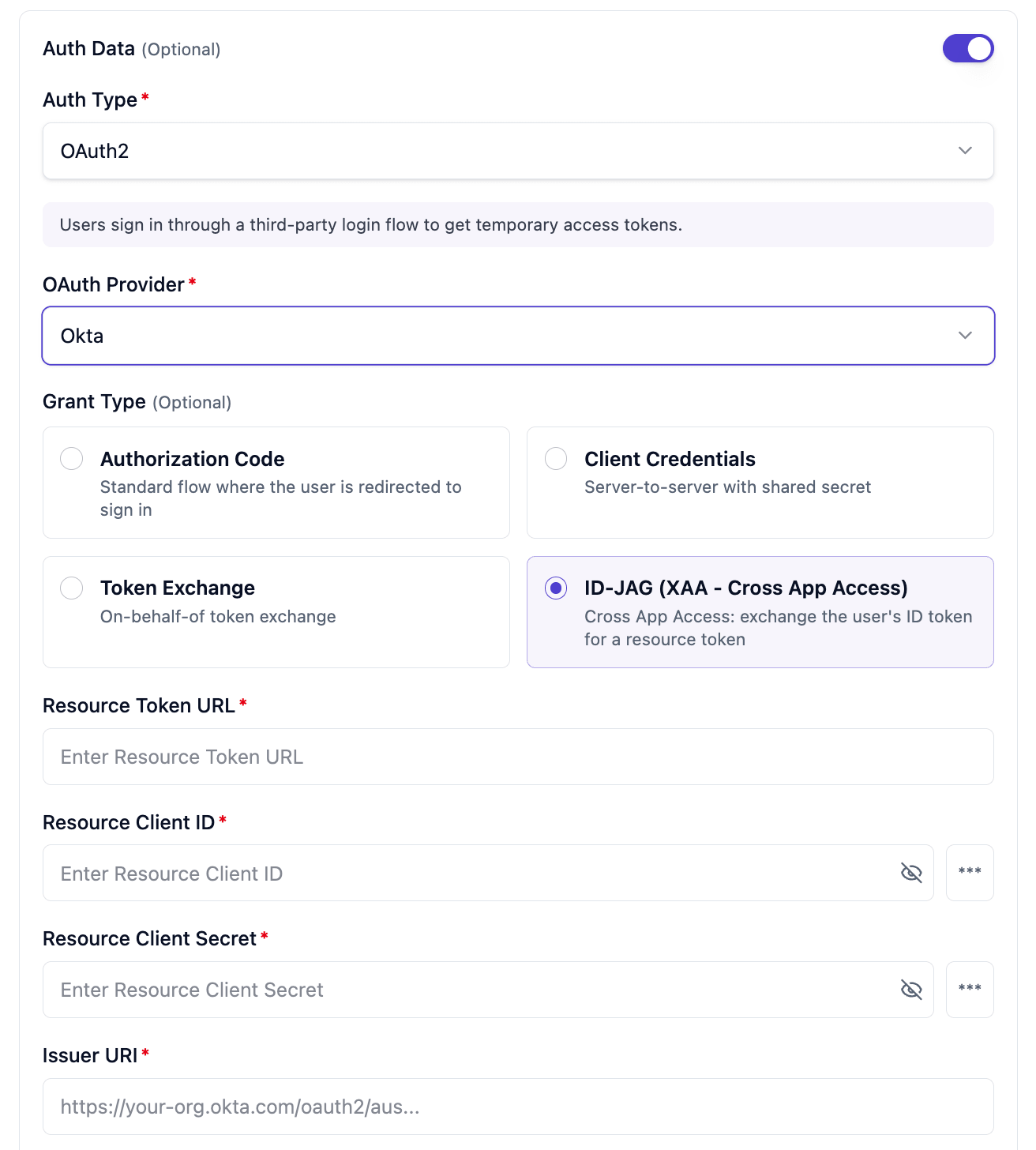 Create a [virtual account](/docs/platform/virtual-account-management) representing the client app and grant it **MCP Server User** on the target server. At runtime the client presents this alongside the user's Okta ID token, and the gateway runs the exchange above.
 ### Pattern 2 — third-party MCP whose authorization server trusts Okta
The cross-vendor case, and the reason the IdP and authorization server are separate roles: the AS that redeems the ID-JAG does **not** have to be run by Okta. It just has to **trust** Okta as an ID-JAG issuer — a small explicit configuration on the resource side (Okta's issuer identifier, its JWKS to verify signatures, and the accepted audience). The resource domain then validates ID-JAGs locally and mints its *own* tokens under its *own* policy — it never imports your user database and keeps full control of scopes and revocation.
```mermaid theme={"dark"}
flowchart LR
subgraph DA[Requesting domain]
App[Requesting app or agent]
Okta[(Okta IdP)]
end
subgraph DB[Resource domain - different vendor]
RAS[3P Authorization Server
### Pattern 2 — third-party MCP whose authorization server trusts Okta
The cross-vendor case, and the reason the IdP and authorization server are separate roles: the AS that redeems the ID-JAG does **not** have to be run by Okta. It just has to **trust** Okta as an ID-JAG issuer — a small explicit configuration on the resource side (Okta's issuer identifier, its JWKS to verify signatures, and the accepted audience). The resource domain then validates ID-JAGs locally and mints its *own* tokens under its *own* policy — it never imports your user database and keeps full control of scopes and revocation.
```mermaid theme={"dark"}
flowchart LR
subgraph DA[Requesting domain]
App[Requesting app or agent]
Okta[(Okta IdP)]
end
subgraph DB[Resource domain - different vendor]
RAS[3P Authorization Server
trusts Okta issuer, JWKS, audience]
MCP[(3P MCP server)]
end
App -->|ID token| Okta
Okta -->|ID-JAG audienced to RAS| App
App -->|jwt-bearer ID-JAG| RAS
RAS -->|scoped access token| App
App -->|Bearer token| MCP
```
**Setup is identical to pattern 1** — the same ID-JAG Auth Data and client virtual account — except **Resource Token URL** and **Issuer URI** point at the third party's authorization server instead of an Okta custom AS.
### Pattern 3 — third-party MCP with no Okta trust: per-user OAuth
When the third party is not part of any XAA trust, the flow degrades to standard 3-legged OAuth, managed by the MCP Gateway per user — consent, token storage, refresh. On the MCP server set **Auth Data → OAuth2**, provider **Custom**, grant **Authorization Code**; each user authorizes their own account on first use (the gateway returns a `401` with an authorization URL). No Okta XAA setup is involved.
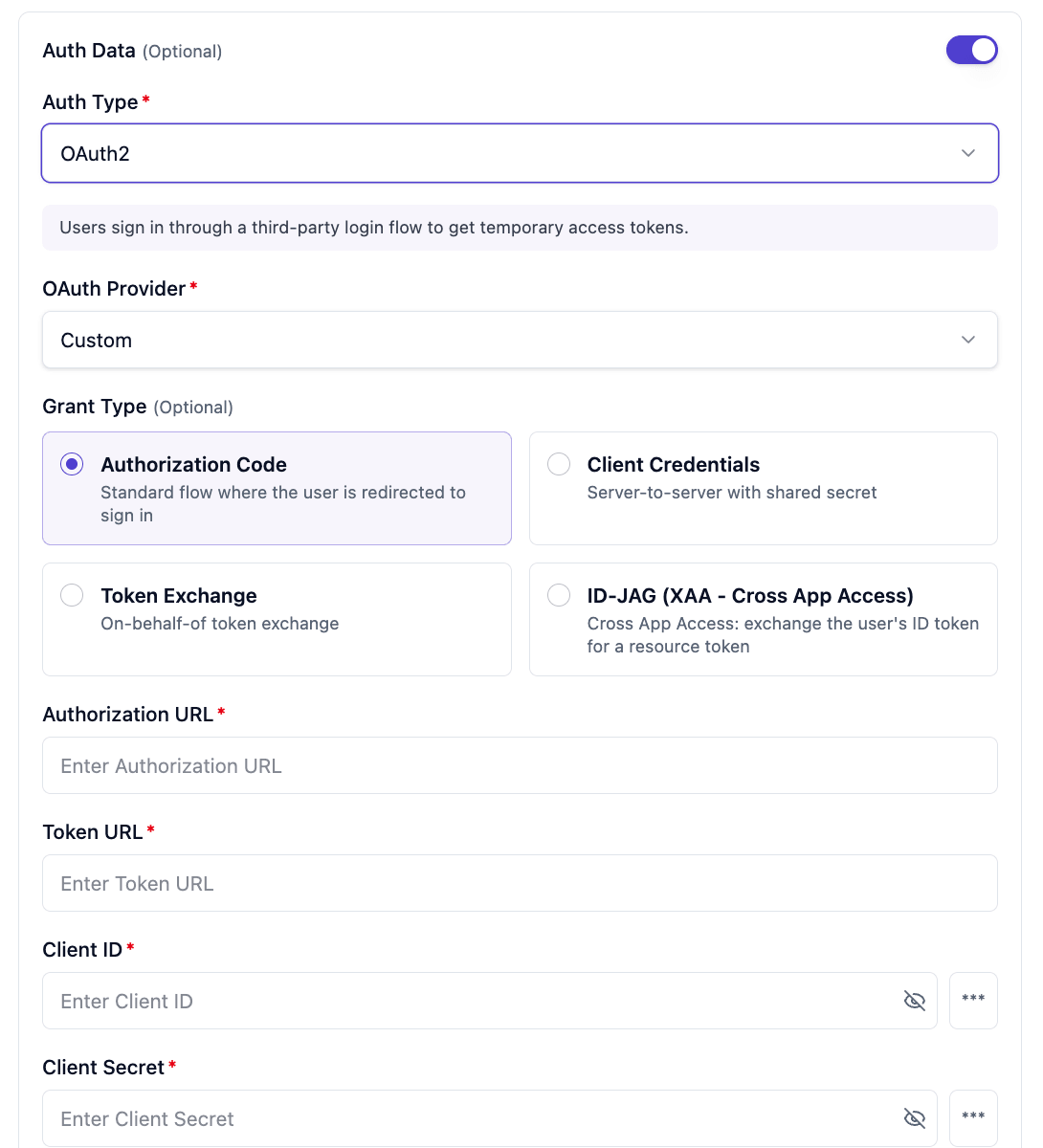 At this boundary you lose the propagated identity assertion, the admin-visible connection, and centralized revocation — end-to-end governance stops at the untrusted hop. The gateway's own audit and access control still apply.
### Pattern 4 — multi-agent chains: Okta AI agents and chained ID-JAG
The full agentic call path — app → agent → agent → MCP — built on Okta's [agent-to-agent token exchange](https://developer.okta.com/docs/guides/ai-agent-to-agent-token-exchange/agent-to-agent/main/). Each hop mints a **fresh ID-JAG** audienced to the next callee's authorization server and nests the acting agent into the `act` chain. The first leg starts from the user's ID token; **onward legs are seeded by the previous hop's access token** — the paid AI Agents product extends the base ID-JAG rule (which forbids an access-token subject) to allow exactly this. It is a *chain of exchanges*, not one carried token.
```mermaid theme={"dark"}
sequenceDiagram
participant C as Client App
participant AGW as TFY Agent Gateway
participant A1 as Agent A
participant A2 as Agent B
participant MGW as TFY MCP Gateway
participant Okta as Okta
participant MCP as MCP Server
C->>AGW: Invoke Agent A with Okta ID token
AGW->>Okta: token-exchange, subject=ID token, requested=ID-JAG, aud=Agent A AS
Okta-->>AGW: Fresh ID-JAG, redeemed to access token
AGW->>A1: Forward, sub=user
A1->>AGW: Invoke Agent B
AGW->>Okta: token-exchange, subject=prev access token, requested=ID-JAG, aud=Agent B AS
Okta-->>AGW: Fresh ID-JAG, act chain nests Agent A
AGW->>A2: Forward, sub=user act=Agent A
A2->>MGW: Call MCP tool
MGW->>Okta: token-exchange, requested=ID-JAG, aud=MCP AS
Okta-->>MGW: Fresh ID-JAG, redeemed to scoped token
MGW->>MCP: Call tool with scoped token
MCP-->>MGW: Result
MGW-->>A2: Result
A2-->>AGW: Result
AGW-->>C: Result
```
In the Okta Admin Console (**Okta for AI Agents**), add each agent to Universal Directory with a human **owner**. Each gets a first-class non-human identity backed by an OAuth client. *(Requires the paid product.)*
Its issuer becomes the ID-JAG `audience` for calls *to* that agent. Agents can share one custom AS (distinct scopes) or use one each.
The terminal MCP server is a resource protected by its custom authorization server, which redeems the final ID-JAG.
Configure connections for each hop — client → Agent A, Agent A → Agent B, Agent B → MCP — so Okta may issue a fresh ID-JAG per hop.
Provide each agent's client ID and signing key plus AS details, so the gateways can perform the exchanges on the chain's behalf.
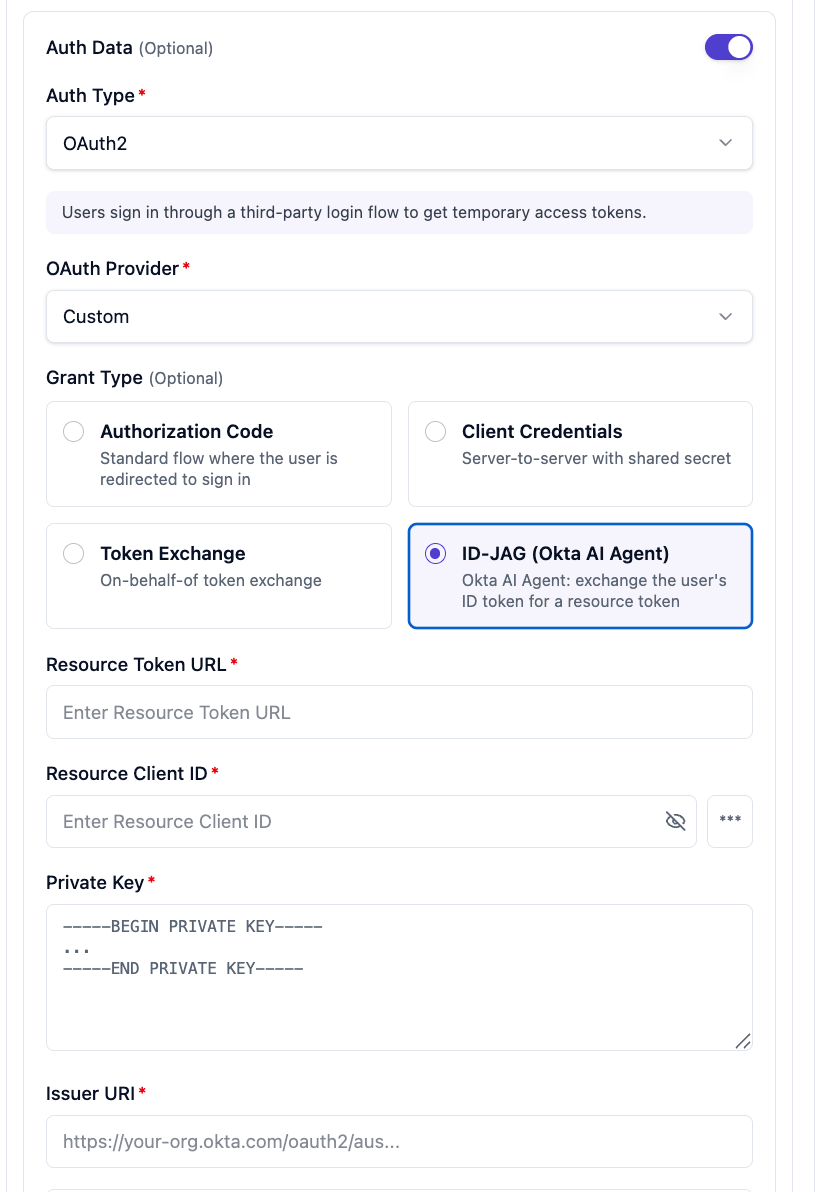
On **each agent** and on the **MCP server**, set **Auth Data → OAuth2**, **Grant Type = ID-JAG (Okta AI Agent)**, filling **Resource Token URL** (the next callee's AS token endpoint), **Resource Client ID**, **Private Key** (Okta AI agents authenticate with a key, not a shared secret), and **Issuer URI** (the callee's AS issuer). The Agent Gateway then mints the fresh ID-JAG at each agent hop and the MCP Gateway performs the final one.
At this boundary you lose the propagated identity assertion, the admin-visible connection, and centralized revocation — end-to-end governance stops at the untrusted hop. The gateway's own audit and access control still apply.
### Pattern 4 — multi-agent chains: Okta AI agents and chained ID-JAG
The full agentic call path — app → agent → agent → MCP — built on Okta's [agent-to-agent token exchange](https://developer.okta.com/docs/guides/ai-agent-to-agent-token-exchange/agent-to-agent/main/). Each hop mints a **fresh ID-JAG** audienced to the next callee's authorization server and nests the acting agent into the `act` chain. The first leg starts from the user's ID token; **onward legs are seeded by the previous hop's access token** — the paid AI Agents product extends the base ID-JAG rule (which forbids an access-token subject) to allow exactly this. It is a *chain of exchanges*, not one carried token.
```mermaid theme={"dark"}
sequenceDiagram
participant C as Client App
participant AGW as TFY Agent Gateway
participant A1 as Agent A
participant A2 as Agent B
participant MGW as TFY MCP Gateway
participant Okta as Okta
participant MCP as MCP Server
C->>AGW: Invoke Agent A with Okta ID token
AGW->>Okta: token-exchange, subject=ID token, requested=ID-JAG, aud=Agent A AS
Okta-->>AGW: Fresh ID-JAG, redeemed to access token
AGW->>A1: Forward, sub=user
A1->>AGW: Invoke Agent B
AGW->>Okta: token-exchange, subject=prev access token, requested=ID-JAG, aud=Agent B AS
Okta-->>AGW: Fresh ID-JAG, act chain nests Agent A
AGW->>A2: Forward, sub=user act=Agent A
A2->>MGW: Call MCP tool
MGW->>Okta: token-exchange, requested=ID-JAG, aud=MCP AS
Okta-->>MGW: Fresh ID-JAG, redeemed to scoped token
MGW->>MCP: Call tool with scoped token
MCP-->>MGW: Result
MGW-->>A2: Result
A2-->>AGW: Result
AGW-->>C: Result
```
In the Okta Admin Console (**Okta for AI Agents**), add each agent to Universal Directory with a human **owner**. Each gets a first-class non-human identity backed by an OAuth client. *(Requires the paid product.)*
Its issuer becomes the ID-JAG `audience` for calls *to* that agent. Agents can share one custom AS (distinct scopes) or use one each.
The terminal MCP server is a resource protected by its custom authorization server, which redeems the final ID-JAG.
Configure connections for each hop — client → Agent A, Agent A → Agent B, Agent B → MCP — so Okta may issue a fresh ID-JAG per hop.
Provide each agent's client ID and signing key plus AS details, so the gateways can perform the exchanges on the chain's behalf.
On **each agent** and on the **MCP server**, set **Auth Data → OAuth2**, **Grant Type = ID-JAG (Okta AI Agent)**, filling **Resource Token URL** (the next callee's AS token endpoint), **Resource Client ID**, **Private Key** (Okta AI agents authenticate with a key, not a shared secret), and **Issuer URI** (the callee's AS issuer). The Agent Gateway then mints the fresh ID-JAG at each agent hop and the MCP Gateway performs the final one.
 If the chain terminates at a **third-party** resource instead, Okta brokers a third-party access token for the last hop ("Resource server" connected-resource type) — register that terminal MCP server with **OBO (Token Exchange)** Auth Data instead of ID-JAG.
### Pattern 5 — same-tenant app-to-app: OBO, without an actor chain
Within one Okta tenant, the gateway performs an RFC 8693 OBO exchange on a custom authorization server. The resulting token keeps the user as `sub` — but Okta's OBO emits **no `act` claim**, so the resource learns *who the user is* but not *which agents touched the request*.
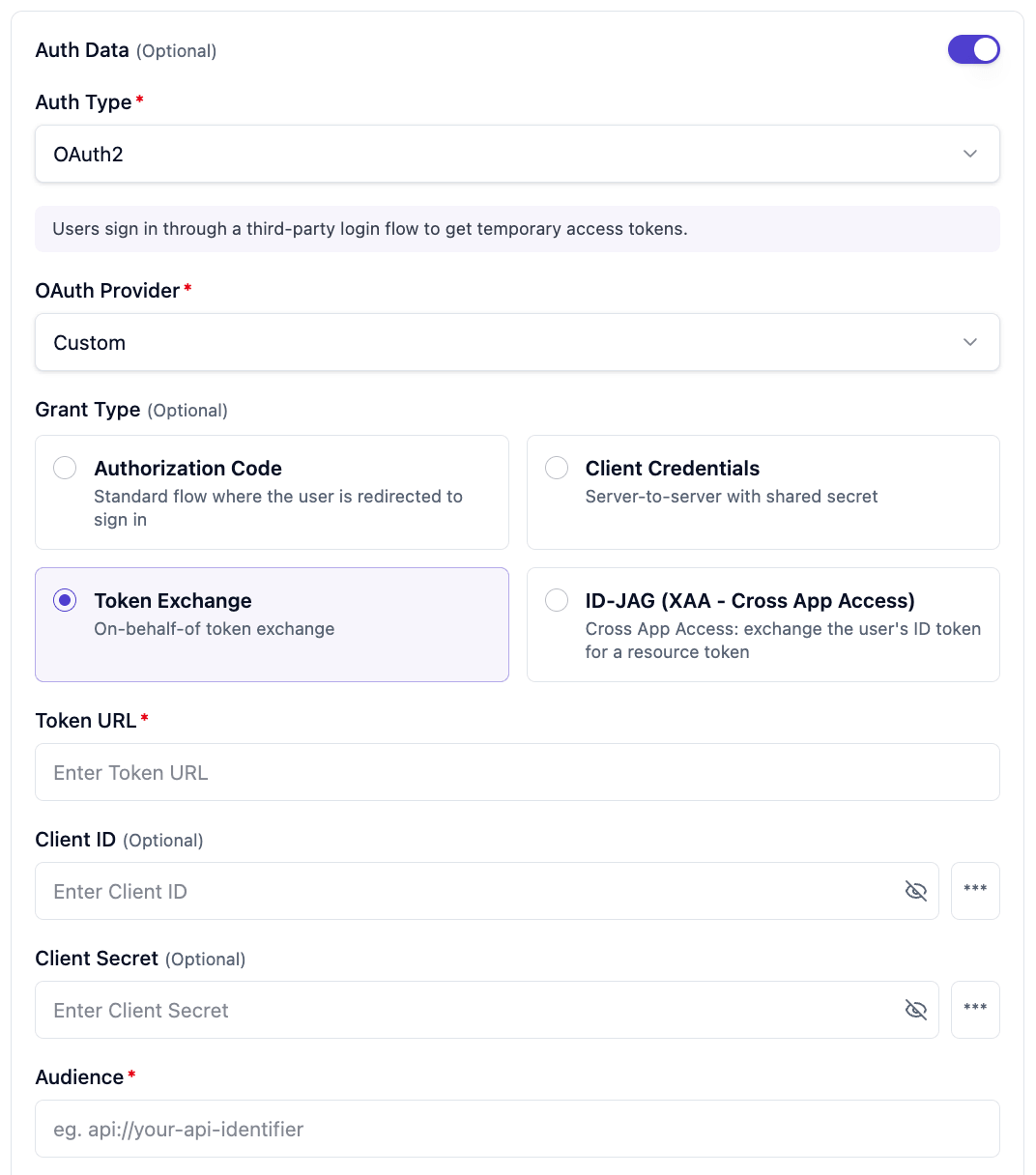
On the MCP server set **Auth Data → OAuth2**, **OAuth Provider = Okta**, **Grant Type = Token Exchange**, with the custom AS **Token URL**, optional **Client ID / Secret**, and **Audience**. No Cross App Access managed connection is needed for OBO.
If the chain terminates at a **third-party** resource instead, Okta brokers a third-party access token for the last hop ("Resource server" connected-resource type) — register that terminal MCP server with **OBO (Token Exchange)** Auth Data instead of ID-JAG.
### Pattern 5 — same-tenant app-to-app: OBO, without an actor chain
Within one Okta tenant, the gateway performs an RFC 8693 OBO exchange on a custom authorization server. The resulting token keeps the user as `sub` — but Okta's OBO emits **no `act` claim**, so the resource learns *who the user is* but not *which agents touched the request*.
On the MCP server set **Auth Data → OAuth2**, **OAuth Provider = Okta**, **Grant Type = Token Exchange**, with the custom AS **Token URL**, optional **Client ID / Secret**, and **Audience**. No Cross App Access managed connection is needed for OBO.
 ## What the gateway adds on top of Okta
Base XAA describes a *single* requesting-app → resource-app relationship. The TrueFoundry gateways fill three gaps:
* **Multi-hop chaining.** The gateway registers in the OIN with the **"Both"** role — resource app for the upstream hop, requesting app for the downstream hop — and mints a fresh, freshly-audienced ID-JAG per hop, stitching single grants into one governed path.
* **Uniform governance across hops.** Each resource AS enforces only *its* hop; the gateway runs the same [authorize → exchange → guard → record](/docs/agent-platform/agent-governance/governance-blueprint#4-authorize-and-scope-the-per-hop-loop) loop at *every* hop.
* **Abstraction.** Apps and agents present the identity they already have; the gateway does XAA or OBO on their behalf. No app author writes a two-legged exchange — which matters at scale, when many agents talk to each other in a mesh.
## Without the Okta for AI Agents product
Patterns 1–3 and 5 work on base Okta (plus API Access Management for custom authorization servers). What the paid product adds is the *lifecycle layer* (registry, discovery, vaulting, kill switch, certification) and the *agent-to-agent exchange* that pattern 4 needs. The most consequential gap on base Okta: OBO emits no `act` claim, so an app → app → MCP path has **no cryptographic actor chain**.
Front the resource with an authorization server that *does* support nested actor tokens — for example [Keycloak](https://www.keycloak.org/) — and let the gateway drive it. Keycloak trusts Okta as the IdP (issuer + JWKS + audience), redeems the assertion, and uses its standard token exchange (RFC 8693, GA since Keycloak 26.2) to mint downstream tokens carrying the user as `sub` and the acting agent in `act`, nesting per hop. You get Okta's centralized brokering *and* a verifiable actor chain.
Keycloak's standard token exchange is GA, but the full `act`/`may_act` delegation semantics are still behind feature flags in current releases. Validate nested-delegation behavior on your version before depending on it.
Note the overlap with TrueFoundry: agent registry, ownership, kill switch, and audit are things the [TrueFoundry implementation](/docs/agent-platform/agent-governance/truefoundry-implementation) provides regardless of Okta licensing. Choose Okta for AI Agents when you want the *directory itself* to be the system of record for agent identities and the per-hop `act` chain minted by Okta.
## FAQ
No. The terminal target only needs to be an **XAA-enabled resource app** — OIN-listed, fronted by an AS that redeems the ID-JAG. You register as AI agents the *autonomous actors* you want as first-class identities. An MCP server is a *resource app*, not necessarily an AI agent.
Multiple apps and agents can share one custom AS (different clients, different scopes). The nuance: each Okta custom AS has a single configured audience, so genuinely different audiences require multiple custom authorization servers or the `audience`/`resource` parameter.
In Okta's XAA, yes — Leg 1 is performed by Okta as the IdP, so the subject token is an Okta-issued ID token (or SAML assertion). Okta can be federated upstream to another IdP, but what is presented to Okta's token endpoint is still the Okta-issued assertion.
Every hop that participates in the XAA chain needs the trust relationship — requesting side via OIN/SSO, resource side via an AS that trusts Okta. A plain third-party app with no Okta trust cannot participate; that hop degrades to per-user OAuth (pattern 3).
## What the gateway adds on top of Okta
Base XAA describes a *single* requesting-app → resource-app relationship. The TrueFoundry gateways fill three gaps:
* **Multi-hop chaining.** The gateway registers in the OIN with the **"Both"** role — resource app for the upstream hop, requesting app for the downstream hop — and mints a fresh, freshly-audienced ID-JAG per hop, stitching single grants into one governed path.
* **Uniform governance across hops.** Each resource AS enforces only *its* hop; the gateway runs the same [authorize → exchange → guard → record](/docs/agent-platform/agent-governance/governance-blueprint#4-authorize-and-scope-the-per-hop-loop) loop at *every* hop.
* **Abstraction.** Apps and agents present the identity they already have; the gateway does XAA or OBO on their behalf. No app author writes a two-legged exchange — which matters at scale, when many agents talk to each other in a mesh.
## Without the Okta for AI Agents product
Patterns 1–3 and 5 work on base Okta (plus API Access Management for custom authorization servers). What the paid product adds is the *lifecycle layer* (registry, discovery, vaulting, kill switch, certification) and the *agent-to-agent exchange* that pattern 4 needs. The most consequential gap on base Okta: OBO emits no `act` claim, so an app → app → MCP path has **no cryptographic actor chain**.
Front the resource with an authorization server that *does* support nested actor tokens — for example [Keycloak](https://www.keycloak.org/) — and let the gateway drive it. Keycloak trusts Okta as the IdP (issuer + JWKS + audience), redeems the assertion, and uses its standard token exchange (RFC 8693, GA since Keycloak 26.2) to mint downstream tokens carrying the user as `sub` and the acting agent in `act`, nesting per hop. You get Okta's centralized brokering *and* a verifiable actor chain.
Keycloak's standard token exchange is GA, but the full `act`/`may_act` delegation semantics are still behind feature flags in current releases. Validate nested-delegation behavior on your version before depending on it.
Note the overlap with TrueFoundry: agent registry, ownership, kill switch, and audit are things the [TrueFoundry implementation](/docs/agent-platform/agent-governance/truefoundry-implementation) provides regardless of Okta licensing. Choose Okta for AI Agents when you want the *directory itself* to be the system of record for agent identities and the per-hop `act` chain minted by Okta.
## FAQ
No. The terminal target only needs to be an **XAA-enabled resource app** — OIN-listed, fronted by an AS that redeems the ID-JAG. You register as AI agents the *autonomous actors* you want as first-class identities. An MCP server is a *resource app*, not necessarily an AI agent.
Multiple apps and agents can share one custom AS (different clients, different scopes). The nuance: each Okta custom AS has a single configured audience, so genuinely different audiences require multiple custom authorization servers or the `audience`/`resource` parameter.
In Okta's XAA, yes — Leg 1 is performed by Okta as the IdP, so the subject token is an Okta-issued ID token (or SAML assertion). Okta can be federated upstream to another IdP, but what is presented to Okta's token endpoint is still the Okta-issued assertion.
Every hop that participates in the XAA chain needs the trust relationship — requesting side via OIN/SSO, resource side via an AS that trusts Okta. A plain third-party app with no Okta trust cannot participate; that hop degrades to per-user OAuth (pattern 3).